
Songs of Forgotten Trees

In Anuparna Roy’s highly individual first feature an actress and her roommate in Mumbai form an unexpected attachment.
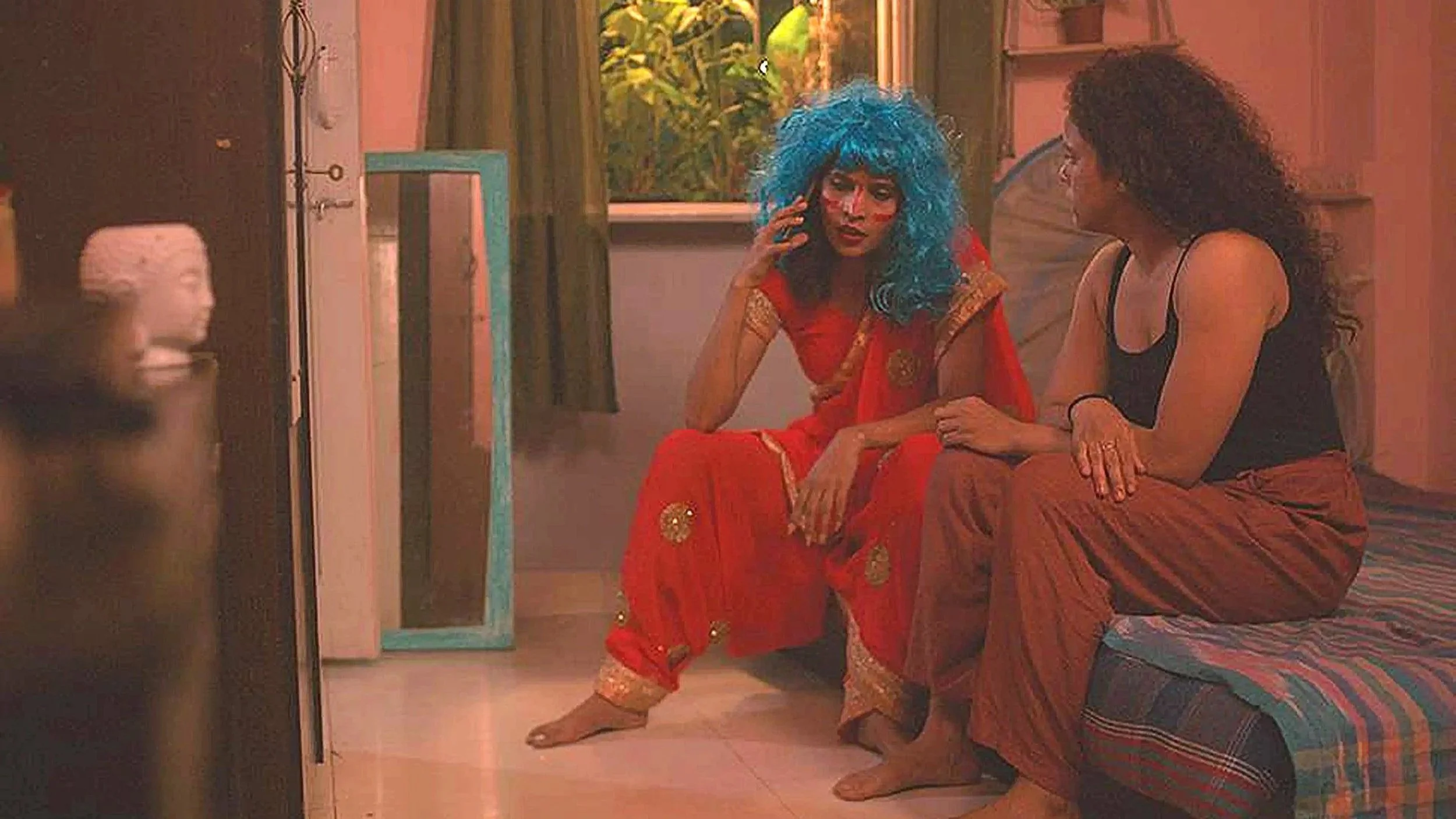
Image courtesy of New Wave Films.
by MANSEL STIMPSON
Although Songs of Forgotten Trees is Anuparna Roy's first feature, one can state with absolute confidence that it shows her to be possessed of a totally individual voice. That was in effect recognised at the 2025 Venice Film Festival when her film won her an award for best director but the personal stamp that marks the piece stems just as much from the character of the screenplay which she wrote herself. Born in 1994, she came from a village in West Bengal but, following studies which included obtaining an undergraduate degree in English literature, she worked in both Delhi and Mumbai before starting out on a career in cinema. Her short film Run to the River made in 2023 was set in her own village whereas this feature film takes place in Mumbai and is focused on two women, each from a rural background, who have come to live in the city. Shweta (Sumi Baghel) is newly arrived but in finding lodgings has become the roommate of Thooya (Naaz Shaikh) who is already established there. In building a work around these two, Roy is clearly echoing something of her own experience and Shweta is portrayed as working for an IT company which is something that Roy herself did when she came to Mumbai.
This is a film which some critics have chosen to compare to Payal Kapadia’s 2024 feature All We Imagine as Light which also focused on women born in villages who subsequently made a life for themselves in Mumbai. There are indeed a number of similarities between the two films including the fact that in each a female viewpoint predominates. But, whereas Kapadia's film took on a less naturalistic tone in its later stages set away from Mumbai, Songs of Forgotten Trees is far more consistent and is for me the more effective film. Nevertheless, the personal style that Anuparna Roy brings to her film is arguably of a kind which may satisfy some viewers far more than others.
In view of this film’s title, it is no surprise when it opens with a rural shot of trees accompanied by the sound of a female voice singing a simple almost folk-like song. It has lyrics which describe how you may know how to build a house but yet need shelter due to not learning to carry an umbrella when it rains. This song will come up again later in the film and will do so more than once just as there are many brief subsequent shots of trees. Nevertheless, Mumbai is very quickly established as this tale’s location and both the song and the images of trees are but passing memories of the world from which the two central characters have come but which they have left behind. For most of the time Roy’s film is observational rather than rounded out and the greater part of it consists of showing us the daily lives of Thooya and Shweta. Debjit Samanta's camera may capture the bustle of city life, but for the most part the film plays out in their shared apartment and the only male character who is prominent is the landlord, Nitin Sawant (Bhushan Shimpi). The latter is significant because Thooya escapes paying rent by accepting the sexual advances regularly made by this man despite his being married. That she puts up with this in order to get by is in keeping with the fact that she uses the premises to receive her clients having set herself up as a sex worker. This step also is one taken to help her to survive while she attends acting classes in the hope of becoming an actress. The apartment is big enough to function too as a place where Shweta can carry on her IT work using her own computer to respond to those who contact her.
Apart from establishing the ways in which Thooya and Shweta work from this abode, the film largely concentrates on their household chores and it may partly be for this reason that some critics have sought to compare Songs of Forgotten Trees with the work of the late Chantal Akerman. But, if the latter is best known for her very long Jeanne Dielman film of 1975, this is a notably different kind of piece in that it runs for a shorter time than the average feature (just 77 minutes). However, it is the case that Roy consciously plays down the element of storytelling which is the driving force in most enacted tales. It is the talk between Thooya and Shweta which gives us some background information about them and there are also conversations that Thooya has with her unseen therapist. But what we learn of their past lives is limited and not illustrated through flashbacks. Nevertheless, we discover early on that Thooya’s father has just died but that she refuses to attend his funeral and blames him for his treatment of her mother who had predeceased him. It is also the case that Thooya is haunted by thoughts of a childhood companion, Jhuma. She describes her as having been her very first friend but she had disappeared and was probably pushed into an arranged marriage at a very young age. We learn less about Shweta but soon find her setting up a date being on the lookout for a potential marriage partner now that she is in the city.
Towards the end of the film there is a narrative development. This arises when the landlord's wife (Lovely Singh) calls on Thooya and reveals that she is aware of the sexual arrangement between her and her husband. This scene takes a different turn from what one might expect and is definitely effective, but as a clear-cut dramatic confrontation it is uncharacteristic of the film. For the most part, the viewer is invited to take in the history of the two women, to recognise their rapport despite their differences and to decide, not least from what we have been told about Jhama, whether this is a portrait of sisterhood in a male-dominated world or a tale of what could be seen as a potential lesbian relationship. The scene in which the two women act out together a pretended telephone conversation features a long-held static shot and invites us to ponder the implications of what is being said. Elsewhere and in contrast the framing often favours unusual mirror images. The film’s music score by Nishant Ramteke is appropriately subtle and, while some viewers may regret that the final scenes contain no conclusive answers or resolution, Anuparna Roy has successfully created a work with a character that is all its own. She is, of course, much helped by her two well cast leading actresses. Nevertheless, the film’s crucial achievement is to show us convincingly lives about which we can speculate but which, despite the detailed context in which they are seen, underline the extent to which outsiders such as we the audience can only look on and draw our own conclusions about other people - conclusions which could be right but may not be.
Cast: Naaz Shaikh, Sumi Baghel, Bhushan Shimpi, Lovely Singh, Ravi S. Mann, Pritam Pilania, Moni Shankar, Shah Alah, Saurabh Yadav, Shubhratanu Mandal.
Dir Anuparna Roy, Pro Bibhanshu Rai, Romil Modi and Ranjan Singh, Screenplay Anuparna Roy, Ph Debjit Samanta, Pro Des Priya Shree, Ed Ashish Patel, Music Nishant Ramteke, Costumes Sachin Lovalekar and Archit Dabas.
Flip Films/River Tale Films/Romil Casting Productions/Nube Cirrus-New Wave Films.
77 mins. India. 2025. UK Rel: 14 August 2026. Cert. 15.
