
Sorry, Baby

First-time director and writer and star Eva Victor delivers a film about sexual trauma with sensitivity, intelligence and rare individuality.
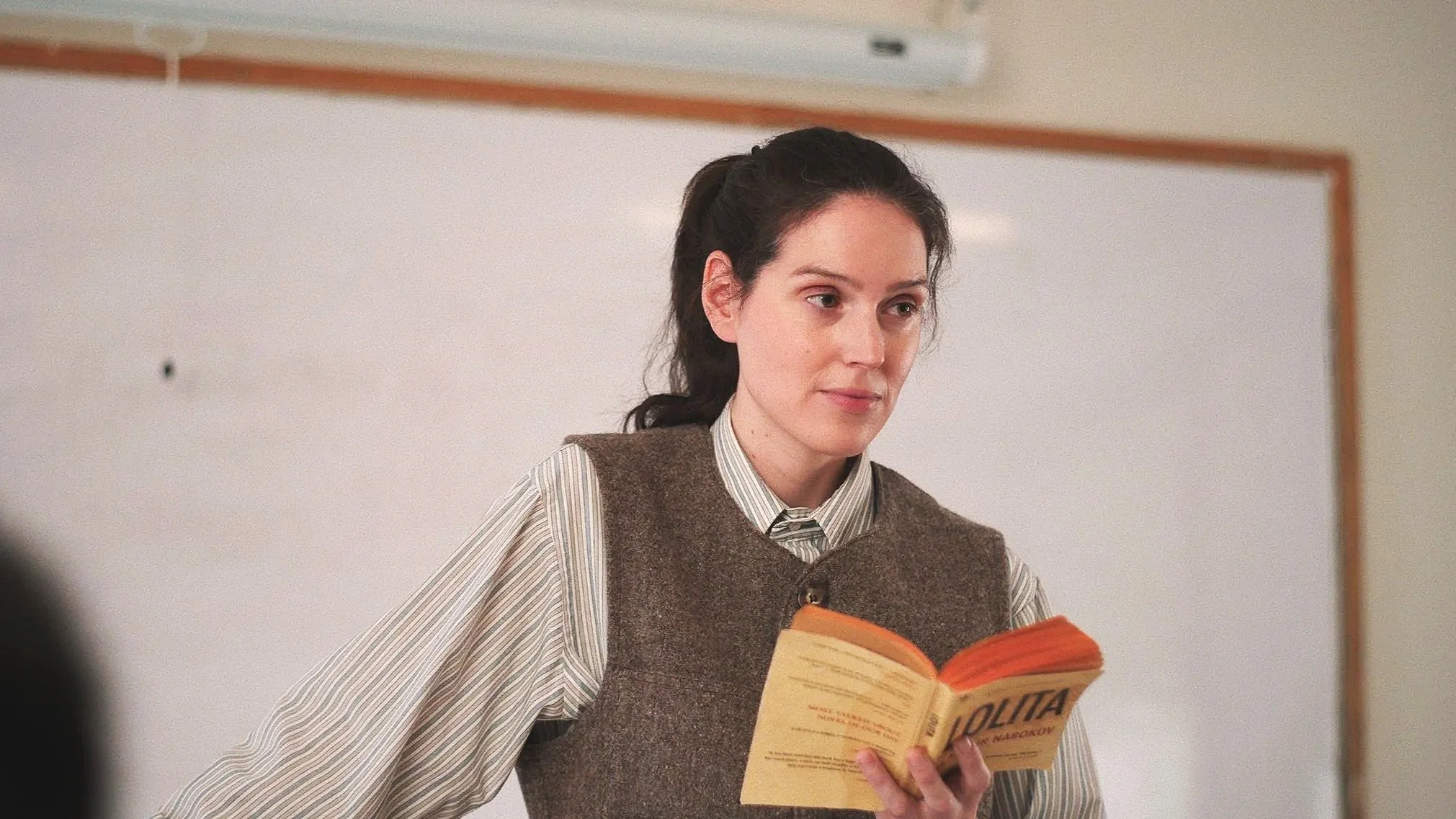
Eva Victor
Image courtesy of Picturehouse Entertainment.
Eva Victor is the writer and director of this film in addition to being its leading actress and for her this is a triumph on all levels. Indeed, in Sorry, Baby she has given us a work which is among the year’s best films and that is quite remarkable considering that for many of us Eva Victor is an entirely new name. She was born in Paris in 1994 but was raised in San Francisco and it is in America that she has become known for her work in television and for a number of short films. In fact, it was with four episodes of a television series entitled Eva vs. Authority that she first gave notice of her wide talents in that in addition to acting in them she was also the writer, the director, the photographer and an executive producer. Even so, Sorry, Baby by being the first feature film to evidence her exceptional talent will undoubtedly give her a very much wider reputation.
Victor's multi-tasking work on it stands out, but this is a film notable too for bringing a fresh approach to an all too familiar subject. The emergence of the #MeToo Movement ensured that the issue of sexual abuse would feature prominently in the press, on television and via the internet quite apart from numerous films and plays on the subject. While the seriousness of the issue made this entirely appropriate, it is quite possible that many people on hearing that this is now the central theme of Sorry, Baby will take the view that this is territory already covered and in no need of yet another treatment on film. But that would be their loss because in her authorial capacity Victor offers something very different from any predecessor: Sorry, Baby is a deeply sympathetic study of resilience which in making its central character, Agnes, a victim of sexual abuse shows how the trauma can be challenged but how even so it will linger on malignantly over the years. Depicting this could have resulted in a well-meaning but heavy-handed film, but Victor finds ways of lightening her narrative (a major subsidiary feature of the film is the bond between Agnes and her best friend Lydie) without ever playing down the long-term consequences of being abused.
Furthermore, Victor’s screenplay brings unexpected elements into play both in the structure and in the tone of the piece. As to the former, one might expect a narrative which would start ahead of the sexual abuse suffered by Agnes and then build up to it. But Sorry, Baby is presented in five titled sections and the first of these takes place long after that incident and sets up the background to the story which is the college in Massachusetts where Agnes graduated later becoming a professor there and a teacher of English. This part of the film establishes too the rapport she continues to have with Lydie who had been her former room-mate but who had left for New York and now returns on a visit. This is also the place where Agnes as a promising student had suffered abuse at the hands of her teacher, Preston Decker. However, it is not until the second segment, ‘The Year with the Bad Thing’, that the film moves into a long flashback to show Agnes in Decker's class and to establish the sympathetic relationship which Agnes as a talented pupil shares with Decker up to that moment when during a study session at his home he rapes her. The immediate aftermath of that shocking experience is also covered in this section. The three further segments of the film which then follow depict in turn a later occasion when Agnes is summoned to be a potential juror in a court case, an encounter with a sandwich shop provider which gives her encouragement at a time when she needs it and a further visit from Lydie and her girlfriend Fran who now have a baby. In these later episodes the film also finds Agnes entering into a passing but helpful sexual relationship with a neighbour named Gavin which offers the reassurance that, in contrast to the likes of Decker, some men can indeed be sensitive and caring when intimate with a woman.
The other notable feature of Sorry, Baby is the way in which it incorporates humorous touches despite its inherent seriousness. This has led some critics to see it in part as a comic film and even the term black comedy has been used to describe it. But that seems to me quite wrong in that the essence of black comedy is that the audience is not encouraged to feel sympathy for the characters. What Sorry, Baby does possess is a deep sense of ironic humour. It is typified by the scene in which two college administrators are all too clearly pleased to be let off the hook when faced with the challenge of confronting Decker because he has resigned and what he may have done can now be dismissed as no longer an issue for them.
If the approach taken in Sorry, Baby helps to make it both distinguished and distinctive, equally valuable is the standard achieved by the actors. Naomi Ackie as Lydie and Lucas Hedges as Gavin are ideally cast and there is an admirable cameo from John Carroll Lynch as the unexpectedly supportive sandwich man who appears in the fourth segment which is actually entitled ‘The Year with the Good Sandwich’. The other supporting players are fine too including Louis Cancelmi as Decker and Kelly McCormack in the role of Natasha, a classmate who is jealous of Agnes. But it is on Eva Victor’s Agnes that the film pivots and, if her writing brings all of the characters fully to life, it is her own excellent performance that is crucial here. She is totally persuasive and her appearance, if slightly unconventional by Hollywood star standards, made me think of her as akin to a younger Frances McDormand. Yet another contribution of note is the well-judged music score by Lia Ouyang Rusli.
I do have one reservation about Sorry, Baby but it is far from being a major one. It is an admirably literate work in a way which makes it intelligently expressive of the individual characters and that makes for a tone that is appropriately naturalistic. Nevertheless, in certain scenes the words come across as more stylised in the sense that they sound closer to what is well suited to a novel or a stage play. That particularly applies to episodes where the humour is being brought out and to the film’s final scene which successfully escapes the risk of seeming sentimental but still sounds like a big set speech. For me these moments fit less than perfectly into the tone of the whole but that is perhaps to quibble. In all important respects this is a major work from an exceptional new talent and one which includes a striking scene which plays like an effective variation on a famous moment in Hitchcock’s Frenzy. Here Victor finds a way to avoid showing the rape itself while proving that discretion when inherently inventive can still capture the full emotional impact of an event. Her directorial skill is no less than her writing ability and her acting prowess.
MANSEL STIMPSON
Cast: Eva Victor, Naomi Ackie, Louis Cancelmi, Lucas Hedges, Kelly McCormack, John Carroll Lynch, E. R. Fightmaster, Cody Reiss, Jordan Mendoza, Hettienne Park, Anabel Graetz, Liz Bishop.
Dir Eva Victor, Pro Adele Romanski, Mark Ceryak and Barry Jenkins, Screenplay Eva Victor, Ph Mia Cioffi Henry, Pro Des Caity Birmingham, Ed Alex O’Flinn and Randi Atkins, Music Lia Ouyang Rusli, Costumes Emily Costantino.
Tango/High Frequency Entertainment/Big Beach/Pastel/Charades Prods/Case Study Films/AF Films & Prods.SL-Picturehouse Entertainment.
103 mins. USA/Spain/France. 2025. US Rel: 27 June 2025. UK Rel: 22 August 2025. Cert. 15.
