
Sound of Falling

Four generations and their secrets haunt Mascha Schilinski’s challenging psychological drama from Germany.
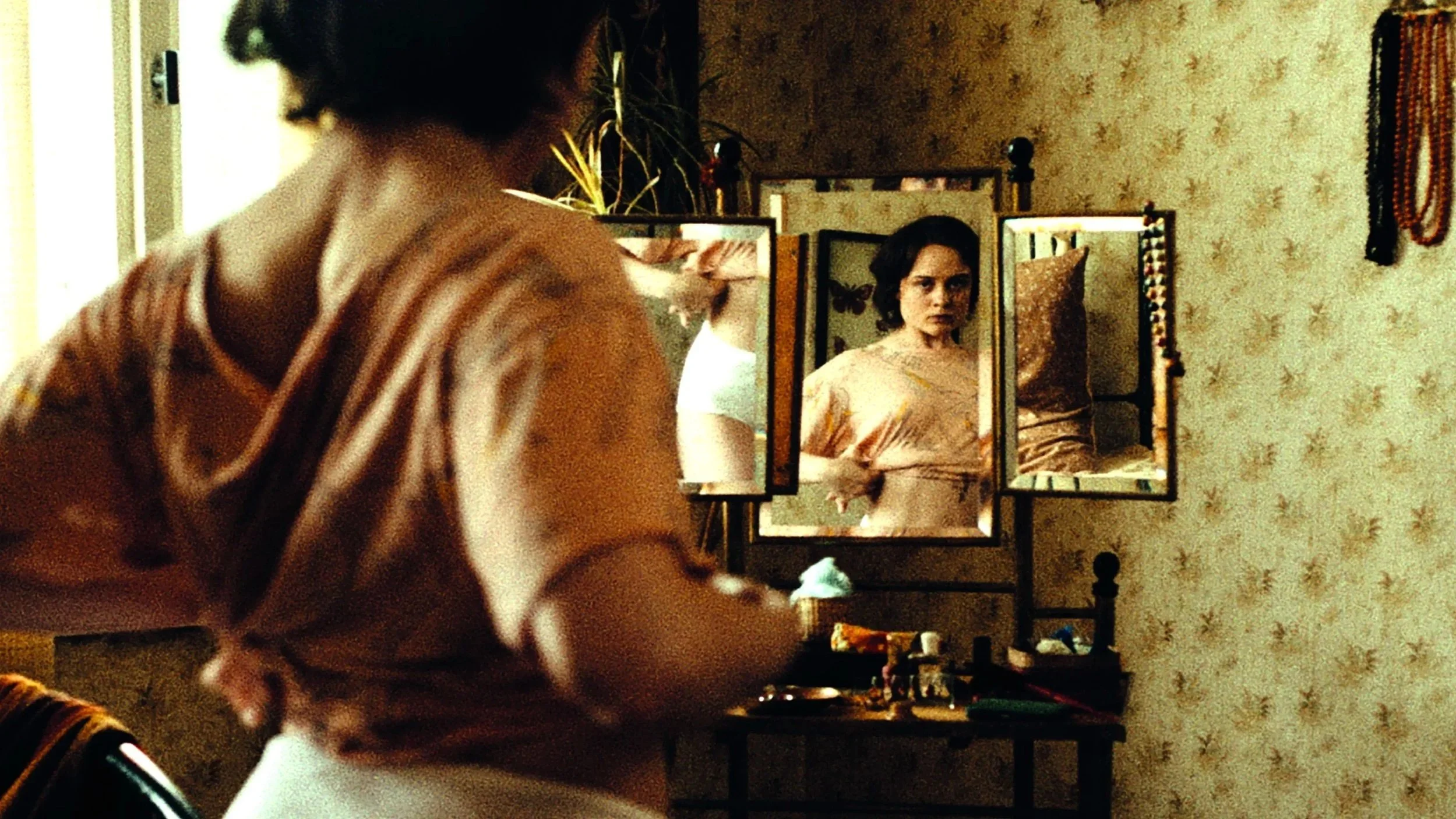
Image courtesy of Mubi.
by MANSEL STIMPSON
This is the second feature film by the German director Mascha Schilinski and its reception at the 2025 Cannes Film Festival was such that she is being acclaimed as a major filmmaker. I had been forewarned that it is a long and complex film but from the opening scenes I could immediately tell that Schilinski, who along with Louise Peter also wrote the film’s screenplay, is a singular talent. Indeed, I found myself comparing this film's impact with that of one of my all-time favourites, Jean-Marie Straub’s Not Reconciled. That film, an adaptation of Heinrich Böll's novel Billiards at Half-Past Nine, was made in 1965 and is a challenging work not easy to understand fully. Nevertheless, Straub created something that pulled me in and fascinated me and I have seen it more times than any other movie. It gave me the arguably illusory feeling that if I kept on seeing it I would in time solve its complexities. Some may have that same experience with Sound of Falling but there is a major difference between the two works. Not Reconciled is an unusually short feature lasting just under an hour but Schilinski's film runs for 155 minutes. To be totally intrigued by a difficult piece lasting 55 minutes is much easier than to have that experience with a considerably longer one and I found Sound of Falling increasingly hard to grasp and to relate to the longer it went on. Anyone eager to take on a demanding film need not hesitate but, for all the skill revealed here by Mascha Schilinski, you probably need to be in that category to find Sound of Falling rewarding.
Despite the problems that I had with it, I did have the advantage of foreknowledge about the contents of this film without which I might well have found getting on terms with it even harder. A screen original, Sound of Falling comprises four sections presented not in sequence but intercut so that one moves back-and-forth between them. The location throughout is a house in the north of Germany in the Altmark region and, while one segment is set in the present day, the others take place in the 1910s, the 1940s and the 1980s respectively. The scenes that follow on from the title are straightforward enough although it is not immediately apparent how they connect with an intriguing pre-credit sequence. There we see Erika (Lea Drinda) pretending to be one-legged when the person who has indeed had a leg amputated is her uncle Fritz (Martin Rother). This is happening in the 1940s but after the title appears we find ourselves back in the early 20th century and the camera follows a nine-year-old girl, Alma (Hanna Heckt), who in effect becomes our guide as she wanders around the house which we discover through her eyes. The film is photographed by Fabian Gamper and Schilinski favours camera movement that invitingly draws us in. Among those living in the house is the young Fritz (Filip Schnack) who has not yet lost a leg but the main focus in all the segments is on female characters. Young Alma is the key figure in the film’s earliest section but she is the youngest of three sisters, the others being Hedda and Lia played by Anastasia Cherepakha and Greta Krämer.
A key feature of Sound of Falling is that decision not to take each period in turn but to ignore chronology and to cut back-and-forth between each of the four periods. When the film moves on after a fade to black, we can never predict with any certainty which of those four settings will feature next. Furthermore, there are a substantial number of characters in each of them although we find that Fritz is the only one who features in more than one. Keeping track of everybody seen and grasping their relationships is far from easy. However, when it comes to the 1980s, the central figure is the teenage Angelika (Lena Urzendowsky) and we see how she attracts the attention not only of her cousin Rainer (Florian Geißelmann) but also of his father, her uncle Uwe (Konstantin Lindhorst). As for the contemporary scenes, Lenka (Laeni Geiseler) is now key along with two other young women, Nelly (Zoë Baier) and Kaya (Ninel Geiger).
In this cast there are no weak performances and young Hanna Heckt is notably assured. But, while it might be expected that the lot of the female characters would improve as time passes, in the event Sound of Falling maintains throughout a viewpoint which stresses the downbeat nature of life, its cruelties, its misjudgments and its suffering. The film seeks to express it not through narratives which, despite being intercut, stand as orthodox period portrayals but by adopting a more stylised approach. Thus it is that at intervals we find a number of the characters suddenly expressing themselves in voice-over telling us what their thoughts are at a particular moment. Even more frequently the film’s soundtrack adds drone-like sounds that seem to represent the grim hand of fate from which no escape is possible. These sounds suggest too an awareness of that fact which in turn invites us to view the film as a present-day summation. To that extent what we see could be regarded as less direct storytelling than a portrayal of recollections and memories. Whether or not one takes that view, Sound of Falling does come across as something that is seen through an artist’s eye and is presented to us in a style comparable to that of certain novels. Some critics have referenced the writings of Virginia Woolf and in that respect the changes between periods to which the viewer is required to adjust here remind one of the confusing switches of viewpoints in what may well be Woolf's most difficult novel, The Waves.
All told then, Sound of Falling leaves a very mixed impression. The ambition behind it is undeniable and all the more so because it is only Schilinski's second feature. The large cast play well too, but blending the four sections over such a long running time and in a manner that can become confusing limits the film’s impact. The emphasis on the women and their situation over time provides a focus. Nevertheless, with so much jumping around involved and so many characters the film never enables one to identify with the people as fully as one would wish. Consequently, rather than this being a detailed, involving drama one gets a somewhat generalised picture which is less meaningful than one would hope. The adventurous style sometimes leaves one asking questions too: do a few sequences feature soft focus in order to suggest something remembered and what purpose is served by occasionally getting an actor to look direct and therefore knowingly at the camera? At the same time at its best Schilinski's work here entitles her to be thought of as a true auteur and one with a deep instinct for the medium of cinema. So it's a challenge and a mixed bag, but remarkable too.
Original title: In die Sonne schauen.
Cast: Hanna Heckt, Lena Urzendowsky, Laeni Geiseler, Lea Drinda, Ninel Geiger, Florian Geißelmann, Konstantin Lindhorst, Martin Rother, Filip Schnack, Zoë Baier, Greta Krämer, Luise Heyer, Bärbel Schwarz, Gode Benedix, Susanne Wuest, Luzia Oppermann, Anastasia Cherepakha, Liane Düsterhöft, Helena Lüer.
Dir Mascha Schilinski, Pro Maren Schmitt and Lucas Schmidt. Screenplay Mascha Schilinski and Louise Peter, Ph Fabian Gamper, Pro Des Cosima Vellenzer, Ed Evelyn Rack, Music Michael Fiedler and Eike Hosenfeld, Costumes Sabina Krämer.
Studio Zentral/ZDF/Das Kleine Fernsehspiel-Mubi.
155 mins. Germany. 2025. US Rel: 16 January 2026. UK Rel: 6 March 2026. Cert. 18.