
Synthetic Sincerity

In Marc Isaacs’ latest idiosyncratic offering, the British filmmaker takes a look at cinematic reality in the age of AI.
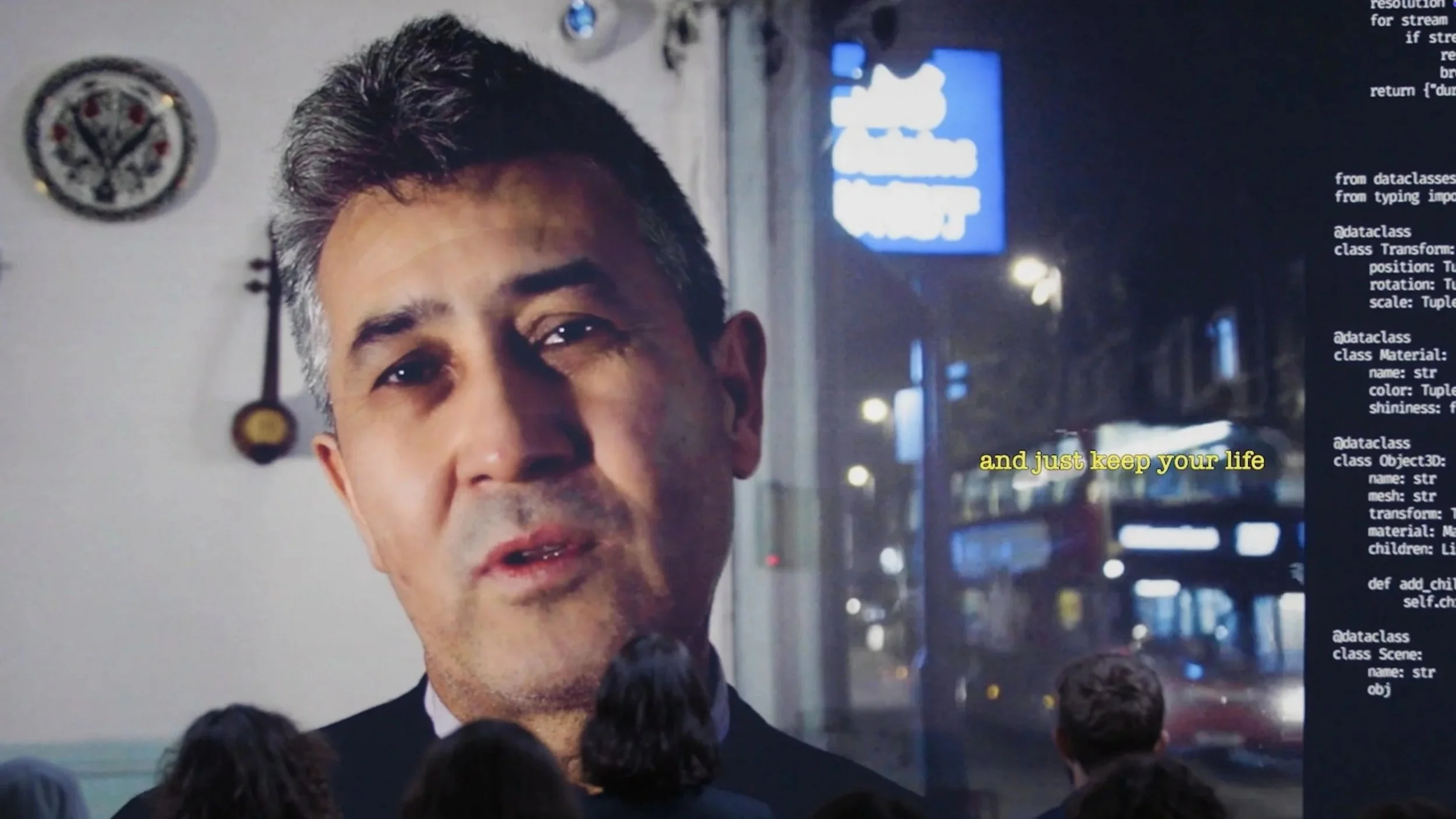
Image courtesy of Verve Pictures.
by MANSEL STIMPSON
Like the late great Terence Davies, Marc Isaacs is a British filmmaker who deserves to be thought of as an artist. Although he has his followers, he is not as well-known as he deserves to be. His films are entirely personal to him, offerings in which he expresses his concerns and his view of life rather than being works undertaken for the commercial market. Born in 1968, his early work largely comprised shorts and TV movies and I did not come across him until his 2012 documentary The Road: A Story of Life & Death was released into cinemas. It dealt with the lives of five immigrants living in London and regardless of any shortcomings I was immediately taken by its humane and sensitive approach. I have not seen his subsequent short films (very much part of his output) but I have seen the three cinema features which have followed and which involve the writer Adam Ganz: The Filmmaker’s House (2020), This Blessed Plot (2023) and now Synthetic Sincerity.
These three pieces have seen Isaacs retaining his compassionate eye but moving into more adventurous territory as he developed a form of documentary that incorporated representations not associated with that format. If the mix in This Blessed Plot veered between the uneasy and the unexpectedly successful, the offbeat aspects in The Filmmaker's House worked very well indeed and Synthetic Sincerity, another idiosyncratic creation, is also a success on its own terms.
Anybody reading about this latest venture will get the impression that this is a film about AI but, while there is certainly some truth in that, AI is not really the heart of the matter. Synthetic Sincerity opens with a written quote from Ingmar Bergman: "Film begins with the human face". Isaacs is offering us a film in line with that, one which focuses on the issue of the extent to which reproductions of faces convey deep truths about people, about their character and about their emotions. Early on it has been suggested that photographs as such, especially posed ones, are limited in what they can convey, just as in earlier ages painted portraits of the rich would be calculated not to tell the truth but to flatter. When we first meet one of the main figures in the film, the Uyghur refugee Ablikim Rahman, he is being photographed. However, the session is one in which he is being asked to express particular emotions in turn and consequently each time what we see lacks a sense of authenticity. Go beyond that and bring in an AI avatar based on the actress Ilinca Manolache and, however close the resemblance, you still get the impression that the image cannot replicate the inner human details that one can read in a real face. All of which might lead one to suppose that, as a humanitarian documentarian, Isaacs would be celebrating the depth and sincerity that cinematography can achieve. And, of course, in many ways he is, but not without raising some pointed questions.
Synthetic Sincerity echoes its two immediate predecessors in being less wholly documentary than it seems, but it does so in a different way. To put across the ideas that they want to convey, Isaacs and Ganz have created a storyline. An imaginary institution, the University of Southern England, has set up The Synthetic Sincerity Lab where an AI research project is in hand run by Professor Yi-Zhe Song. I am told that in real life Song is a co-director of a comparable set up in Surrey but he appears here as somebody who is inviting Marc Isaacs (very much a presence in his film) to participate. The idea is that Isaacs will allow real people appearing in his films (including Kelly Downing who featured in his 2011 TV movie Outside the Court) to be documented from these clips and thus provide data for the scientists hoping to create an AI with all the human emotions. For his part Isaacs will be allowed to film these proceedings.
In this way, we become familiar with some of the staff, not least Lynn and Dawn, as their work leads up to a presentation which will launch The Inscribed Humanity Project and which will feature the realised AI version of Ablikim Rahman. In this way, Synthetic Sincerity is directly concerned with AI but never takes on the form of a work featuring talking heads arguing about the balance between the benefits and the dangers of AI. Nevertheless, the plot is developed in ways which bring out the possibility of those in charge of an AI project coming under political pressure to censor what emerges and viewers are left to judge for themselves just how real the AI version of Ablikim Rahman feels. Furthermore, the film’s portrayal of his background and of Lynn's attachment to her grandmother still living in Beirut under Israeli bombing (she is Lebanese) render both Ablikim and Lynn people who are viewed in depth though the camera lens. We may not know how much is in fact enacted but a human truth is captured here.
Isaacs is, of course, fully aware that even documentary films of a standard kind are constructs. He references his own experience when making a BBC documentary which was never transmitted because it turned out that its central figure who claimed to be an Iraq war veteran proved to be bogus, But, over and above a special case like that, Isaacs is aware that a degree of artifice is always part of a filmmaker’s work. At 70 minutes Synthetic Sincerity is like its aforementioned predecessors a rather short feature and towards the close of it he is heard asking what can be done not to leave it under length. A shot of Lynn late on which is accompanied by a song is questioned over its possible emotional manipulation, yet throughout the film Isaacs once again illustrates how well he uses music ensuring that it adds to the atmosphere while being discreet enough not to become self-conscious. There is humour in his work too, most memorably here when Ilinca Manolache’s AI avatar turns on Isaacs himself. Although this latest endeavour has the originality now to be expected of Isaacs, it may not amount to a major work. Nevertheless, it is admirably thought-provoking and not just on the subject of AI.
Cast: Marc Isaacs, Ilinca Manolache, Lynn El-Safah, Ablikim Rahman, Yi-Zhe Song, Dawn Raison, Pinaki Chowdury, Kelly Downing, Adam Ganz, Yuanchen Wang, Guy Martin.
Dir Marc Isaacs, Pro Marc Isaacs, Screenplay Adam Ganz, Ph Marc Isaacs, Ed Marc Isaacs, Music Yahli Lev.
Andanafilms/Sincerity Films-Verve Pictures.
70 mins. UK. 2025. UK Rel: 17 July 2026. Cert. PG.
