
The Encampments

Coverage of last year’s pro-Palestine protests at New York’s Columbia University reveals much about Trump’s America.
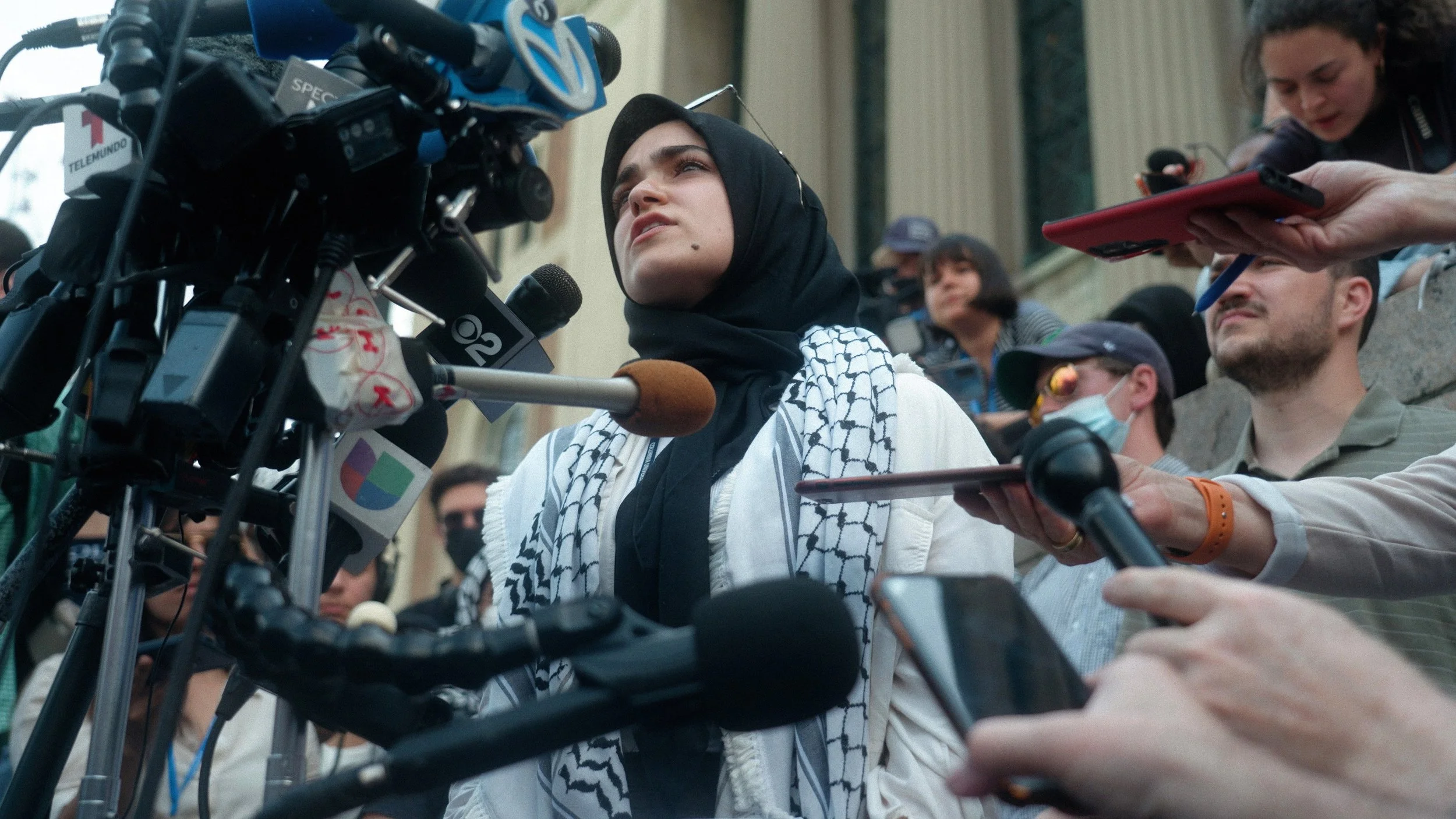
Image courtesy of Watermelon Pictures.
The day after I watched this film there were news headlines about Mahmoud Khalil who is a leading figure in it. The news in question was that a federal court in New Jersey had ruled that the foreign policy grounds on which Khalil had been detained with a view to deporting him from the USA were likely to be unconstitutional. The seizure of Khalil had arisen from his being one of the students at Columbia University in New York who had participated in the protest there regarding what was happening in Gaza and which had lasted for some fourteen days in April 2024. That event is the subject of The Encampments and it could be argued that this latest development made the release of the film in the UK especially timely. But it is also possible to take a quite different view. The current situation could equally well be grounds for saying that what we see in this documentary by Kei Pritsker and Michael T. Workman is only the first part of a developing story and for that reason it would have been better for them to have waited and to have made a wider-ranging film.
What we have here is a detailed record showing from the viewpoint of the student protesters the steps that they took in support of the Palestinian people. They regarded the extreme actions of the Israelis in Gaza as tantamount to a genocide and wanted the university authorities to reject the support of investments from Israel just as they had earlier diverted comparable backing linked to Russia. In setting up an encampment for this purpose on the university lawn, the organisers who included the Jewish Voice for Peace had not expected that on the second day the university authorities would allow members of the NYPD to enter and make mass arrests. The consequence was that a second encampment was quickly set up followed by attempts to negotiate with the university which produced only an eventual offer which was felt to be too poor to be acceptable. That realisation led to occupation of one of the university halls which was dealt with by a full-scale raid by the police.
We follow these happenings at Columbia on an almost daily basis as described by various students and journalists. Alongside that we see newsreel footage and hear of other American universities which became the sites of comparable protests. Slightly more detail is included in the case of the University of California in Los Angeles, but the main focus of the film remains on Columbia even to the extent of referencing the famed campus takeover which happened there in 1968 over the issue of the Vietnam war. The film also on occasion incorporates scenes of devastation in Gaza including mention of the universities there which have been destroyed. One or two contributors do look back on their own experiences but not sufficiently for any of them to come across in a way that is personal enough for us to get a strong sense of them as individuals. What is conveyed is the shared human concern that unites them and which on this occasion happens to be focused on the suffering of the Palestinians in Gaza. There is no sense of these protesters being driven by anti-Semitism and, while claims made by some Israeli students that they felt intimidated and fearful during the protest are acknowledged, it is suggested that this was an overreaction even if there could have been some such behaviour on the part of a small minority of Palestinian supporters. In contrast to that what comes over very clearly in the news clips is the hostile rhetoric of such figures as the Speaker of the House of Representatives, Mike Johnson, who brands all the protestors radical extremists whose ideology poses a threat and of other officials who declare them to be pro-Hamas sympathisers, fanatics and freaks who have been brainwashed. We can recognise from what we see here just how exaggerated such claims were.
The importance of The Encampments lies in what it tells us about the extent to which free speech in America is under threat in Trump's America including the widening crackdown on students who have joined campus protests against Israel's war in Gaza. The events at Columbia in April 2024 certainly illustrate that. Nevertheless, by concentrating so much on those days the film can feel constricted and at times it is not helped by contributions so softly spoken that it is not as easy as it should be to take in everything that is being said. In any case the focus feels narrow when what counts most is, arguably, what is happening now in the period subsequent to that covered by the film. It is not just the question of the fate that awaits Mahmoud Khalil who is still in detention but the wider actions emerging this year with ICE, the agency handling U.S. Immigration and Customs Enforcement, instructed to detain and deport those who participated in the protests at Columbia and threatening noises being made about withdrawal of Columbia's federal funding. Trump's feud with Harvard can be seen as a development of all this and the big story is, alas, one that is still in progress. What we have in The Encampments is detailed and certainly not without interest but, if viewed in this wider context, it is merely an opening chapter.
MANSEL STIMPSON
Featuring Mahmoud Khalil, Grant Miner, Sueda Polat, Jamal Joseph, Naye Idriss, Bisan Owda, Ali Abunimah, Layan Fuleihan, Maya Abdallah.
Dir Kei Pritsker and Michael T. Workman, Pro Matthew Belen, Munir Atalla, Kei Pritsker and Michael T. Workman, Ph Kei Pritsker, Michael T. Workman and Craig Birchfield, Ed Michael T. Workman and Mahdokht Mahmoudabadi.
Breakthrough Media/Watermelon Pictures/Macklemore-Watermelon Pictures.
80 mins. USA. 2025. US Rel: 28 March 2025. UK Rel: 6 June 2025. Cert. 15.
