
The Fall of Sir Douglas Weatherford

Incoherence ultimately sinks Seán Dunn’s debut feature set in the Scottish Highlands, but its star, Peter Mullan, rises above it.
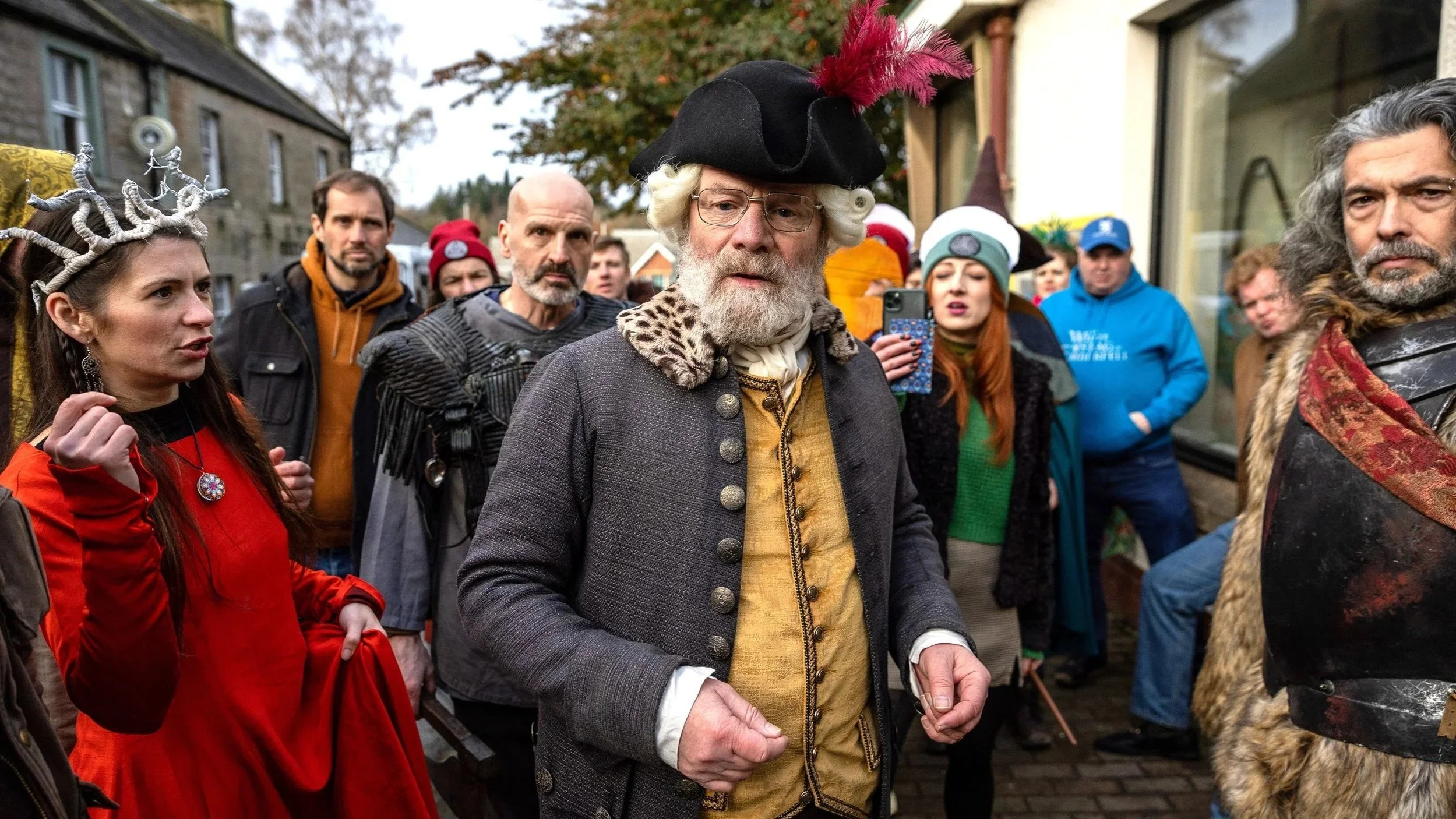
Peter Mullan
Image courtesy of Mubi.
by MANSEL STIMPSON
Edinburgh-born Seán Dunn now follows three short films with his feature debut and as with its predecessors The Fall of Sir Douglas Weatherford is a work both written and directed by him. Set in the Scottish Highlands in the imaginary town of Arberloch, the film is centred on the fact that we live in a world in which the majority of people are far more interested in popular but trashy TV fantasy dramas and in those who act in them than they are in real-life historical figures. That idea has obvious potential as a subject of satire, but the way in which Dunn has chosen to develop it in his screenplay is bizarre and strangely ill-defined regarding its ultimate aim.
The central character here is a widower named Kenneth Mackay, a role played by Peter Mullan. Kenneth is not just interested in local history but is positively obsessed by an 18th century philosopher who is an ancestor of his. This is Sir Douglas Weatherford. Acting as a tourist guide and wearing an appropriate period costume, Kenneth tells visitors about Weatherford's life and shows them a local landmark in the form of a rock associated with him and accordingly marked by a plaque. However, his routine is disrupted when a TV film crew arrive in town to shoot scenes for a popular drama series entitled The White Stag of Emberfell. Both townsfolk and visitors now seem unconcerned about Weatherford and his history and are far more taken by the idea of witnessing the filming and admiring the lead actor, one Oscar Sorenson (Jakob Oftebro). He has become a celebrity due to his central role in this piece, one that features dragons and witches and in which he appears as a prince ready to kill his own father. Even so, he is shown to be a poor actor whose wish to play Hamlet will never come about.
In some respects, Kenneth could be regarded as a heroic figure standing up for the value to be found in seeing history as a rewarding study in total contrast to those who are happy to become devoted fans of a popular but feeble fantasy filling our TV screens. Indeed, Dunn's film opens on a note of offbeat comedy by having the tale introduced by the off-screen voice of the late Sir Douglas Weatherford himself. He holds forth about his own brilliance and tells us that he views his descendant, Kenneth, as someone he relies on to keep awareness of his achievements alive. The voice we hear is that of the actor Jonathan Hyde who finds exactly the right tone for it. But, if he makes all this entertainingly self-aggrandising, it soon becomes clear that, despite being venerated by Kenneth, Weatherford was in actuality a man who behaved appallingly. We learn, for example, that he dealt in vivisectional experiments including a brain transplant involving a goat and a lunatic from an asylum which resulted in their deaths and which he describes as no great loss.
Some aspects of this film bring to mind however indirectly certain films made by the celebrated Ealing Studios. The fact that this is very much a Scottish piece leads one to recall Whisky Galore! while the voice-over by Sir Douglas reminds us that Kind Hearts and Coronets was told by a man who had killed in order to inherit a dukedom. However, even more pertinent to my mind is the later Ealing comedy The Man in the White Suit. Although that work is admired by many and does indeed contain some great scenes, I have always found it a drawback that the inventor with whom the viewer wants to sympathise (a role played by Alec Guinness) should end up creating a cloth which, if successful, would last forever thereby causing economic chaos and putting people out of work. What do we feel about him when that becomes clear? It is somewhat similar with Kenneth here. The fact that the TV series is viewed so adversely both as regards the people who make it and those who are fans of it leads one to want to side with Kenneth yet his blindness to all of his ancestor’s faults undermines that. We do find that some of Kenneth’s relatives enjoy the TV drama but, when they challenge his attitude and want him to be more progressive and to adapt to modern times, it is they who are the targets of the film’s satire.
By and large, this is a film in which a range of characters appear without really being built up in a meaningful way, among them Kenneth's daughter Anna (Gayle Rankin) and Oscar Sorenson's partner Emma Glen (Saskia Ashdown). Also rather poorly developed is the character of a young photographer, Stewart (Lewis MacDougall), who is taken on by Kenneth to film him as he seeks to produce his own movie about Sir Douglas Weatherford complete with re-enactments. Eventually Stewart will deliver his own footage which finds a more apt way to remember this figure as it fuses a positive achievement of Sir Douglas with appreciation of the natural world. This could be seen less as a compromise than as a more acceptable third viewpoint superior to what drives Kenneth and to what motivates the TV people. Had it been more firmly emphasised it might have given some point to the film but, as it is, it lacks the force needed to do that.
However misguided Kenneth is in his hero worship of his ancestor, the film certainly portrays him as a lonely man who has found solace in his obsession. On the other hand, his mental state eventually becomes such that his hostility to Oscar Sorenson and his colleagues drives him to the point of him planning to kill the actor (at which point the film is perhaps closer to drama than to the black comedy of, say, The Ladykillers). This development along with a final brief scene in which Kenneth seems to have changed his mind about the acceptability of TV fantasy dramas only leaves one more perplexed as to how exactly Seán Dunn wants viewers to interpret his tale. The Fall of Sir Douglas Weatherford is such an odd piece (you never know what turn it will take next) that it is saved from being boring. Nevertheless, aside from Jonathan Hyde’s perfect voice-over, only two aspects of it really satisfy. One is the film’s unusual but decidedly effective music score by Gazelle Twin and the other is the performance of Peter Mullan. I may have found only doubt and confusion as to what I was meant to make of Kenneth either as a comically eccentric figure or as a pathetic one, but Mullan is never less than a firm centre and a tower of strength. And that is so regardless of the challenges he has to meet in what I find to be a deeply incoherent screenplay.
Cast: Peter Mullan, Jakob Oftebro, Lewis MacDougall, Saskia Ashdown, Gayle Rankin, Sid Sagar, Cameron Fulton, Oliver Maltman, Ian Davies, Jimmy Yuill, Allison McKenzie, and the voice of Jonathan Hyde.
Dir Seán Dunn, Pro Alex Polunin, Scott Macauley and Jennifer Monks, Screenplay Seán Dunn, Ph David Gallego, Pro Des Jamie Lapsley, Ed Shanti Bhagchandani, Music Gazelle Twin, Costumes Elle Wilson.
BBC Film/BFI/An Ossian Pictures Production/BBC Scotland/Screen Scotland/The Fold-Mubi.
95 mins. UK. 2026. UK Rel: 12 June 2026. Cert. 15.
