
The Glassworker

Pakistan expands its cinematic horizons with an anti-war romantic drama in the tradition of Studio Ghibli.
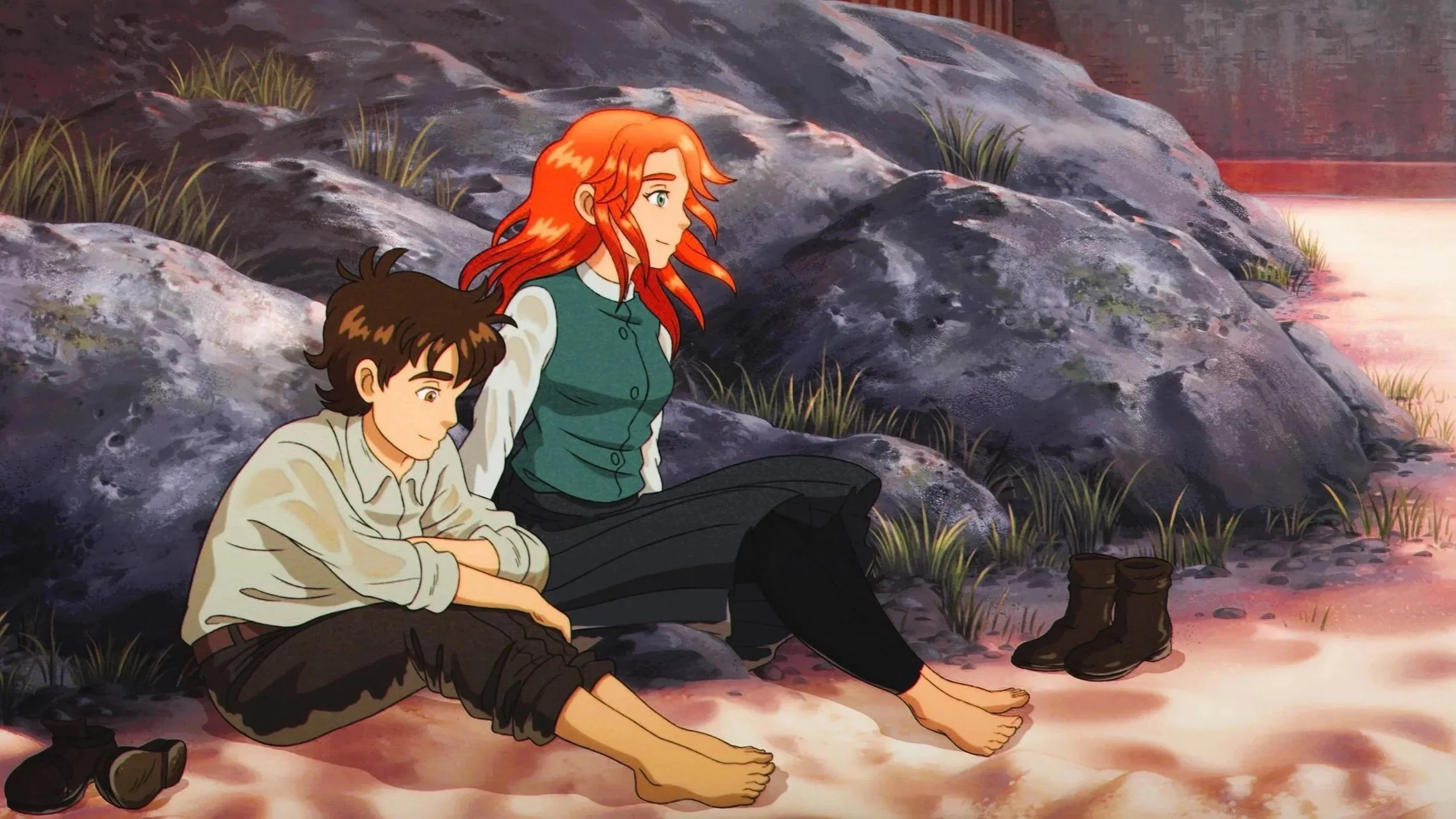
Image courtesy of Dazzler Media.
This film undoubtedly possesses special status being the first hand-drawn animated feature to be made in Pakistan. The filmmaker is the multitalented Usman Riaz who comes from an artistic family and who in 2016 was one of the founders of the Mono Animation Studios which functions in Karachi. He and Moya O'Shea share the credit for the original story, the music is also in part by him and his wife Mariam Paracha is the film’s art director. Given that handling this form of animation is such a lengthy procedure it is no surprise to learn that The Glassworker has been in the making for the better part of a decade. It’s also the case that the decision to make the film in the wide screen ratio means that every image contains a lot of space to fill.
The Glassworker takes place in an imaginary country but one that suggests an eastern setting and for that reason I was disappointed to learn that the version being distributed in the UK features a voice cast speaking in English. This is, however, well done and, while I would probably have preferred to have Urdu spoken and translated into subtitles to make the piece more atmospheric, it is the English language version which is the original soundtrack and the one in Urdu is the dub. Furthermore, the casting here is such that South Asian British actors provide the voices.
Usman Riaz's film is clearly a heartfelt endeavour and it is one that is well worth seeing even if there are elements within it that don't make a natural fit. On one level The Glassworker is a traditional love story indebted to the model of Romeo and Juliet. Young Vincent is a 14-year-old boy who is apprenticed to his widowed father, Tomas, who runs his own glass-blowing workshop and store in the town of Waterfront. This talent has made Tomas well known there, but the fact that he is an ardent pacifist incurs the disapproval of the locals – and it is all the sharper because a border war has broken out in this region centred on disputed territory noted for its mineral wealth. Vincent, himself an artistic child drawn to his father's craft, may be too young to be expected to fight but is nevertheless deeply affected by the situation in a special and personal way. He has experienced first love on encountering a girl who is a classmate. She is Alliz who is already a talented violinist, but the key fact about her is that she is the daughter of Colonel Amano, a leading figure in the war who has been posted to Waterfront. Alliz may be attracted to Vincent but she has other suitors too, one of them being Malik a youth regarded by her parents as a more suitable boyfriend: meanwhile with Alliz being supportive of her father's militaristic views, Vincent's father does not see such a girl as an appropriate companion for his son.
There is a certain timeless quality about the film and, since the story unfolds in flashback arising from Vincent as a young adult finding and reading for the first time a letter addressed to him by Alliz, the main narrative is indeed presented as happening some years earlier. But the tone of the film is such that it suggests a tale from an earlier age altogether. The war provides but a distant background and the tale of the very young lovers is told with a certain charm and a quiet romantic sincerity very different to what we see in most films today. Indeed, the theme of Vincent being influenced by the pacifism of his father and taunted by schoolmates because of it even carries an echo albeit a very distant one of a much-filmed classic tale which is over one hundred years old, A.E.W. Mason’s The Four Feathers (possibly that is also brought to mind because the setting lends itself to echoes of the colonial age).
What is more modern here is the notion of making an animated film which, likely to appeal both to adults and to younger audiences, carries an anti-war message of its own for Riaz is clearly intending the audience to sympathise with the beliefs of Tomas. In doing that he is consciously echoing some of the later work of the famous animator Hayao Mayazaki and not least his 2013 work The Wind Rises (Riaz has acknowledged his admiration for the Japanese master). Although I found this a pleasing element in the film it doesn't always match up with the old-fashioned appeal of the love story. In that respect Riaz is not afraid to include a cliché of romantic drama when Alliz expects Vincent to attend a concert in which she is playing and then thinks he has chosen not to turn up when in reality he has been prevented from entering the hall. As for the construction of the film it can feel disjointed (the flashback format especially in its early scenes involves frequent switches between the present and the past that is recalled through the reading of Alliz’s letter).
The Glassmaker is for much of the time more adroit when it opts to limit its visualisation of war references to a curfew and to the danger from bombs being dropped. Later, however, the colonel is called away along with Malik to join those taking on the enemy and this leads to a scene of action emphasising Malik’s bravery. It’s an episode that is confidently staged but it seems somewhat at odds with the pacifist theme. A further dramatic incident late on does involve Tomas acting on his beliefs but further doubts arise through the film’s inclusion of visual references to a djinn. Local audiences in Pakistan may find this a colourful extra but to bring in this supernatural figure of Islamic myth is to incorporate an aspect which feels part of a different genre altogether. In the circumstances I cannot regard The Glassworker as a total success, but the quality of the animation is a real credit to Riaz and his studio and, even though it falls short at times, this film as a whole is an endearing work and one in which those aspects that work well are far more important than those which raise doubts. A brave venture like this deserves your support.
MANSEL STIMPSON
Voices Art Malik, Sacha Dhawan, Anjli Mohindra, Tony Jayawardena, Teresa Gallagher, Mina Anwar, Sham Ali, Nila Aalia, Maya Saroya, Alex Jordan, Bex Wood, Dnita Ghohil, Nicholas Khan, Marcel McCalla.
Dir Usman Riaz, Pro Khizer Riaz and Manuel Cristóbal, Screenplay Moya O’Shea, from a story by Usman Riaz and Moya O’Shea, Art Dir Mariam Paracha, Ed José Manuel and Jiménez Martínez, Music Carmine DiFlorio and Usman Riaz, Animation Dir Aamir Riffat.
Mano Animation Studios/Awedacious Originals-Dazzler Media.
98 mins. Pakistan/India/USA. 2024. US Rel: 15 August 2025. UK Rel: 19 September 2025. Cert. 12A.
