
The Kingdom

A mafioso drama is distinguished by great acting in Julien Colonna's feature hinging on the troubled bond between a fifteen-year-old girl and her father.
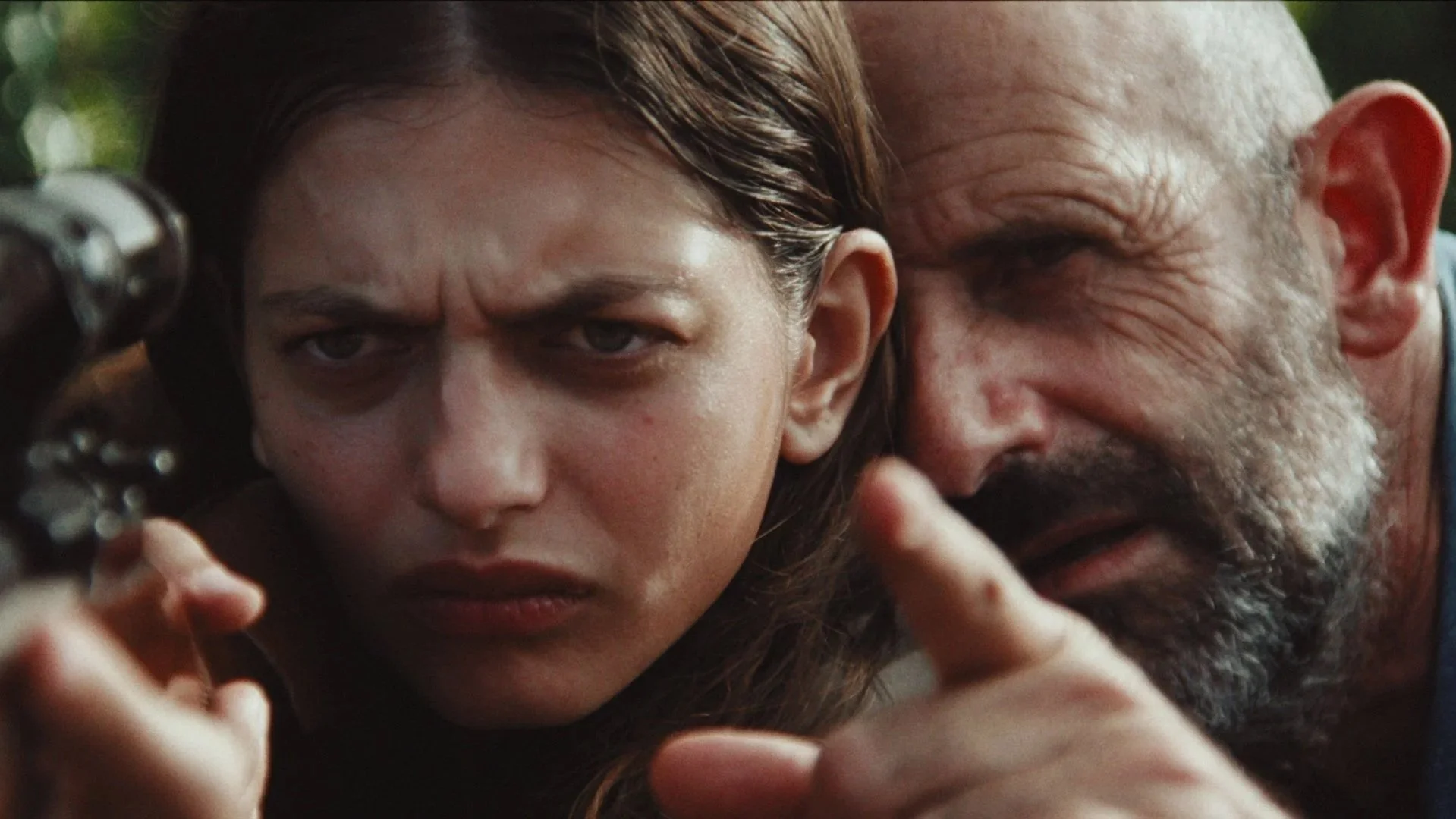
Ghjuvanna Benedetti and Saveriu Santucci
Image courtesy of Vertigo Releasing.
Julien Colonna's first narrative feature set in his native Corsica has at its heart the story of a father and his daughter. He has reached the age of fifty-nine and is a widower and she is fifteen years old. Early on in the film the girl, Lesia Savelli (Ghjuvanna Benedetti), complains that nobody tells her anything. Both her comment and the reason for it are understandable since her father, Pierre-Paul (Saveriu Santucci), is some kind of mafioso who lives in full awareness that he could at any moment be assassinated by a hit man employed by a rival. That is why he frequently moves from place to place with his own band of men and why to keep her safe he has been insisting that Lesia should live away from him with an aunt. However, she yearns to be closer to her father and is now summoned to be with him in the remote setting where he is currently living. Until now he has kept her at a distance when in cahoots with his men but, now that she is growing up, he feels that without involving her in his activities he can nevertheless let her be around during their discussions although this is on the understanding that she must keep anything she hears to herself.
Some critics have compared The Kingdom to The Godfather films as a portrait of a family of mafiosi but have pointed out the key difference that Colonna's film unfolds from the viewpoint not of the clan leader Pierre-Paul or of his men but from that of the one female literally born into this world, Lesia. That is a fair comment albeit that The Kingdom's main concern is eventually revealed as being the bond between its two central characters (Lesia’s mother had died some years earlier). The centrality of this relationship results in this being a film in which for at least half of its length violence is kept at a distance from the viewer being confined to television reports of car bombs and killings. Quite late on in one of the film’s best scenes, Pierre-Paul will reveal details of his past life to Lesia and the screenplay, written by Colonna and Jeanne Herry, is very successful in showing the father as a man whose life is convincingly centred on violence but who is also tender towards his daughter (the film's title could be read in more ways than one but Pierre-Paul talks fondly of those times when he had been closest to his daughter and describes that experience as being their kingdom).
If there are two sides to Pierre-Paul, there are also two sides to this film which has to ensure first that the characters are real enough to justify the central relationship being the quiet main focus and secondly that it loses none of the impact of a mafia drama when in its second half action scenes come to play a key role. It is in fact greatly to the credit of Colonna and his two leading players that The Kingdom impresses in both respects. Both Ghjuvanna Benedetti and Saveriu Santucci were non-professionals yet Benedetti has a magnetic quality on screen and Santucci is totally successful in capturing the contradictions in Pierre-Paul’s character. For this Colonna must share in the praise and aided by his editors he triumphs in his own right when strong action scenes become part of the story (an assassination in Ajaccio, a raid on a villa and a climax that occurs out of the blue).
With so much of quality to be found here it might be expected that The Kingdom would be a notably successful work. However, in my eyes (others have been far more positive about the film as a whole) it suffers from one major setback. When Lesia makes that complaint about not being told anything it turns out to be a pre-echo of my own response to the storytelling here. That a tale told from Lesia's viewpoint should reflect her own lack of knowledge about her father and his activities initially is understandable enough, but she does at least have some awareness of her family members and of the men close to her father. The viewer, however, is given precious little information as to names and identities. Indeed, the name of Lesia’s aunt never emerges and, to give but one example, it is typical of the film that, when we hear that somebody called Ghjasé has been locked up, we can recall hearing the name once earlier but have no idea which of the men around Pierre-Paul he is. For that matter the TV reports refer to politicians targeted and associated with Pierre-Paul but, in contrast to the coherent description of Pierre-Paul’s early days which eventually emerges, the exact nature of the rival clans never becomes clear. This meant that, while I wanted to feel as deeply involved as the quality of the performances deserved, I was far too often distracted by the need to figure out as best I could the information which was lacking but which was requisite for the drama to have its full power. But, if The Kingdom is for this reason much less effective than one would wish, it is nevertheless a notable calling card for Colonna as a director well suited to drama and, whether or not they act again, his two leading players both do exceptional work here.
Original title: Le Royaume.
MANSEL STIMPSON
Cast: Ghjuvanna Benedetti, Saveriu Santucci, Anthony Morganti, Andrea Cossu, Frédéric Poggi, Régis Gomez, Eric Ettori, Thomas Bronzini, Pascale Mariani, Marie Murcia, Attilius Ceccaldi, Cyrille Hertel.
Dir Julien Colonna, Pro Hugo Sélignac and Antoine Lafon, Screenplay Julien Colonna and Jeanne Herry, Ph Antoine Cormier, Pro Des Louise le Bouc Berger, Ed Albertine Lastera, Music Audrey Ismaël, Costumes Caroline Spieth.
Chi-Fou-Mi Productions/Canal+/Netflix/Entourage Sofica-Vertigo Releasing.
111 mins. France/USA. 2024. US Rel: 30 April 2025. UK Rel: 8 August 2025. Cert. 15.
