
The Last Musician of Auschwitz

In the worst place on Earth, music still found a voice.
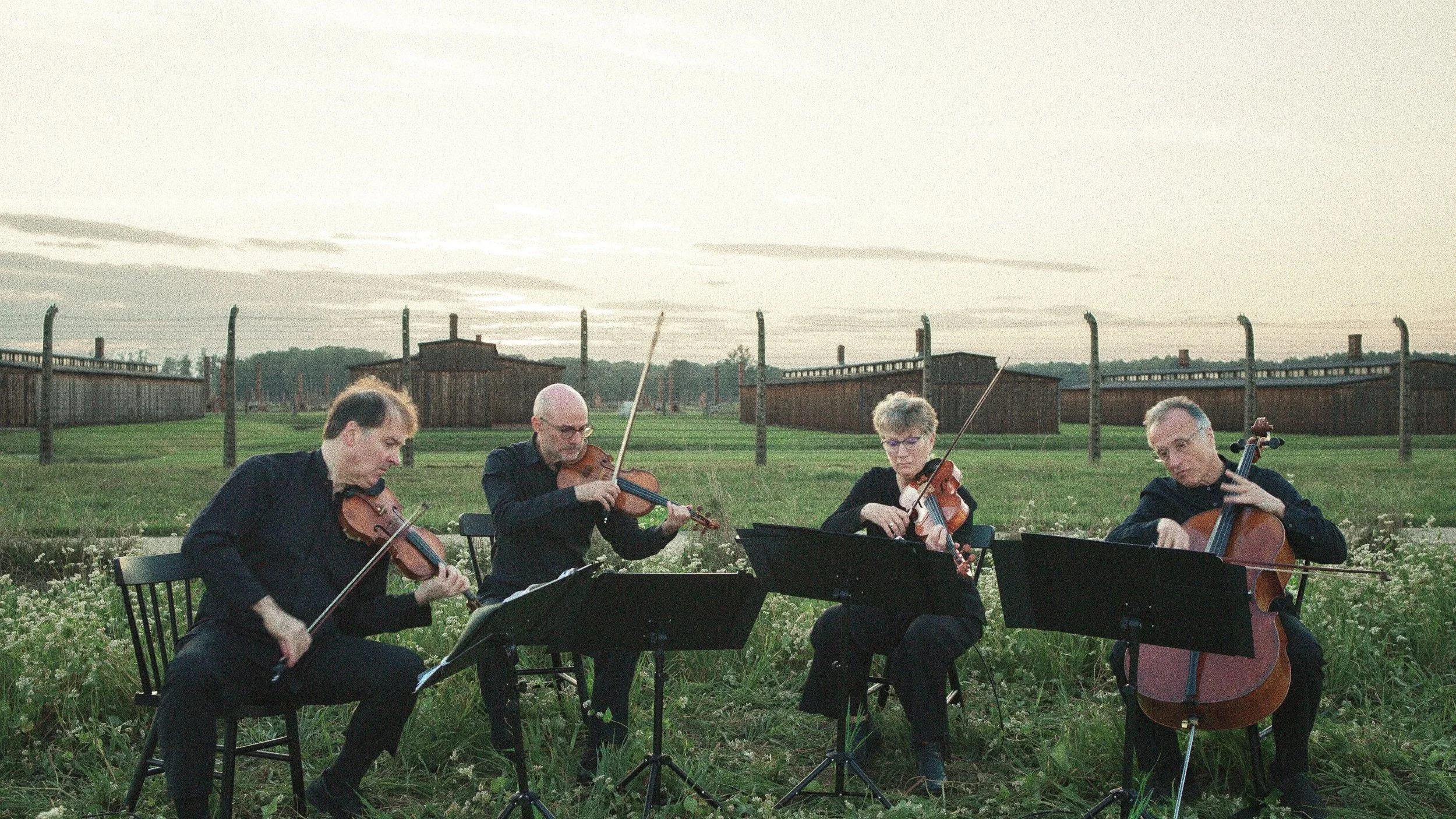
Image courtesy of Cosmic Cat.
This is another documentary feature about the Holocaust and that's a subject that has been treated many times and has yielded a good number of films that can be called masterpieces. Even so, the Nazi camps are of such importance that I feel that it would be wrong to give The Last Musician of Auschwitz less than a three-star rating despite what I regard as much poor judgement by its well-meaning director Toby Trackman whose previous work has largely been for television. Whatever its weaknesses, one has to recognise that some who view it could be people for whom this detailed account of Auschwitz-Birkenau is the first time that this subject matter has come their way and, given that some people still deny what happened there, this means that Trackman's film does indeed have value.
In part I could be accused of being prejudiced against the film because it is not what I was expecting, but in my defence I would point to it misleading title. It appears to promise a work about the celebrated cellist Anita Lasker-Wallfisch since she at the age of ninety-nine has now become the last survivor of those whom the Nazis selected to perform in the Women's Orchestra at Auschwitz. As recently as 2024 she appeared in the documentary The Commandant’s Shadow which not only looked back to the camp under Rudolf Höss but explored the extent to which all these years later the descendants of those who ran it and of those like Anita who were prisoners there are still working out how best to respond and how to regard each other. That was a thoroughly worthwhile film and Anita Lasker-Wallfisch made a not insubstantial contribution to it. Nevertheless, its focus meant it lacked the chance to give a fully rounded portrait of this wonderful woman and I hoped that a separate film might in due course emerge that would do that. When I heard of Trackman’s film and took its title on board it suggested that my wish was being fulfilled but that is far from being the case.
Opening with a reference to the liberation of the camp, the film does soon feature Anita Lasker-Wallfisch herself seen in her own home and still a strong, firm personality despite her great age. She talks of her childhood and a little later on of a failed attempt to escape from the Nazis which led to a year in prison and thereafter to transportation to Auschwitz. That was the kind of thing that I was expecting, but for the fact that equal weight is soon given to the historian Jonathan Freedland who at frequent intervals will update us on the history of the period with particular reference to Auschwitz itself. He does this well but it makes the film far more generalised than its title suggests. As for Anita, it has been decided to move away from the scenes of her talking to incorporate voice-over readings from her memoirs intercut with scenes of the actress Katie Shalka pretending to be the young Anita and speaking direct to camera. Splitting her into three like this seems quite unnecessary and it’s distracting too.
As the film proceeds it spends much of its 90 minutes featuring other testimonies about Auschwitz. Many of these involve unidentified survivors which leaves one wondering who they are although the end credits suggest that this footage is taken from archive material and names are grouped together there. Meanwhile, Trackman is fitting in more substantial scenes about other prisoners often selecting them in order to sustain the musical connection. They include instrumentalists and composers and since most of them are dead their stories are often told by a descendant but once again with some re-enacted scenes in which actors speak what purport to be their words although it is not always clear what their exact source is. It does makes sense to introduce into the mix several performances of music especially of works that are associated with the camp (there are folk songs and pieces composed there as an echo of home including, for example, a movement from a String Quartet featuring Polish themes). Several of these items are seen performed against the background of contemporary Auschwitz or with old camp footage intercut but that again feels more distracting than apt.
One aspect of this film brings in an issue less commonly touched on in Holocaust films and that is done through the presence of Petra Gilbert who represents the Romany population and introduces songs of theirs. But throughout we find Jonathan Freedland reappearing to offer more contextual history and, while we don't actually lose sight of Anita Lasker-Wallfisch, the film in moving forward to 1945 keeps jumping from one figure to another. It is indeed Anita who declares near the close that “Nobody thought you would get through the gate alive”. Furthermore, for all the way in which the film roams around its musical centre, it does ultimately cohere in seeing music as a means of resistance which played its own potent part in making many of these inmates believe that one should never surrender.
MANSEL STIMPSON
Featuring Katie Shalka, Rosalyn Mitchell, Laurence Dobiesz and Dan Blaskey and as themselves Anita Lasker-Wallfisch, Jonathan Freedland, Petra Gilbert, Andre Laks, Francesco Lotoro, Ulrike Migdal, Krzysztof Kulisiewicz, Raphael Wallfisch, Liv Migdal, Ben Caplan, Elizabeth Wallfisch, Simon Blendis, and Philippe Graffin.
Dir Toby Trackman, Pro Deborah Lee and Bartek Rainski, Ph Toby Trackman, Duane McClunie and Ricky Patel, Pro Des Jonathan Paul Green, Ed Gwyn Jones, Music Jessica Dannheisser.
Two Rivers Media-Cosmic Cat.
90 mins. UK. 2025. Rel: 9 May 2025. Cert. 15.
