
The Last One for the Road

Two middle-aged friends set off on a boozy road trip in Francesco Sossai’s episodic but sensitive comedy-drama.
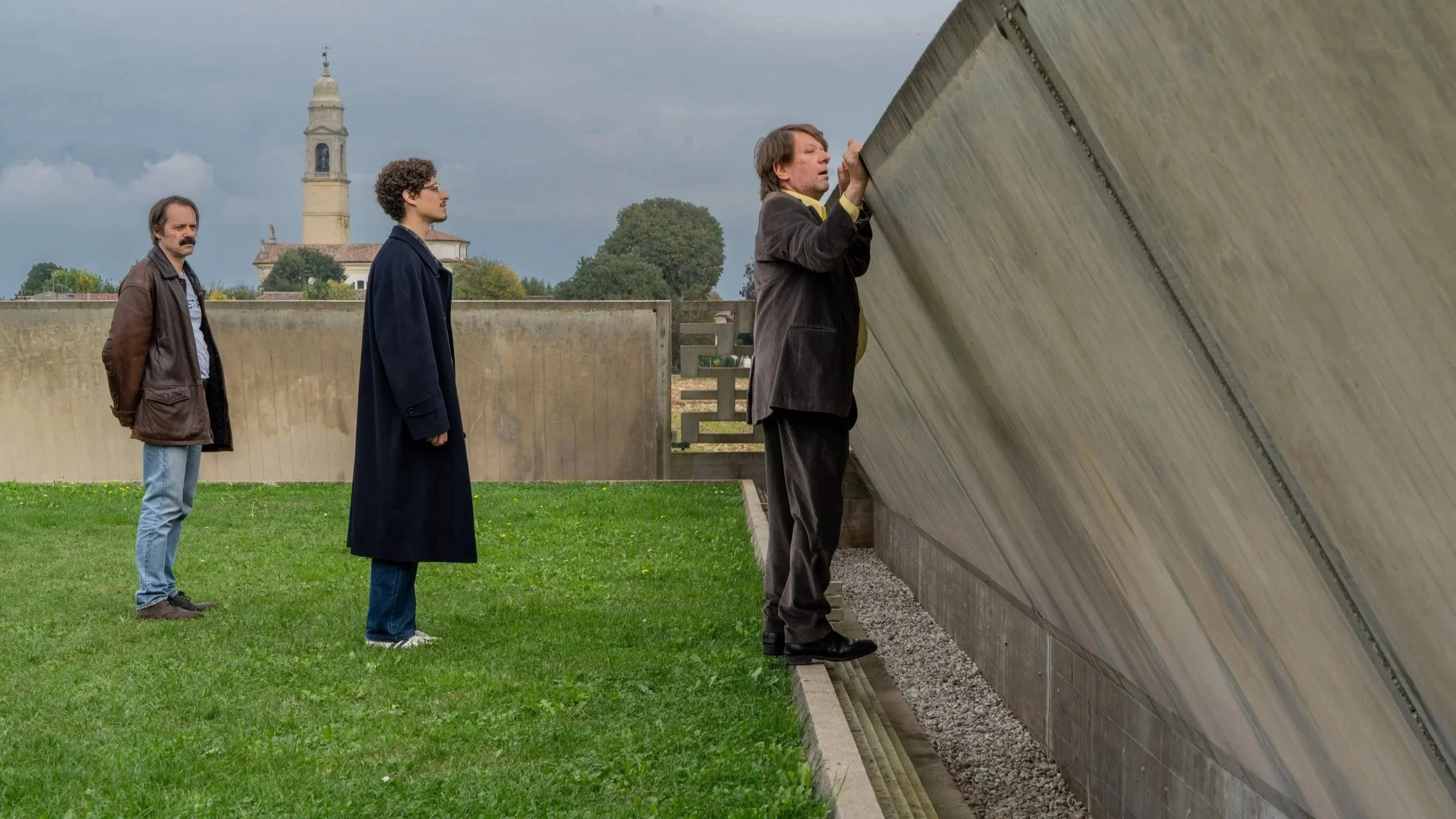
Image courtesy of Bulldog Film Distributors.
by MANSEL STIMPSON
The first feature film to be directed by Italy's Francesco Sossai was Other Cannibals made in 2021 and it won three awards but it has taken this second work, again written by Sossai and Adriano Candiago, for him to break through in a big way into the international market. In addition to being screened at a whole range of film festivals, it has obtained distribution in France, Greece, Russia, America and now the UK. In some ways it is surprising since The Last One for the Road is a relatively modest work and one which, in contrast to so much of today's cinema, has a relaxed, cool air. That gives it a distinct individuality, but no less crucial to its success is the fact that the casting of the lead roles is ideal. Despite these qualities, the film comes across as an entertaining piece that is relatively lightweight, although it could indeed be argued that without ever being heavy-handed it has greater depth than that description might lead one to suppose.
In 2021 the Danish director Thomas Vinterberg had a great success with Another Round which told a story about heavy drinking and was described as being both a dark comedy and a psychological drama. As the very title of Sossai's new film suggests, this too is a film about people for whom drinking has become central to their lives. Here the focus is on two lifelong friends now in their fifties. They live in the Veneto region not far from Venice and one is Doriano (Pierpaolo Capovilla) and the other is Carlobianchi (Sergio Romano). They regularly drink together and have developed the habit of taking just one more glass as the last one for the road while knowing that they will find a way to have yet another whenever possible. They acknowledge that they spend much of their time wasted but drinking does not make them rowdy or aggressive and on one level at least they are happy to share their lives in this way since they lack other attachments. Consequently, this is not a film that moves away from comedy to explore the darker side of alcoholism but one that chooses to engage throughout on what is superficially a lighter level than that.
The humorous approach of the film is established early on but in a rather odd way. We do see Doriano and Carlobianchi at the outset but almost at once there is a cut away and we see a long-time factory worker (Gianni Da Re) on the day of his retirement. He may receive a Rolex watch from the owner (Roberto Citran) but it is apparent that this man actually has more important things to do and is pretending to be personally aware of his employee’s history based on information that has been spoon fed to him. The former employee will briefly reappear much later on but seeing him in this short sequence at the start is a rather strange introduction to the story of our two lead characters. Nevertheless, this segment does set the film's tone and we now get on to the story of how Doriano and Carlobianchi are planning to drive to an airport to pick up an old friend, Genio (Andrea Pennacchi), who has been living in Argentina.
What follows comes close to being a road movie since the car ride they take is central. They will lose their way and fail to pick up Genio as intended but they drive on and find themselves in the company of a shy youth named Giulio (Filippo Scotti). He is studying architecture and is very earnest about his work but for a few days at least Doriano and Carlobianchi virtually adopt him and seek to encourage him to be ready to live for the moment. That includes persuading him that he should follow his heart and seek out a fellow student, Giulia Antonia (Giulia Bertasi), who has just graduated and has gone home to Verona but to whom he is clearly attracted. Seizing every chance because there is never another time is what they promote.
As is often the case with road movies, The Last One for the Road is a somewhat episodic film but that is no disadvantage. There are flashbacks too and from these we learn that Genio had been involved with Doriano and Carlobianchi in the black-market trading of stolen sunglasses and as the only one to be identified by the police had fled abroad. This feeds into the present narrative since Genio is now back and hoping to dig up his share of the profits which he had hidden. However, this is just a side issue and not a key part of the narrative. The fact that Doriano and Carlobianchi had blown their share way back is just what you would expect and we constantly see them ready to cadge be it merely a cigarette or a more elaborate ruse which arises by chance. That is when the two of them together with young Giulio are mistaken by a count (Denis Fasolo) for architects due to advise him regarding his grand villa which is threatened by a highway scheme. They not only fall in with his misapprehension but ask for a fee and travelling expenses as well!
This is very much a male orientated film and its appeal to female viewers may be much less (it is seen as something to approve when Doriano and Carlobianchi arrange for what appears to be Giulio's sexual initiation with somebody who is a stranger to him and push him into it). But importantly this is not a macho film and, despite its light touch, it is a sensitive portrayal of the sadness of life. This is quietly reflected in the film’s music by Krano including snatches of song and in the film’s references to architecture. A number of tracking shots emphasise the drabness of modern buildings and there is in contrast a sequence set at the l-shaped Brion tomb which plays as a homage to the Italian architect Carlo Scarpa who died in 1978. The destructive impact to the countryside of a proposed major highway is more than an incidental detail here and that also applies to that early scene of the worker’s retirement. When it comes to Doriano and Carlobianchi and their decision to drink their way through life, what is being criticised is not their choice but the circumstances of life today which have placed them in that position.
Among the prizes won by the film are a whole group of the latest David di Donatello awards presented by Italy’s Academy of Italian Cinema and there Sergio Romano’s Carlobianchi won him a best actor award beating Pierpaolo Capovilla’s Doriano. However, so good are both actors that one is inclined to feel that it was the Thessaloniki International Film Festival which got it right when deciding that its 2025 best actor award should be shared between them.
Original title: Le città di pianura.
Cast: Filippo Scotti, Sergio Romano, Pierpaolo Capovilla, Andrea Pennacchi, Denis Fasolo, Roberto Citran, Giulia Bertasi, Loreno De March, Nicola Rossato, Francesco Buskin, Simone Bergamasco, Gianni Da Re.
Dir Francesco Sossai, Pro Marta Donzelli and Gregorio Padnessa, Screenplay Francesco Sossai and Adriano Candiago from their story, Ph Massimiliano Kuveiller, Pro Des Paula Meuthen, Ed Paolo Cottignola, Music Krano, Costumes Ilaria Marmugi and Guillem Soler Pou.
Vivo Film/Rai Cinema/Maze Pictures-Bulldog Film Distributors.
101 mins. Italy/Germany. 2025. US Rel: 1 May 2026. UK Rel: 10 July 2026. Cert. 15.
