
The Marbles

David Nicholas Wilkinson’s documentary makes a strong case for the return of the Parthenon Sculptures to Greece.
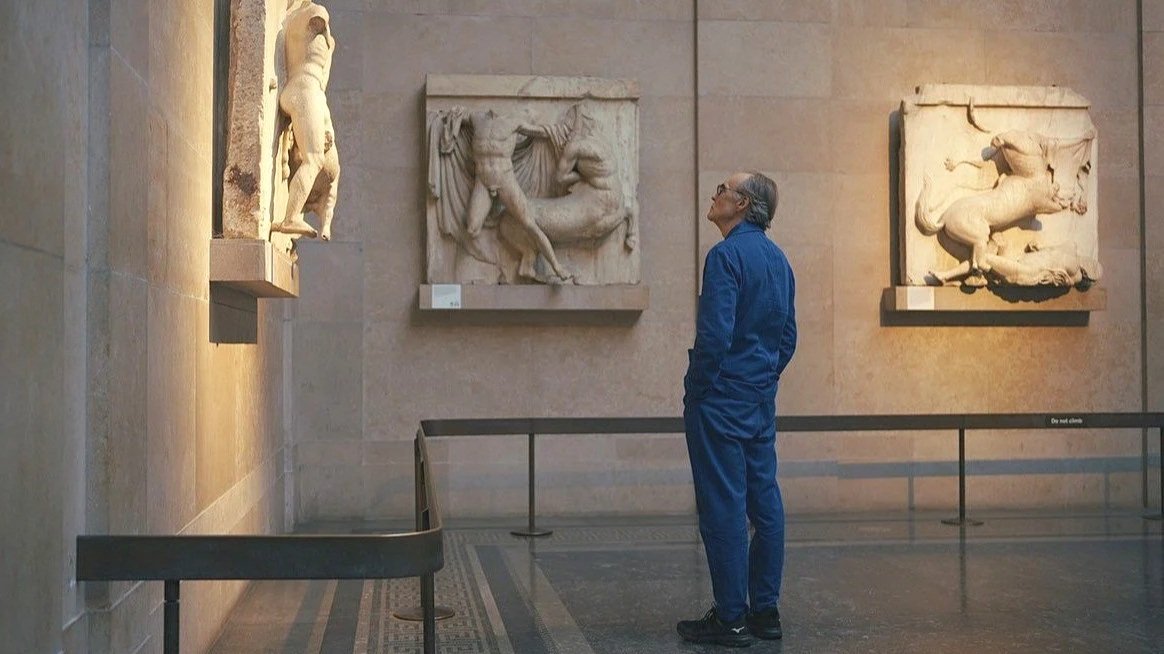
David Nicholas Wilkinson
Image courtesy of Guerilla Films.
The name of Elgin will forever be associated with a collection of Greek sculptures and other artefacts taken from the Parthenon Temple in Athens by Lord Elgin circa 1801-1805. Ever since they were removed from Greece to Britain there has been controversy surrounding them and never more so than today. Whereas Lord Elgin, a Scottish diplomat, parliamentarian and Ambassador to the Ottoman Turkish Empire, was hoping to further Britain’s appreciation and appetite for exhibiting global classical art works, it is more likely that he wanted to garner kudos for himself by transporting these monuments to his home in Scotland. However, the argument for sending the Marbles back to Greece, where they rightfully belong, continues to rage on.
Back in the 19th century all kinds of damage was done to the ruins on the Acropolis, following wars and looting and the acquiring of old stones to fashion into new architecture. Lord Elgin obviously saw his chances and in the position of Ambassador appointed artists and draughtsmen to make drawings of certain artefacts, the hope being that the UK government would give him permission and money to import them to Britain. When they refused, he decided to ship them himself. The art works were eventually bought by the British Museum for £35,000, although they had cost Elgin £75,000 to acquire and transport them.
However, there has always been some doubt about whether Elgin ever received permission to take some fifteen metopes (architectural plaques), friezes, pediments, columns and caryatids, etc, because the original document of permission, a firman, has never materialised. This puts Elgin on the same level as the Nazi war criminals who systematically stole art and cultural objects from Jewish and other families in World War II in order to amass a collection for Hitler’s own museum. Despite decades of action against keeping the Parthenon Marbles, the British government have always refused to surrender them back to their rightful owners – the people of Greece.
David Wilkinson’s very fair but enquiring film adds more flames to fire up the campaign for returning the Marbles. However, he does it in a measured way by talking to all kinds of people who feel strongly that nowadays Britain has no need to prove its interest in global culture, as it has always been recognised as an artistic hub which visitors from home and abroad continue to support. What is more is that many other countries around the world – including Scotland – have all returned cultural items acquired over the centuries.
When you have very experienced commentators as witnessed here, surely the day will come when Greece will get back what they have lost. There are many examples in Wilkinson’s documentary of other museums and galleries returning artefacts to their rightful owners. Patricia Allan, formerly the Curator of World Cultures at Glasgow Museums, researched international repatriation of ancestral remains, indigenous cultures and heritage. Tristram Besterman is a retired director of Manchester Museum who developed ethical standards for cultural restitution. Neil Curtis of the University of Aberdeen has been involved in repatriations to Canada and elsewhere. Alexander Herman has written a book on The Parthenon Marbles Dispute. Mark Stephens is a lawyer who has worked on the Marbles case for some fourteen years as well as Nazi-looted art claims. Perhaps most outstanding is the actress Janet Suzman who chairs the British Committee for the Reunification of the Parthenon Marbles and has worked tirelessly to gain public opinion on the side of returning them. These and many other notable contributors to Wilkinson’s excellent film ought to be able to persuade the British government to show some compassion and let Greece have back their rightful heritage. Would they do the same if the United Kingdom were to suffer cultural losses due to art theft? Think on...
MICHAEL DARVELL
Featuring Patricia Allan, Melina Antoniadis, Paul Cartledge, Clare Clifford, Brian Cox, Neil Curtis, Andrew George, Alexander Herman, Victoria Hislop, Evdoxia Lymperi, Tom Minogue, Ioannis Raptakis, Dominic Selwood, Mark Stephens, Christopher Stockdale, Janet Suzman, Guo YU, David Nicholas Wilkinson.
Plus Shian Donovan, Scottish Government Spokesperson; Ruby Crepin-Glyne, UK Government Spokesperson; Jonathan Guy Lewis as Boris Johnson; Janet Suzman, Artefacts voice-over; Paul McGann, Lord Byron voice-over; Miriam Margolyes, Scottish woman’s voice-over; Hartwig Fischer, Sebastian Heckmeier voice-over; Chief Dave Bald Eagle, Wounded Knee Memorial voice-over.
Dir David Nicholas Wilkinson, Pro David Nicholas Wilkinson, Ex Pro Kate Charles, Art Dimopoulos, Nick Drossos, Bill Lawrence and Amaryllis Roberts, Screenplay David Nicholas Wilkinson and Emlyn Price, Pho Don McVey, Ed David Hughes, Music Christopher Barnett, Sound Tudor Davies Post Prod Jon Walker.
Guerilla Docs & JoJo Films in association with the National Hellenic Society, George & Judy Marcus Foundation/Oikos Voutsas-Papadopoulos/ AHEPA Victoria–Guerilla Films.
114 minutes. UK. 2025. World Premiere: Central Scotland Documentary Festival: 30 October 2025 (Opening night film). UK Rel: 7 November 2025. Cert. TBC.
