
The Marching Band

Long-lost brothers are united in Emmanuel Courcol’s thoroughly engaging French drama.
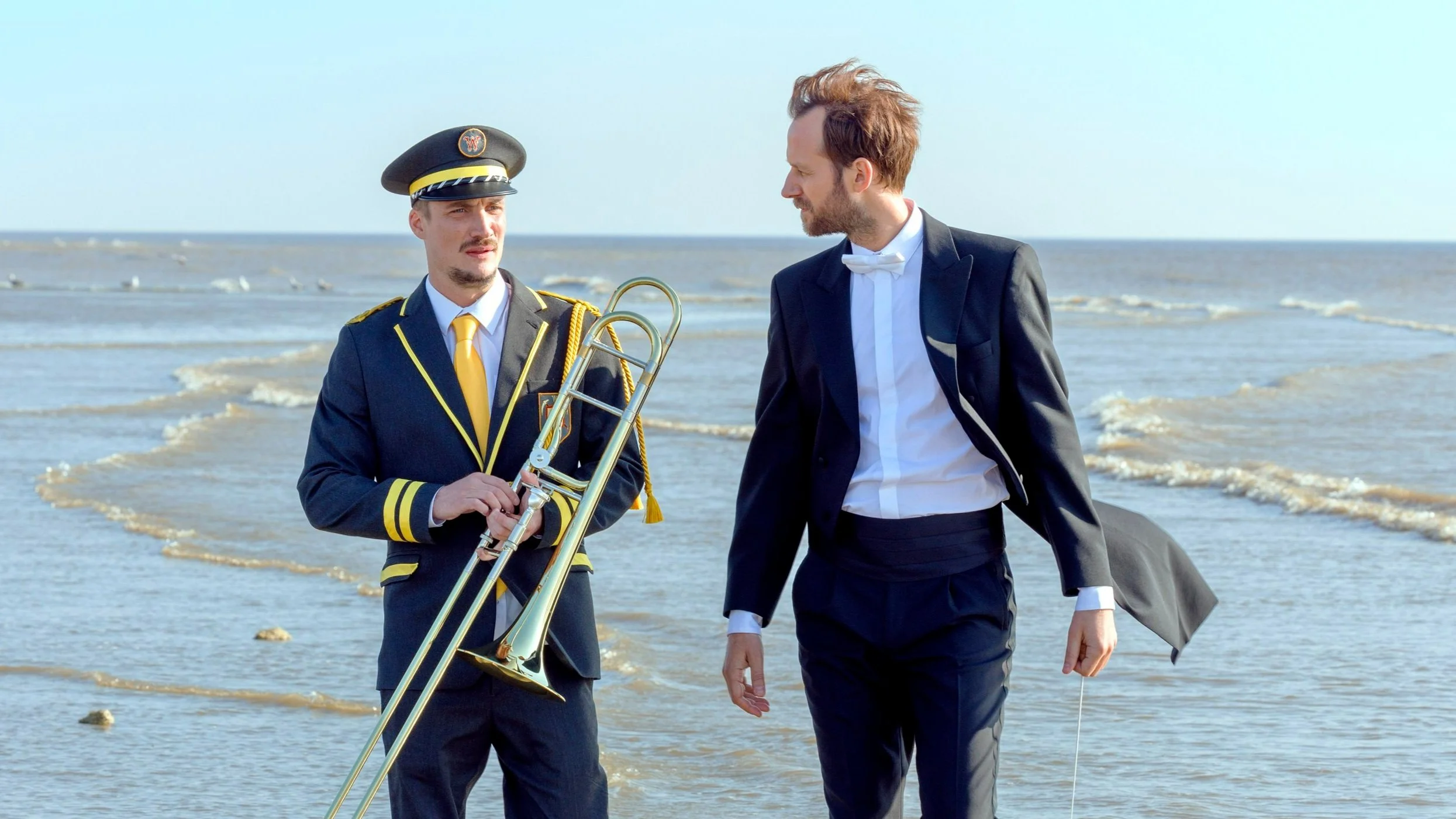
Image courtesy of Vertigo Releasing.
Long established as an actor, Emmanuel Courcol waited long before taking on directing and made his first feature film, Ceasefire, in 2016 when in his fifties (he was born in 1957). It also found him functioning as the screenwriter and his second feature which introduced me to his work, 2020’s The Big Hit, saw him credited both as director and co-writer which is again the case with this new piece which has been a huge hit on its home ground in France. Both this new piece, The Marching Band, and The Big Hit share a strong sense of being works designed to have wide popular appeal although on paper they sound very different.
The Big Hit was based on real life events and was concerned with the positive impact on prison inmates of taking part in a staging of Samuel Beckett's play Waiting for Godot and we were invited to root for them in a way that brought to mind our sympathy for the characters who are out of work in The Full Monty. Courcol applied a light touch, but the fact that the play involved was Beckett’s avant-garde classic may have been off-putting for some viewers and a comparable theme had been dealt with in greater depth in Caesar Must Die (2012), that masterpiece by the Taviani Brothers. This time around, however, Courcol has been far more adroit in maintaining popular appeal throughout and, if the earlier film recalled The Full Monty only indirectly, The Marching Band far more obviously brings to mind the British hit of 1996 Brassed Off (that could even have been an influence in finding an English language title since originally the film was known simply as En fanfare).
Although a brass band plays a not unimportant role here, The Marching Band is at heart the story of two brothers who, having been separately adopted as children, had been unaware of each other's existence. One of them, Jimmy (Pierre Lottin), lives a humble life in a small town in the north of France being now divorced and working in the cafeteria of a colliery which has a band of its own in which he plays trombone. The other brother, Thibaut (Benjamin Lavernhe), has in contrast become a celebrity and, now in his thirties, is well established internationally as a conductor of classical music. Consequently, The Marching Band is able to feature not only band music (the colliery band is set to take part in a competitive event for which they are learning the Grand March from Aïda), but we witness too Thibaut at work in the concert hall thus leading to scenes that include extracts from popular classics by such composers as Mozart and Debussy. For that matter we also hear some jazz records briefly since both brothers love that music too.
However, while music plays a prominent and appealing role, the relationship between the newly acquainted brothers is at the centre of the film. The bond quickly becomes a strong one because Thibaut has only tracked down Jimmy through DNA after suffering a sudden collapse leading to an urgent need for a bone marrow transplant and, as a sibling offers the best chance of success, Jimmy has been persuaded to be the donor. Despite being busy with his own career, Thibaut being thus indebted takes time to support Jimmy, recognises that he has untapped musical talent (he has perfect pitch) and encourages him to advance into conducting. However, as the brothers get to know one another beneficially it also becomes apparent that Jimmy is coming to realise how much he has been disadvantaged by not having the same adoptive parents as Thibaut.
This makes for thoroughly engaging viewing thanks to a screenplay that is persuasive in its characterisations and through ideal casting. Lavernhe and Lottin capture perfectly the growing rapport of the siblings which overcomes the tensions that sometimes surface while an actress unknown to me, Sarah Suco, does wonders in bringing fully to life a single mother named Sabrina. She also plays in the band and has to look after her child as well as having a brother with Down’s syndrome. Although it is clear to us that Sabrina is drawn to Jimmy, he as a divorcé living a very routine life has a low opinion of himself and can't believe that she could feel him to be worthy of her. Again, it's a human situation to which the viewer responds.
As well as being well cast, Courcol’s film is very well edited by Guerric Catala and attractively photographed by Maxence Lemonnier using the wide screen. Where it does fall down slightly is in juggling so many balls in the air. The story of the brothers is a strong one in its own right, Sabrina’s situation could be viewed as akin to an effective sub-plot and the musical side of the tale builds not just to one climax (a competition in which Jimmy is due to conduct the band) but to two (the other being a climactic concert at a time of crisis). The latter follows on from an earlier plan to hold a benefit concert on account of the colliery being threatened with closure and the workers being on strike over that and it is this thread that underlines the likely influence of Brassed Off. But with so much else going on the issue about the treatment of the work force too often feels merely part of the background rather than a key element.
Another factor to be taken into account is Courcol’s desire to end a film with a huge emotional climax. That is not necessarily bad in itself but both The Big Hit and The Marching Band go in for that by featuring scenes that are built up in a way that seems far too unrealistic to please me. Musically, The Marching Band goes out in a big way featuring Ravel’s famous ‘Bolero’ but it is handled in a manner that cuts across any sense of credibility. Perhaps this is a matter of personal taste and the huge popularity that this film has found with French audiences suggests that many viewers will, unlike myself, lap up this climax. Nevertheless, it's this conclusion which reduces my own rating for what in so many ways is a well-made film. But for others it could well be something that they regard as the icing on the cake.
Original title: En fanfare.
MANSEL STIMPSON
Cast: Benjamin Lavernhe, Pierre Lottin, Sarah Suco, Clémence Massart, Jacques Bonnaffé, Anne Loiret, Nicolas Ducron, Mathilde Courcol-Rozès, Charlie Nelson, Marie-José Billet, Antonin Lartoud, Johnny Montreuil, Ludmila Mikaël.
Dir Emmanuel Courcol, Pro Marc Bordure and Robert Guédiguian, Screenplay Emmanuel Courcol, Irène Muscari with Oriane Bonduel, Marianne Tomersy and Khaled Amara, Ph Maxence Lemonnier, Pro Des Rafael Mathé, Ed Guerric Catala, Music Michel Petrossian, Costumes Christel Birot.
AGAT Films & Cie/ France 2 Cinéma/Canal+/Ciné+/France Télévisions/Entourage Sofica 2/Indefilms 12-Vertigo Releasing.
103 mins. France. 2024. UK Rel: 16 May 2025. Cert. 15.
