
The Portuguese House

Reflecting on the importance of personal interconnection, Avelina Prat’s new drama is a perfectly acted tale.
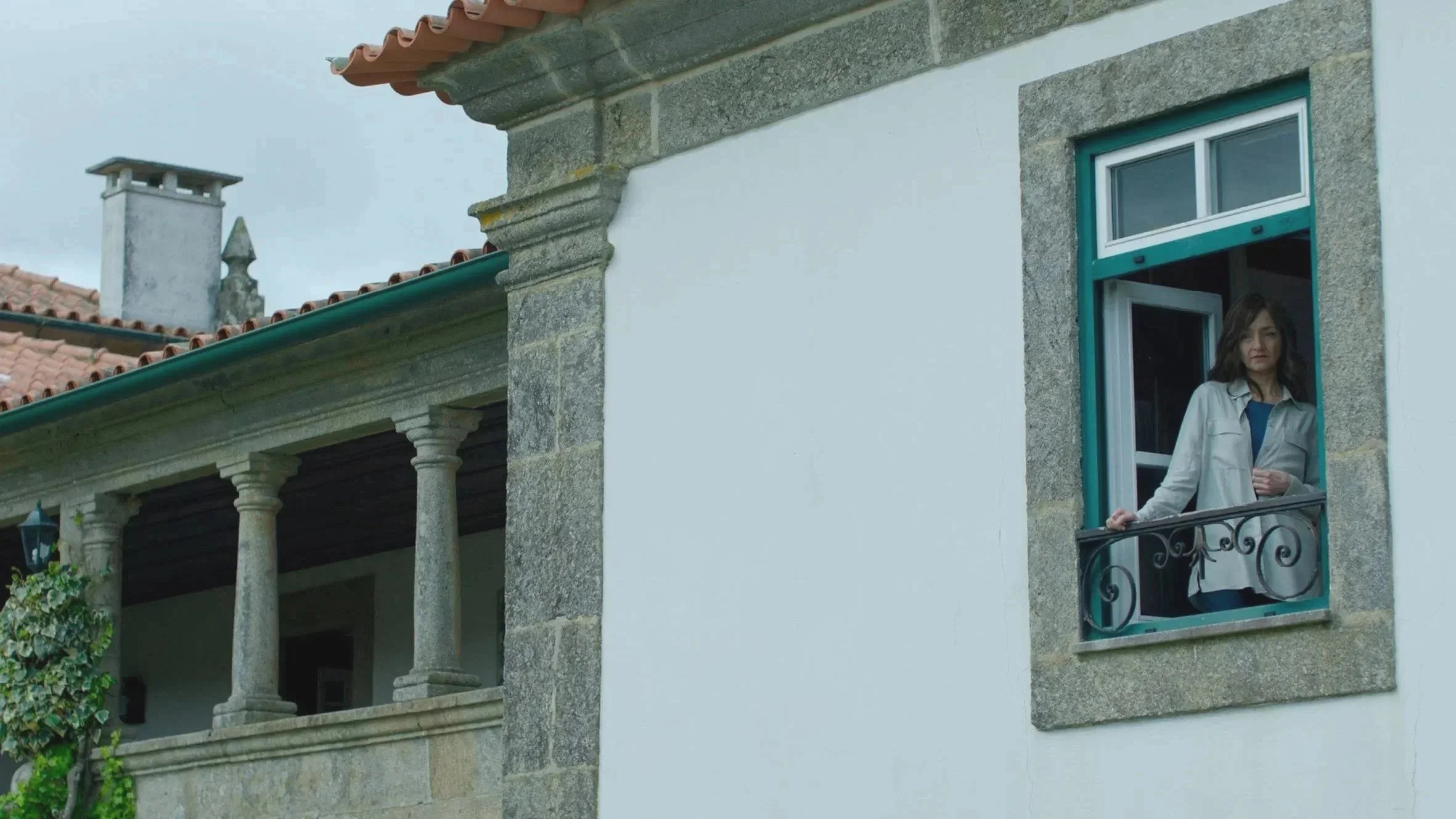
Image courtesy of AX1 Films.
by MANSEL STIMPSON
I feel a warm attachment to this film which is not something that I had anticipated. It is the case that The Portuguese House has won ten awards but most of them were received in Spain which counts as more or less home ground (this is a Spanish/Portuguese co-production and the footage features scenes shot in both countries). The number of reviews in English to be found online are very few so the film seems to have made limited international impact and it is only the second feature by a writer/director, Avelina Prat, of whom I had no knowledge. Yet in the event The Portuguese House reveals her to be a true auteur whose personal approach to the material gives it a unique character.
The story that she tells is an unusual one which in other hands might have encouraged questions about its credibility but so deftly is it presented – so well acted and so perfectly cast – that one is only too happy to suspend disbelief. It is quite deliberately and appropriately a film that takes its time but one is made to feel involved from the outset. The only problem here is for the critic since one recognises that it is best for the viewer not to know too much in advance about the slow-moving events depicted. Consequently one feels constrained when it comes to describing the film. Thus, it seems best not to reveal what is happening that draws one in during that opening scene but merely to state that this film is about a teacher, Fernando (Manolo Solo), who is a professor of geography in Spain whose life suddenly falls apart due to a totally unforeseen event which throws him right off balance. What can be said is that he gets right away by travelling on his own to a coastal town in Portugal. It is out of season, only one hotel is open and he finds himself talking to a man employed there as a gardener, Manuel (Xavi Mira). Chance leads to a spur of the moment decision when Fernando has the opportunity to take on a post intended for Manuel. This puts him in the employment of Amalia (Maria de Madeiros) who owns a Portuguese quinta consisting of a fine house and what is left of what had once been a rather grand estate known for its almond trees.
Fernando presents himself to Amalia as though he were Manuel but if that brings to mind another film in which one man takes over another's identity – Antonioni’ s The Passenger (1975) – it should be emphasised that the character and concerns of these two films could hardly be further apart. The Portuguese House is a quiet film which, even if it carries the uncertainty of whether or not Fernando's deceit will be realised, is essentially about troubled people seeking to come to terms with their experience. If Fernando is seeking to regain composure after what has just shattered his life and his confidence, Amalia is somebody who has inherited the quinta from her grandmother but who had herself been born in the colonial setting of Angola and has come to realise that neither Portugal nor Angola feel like places where she truly belongs.
The last quarter of The Portuguese House springs a surprise by introducing a development which calls Fernando back to Spain despite his growing rapport with Amalia. Unexpected as these scenes are, they work well and a new character introduced (she is played by Branka Katic) is again fully realised. Furthermore, she adds to the film’s focus on people living in a country not their own and to some extent caught between two worlds. Indeed, the whole film centres on the help that people can give to one another and which can create bonds of meaningful friendship. That is even seen in the relationship between Amalia and her cook, Rita (Rita Cabaço).
This is a film with a number of fine qualities. The photography by Santiago Racaj captures the atmosphere of this part of Portugal and Vincent Barrière’s music score is entirely in keeping. All of the actors are splendid and perfectly in accord with no histrionics and a uniform naturalism. Much of the credit is theirs, but Avelina Prat herself is surely the key contributor. The way in which she presents the characters makes good people interesting and conveys the value of human connection. It is, I think, a valid criticism of The Portuguese House that it is not always clear just how much time passes in the period when Fernando is gardening for Amalia. It is also possible to wonder if, for all its qualities, the tale lacks what it takes to become an actual masterpiece. Yet its way of expressing without any sentimentality the value of the intimate connection established by all of its characters is something quite special. One feels that it must stem from Avelina Prat, but all of her players do her proud and having seen the film I found it especially tragic to learn that its lead actor, Manolo Solo, died of cancer not long after The Portuguese House was completed. It is also worth adding that, given the particular character of the piece, its concluding scene is perfect. This ending is very succinct but yet says all that needed to be said.
Original title: Una quinta portuguesa.
Cast: Manolo Solo, Maria de Madeiros, Branka Katic, Rita Cabaço, Xavi Mira, Kasia Kapcia, Gonçalo Dantas, Rui Morisson, Ivan Barnev, Luisa Cruz, Zia Soares, António Mortágua, Morgan Blasco.
Dir Avelina Prat, Pro Luís Urbano, Miguel Molina and Adán Aliaga, Screenplay Avelina Prat, Ph Santiago Racaj, Pro Des Artur Pinheiro, Ed Juliana Montañés, Music Vincent Barrière, Costumes Giovanna Ribes.
Distinto Films/Jaibo Films/O Som e a Fúria/À Punt/3Cat/RTVE/RTP-AX1 Films.
114 mins. Spain/Portugal. 2025. UK Rel: 2 October 2026. Cert. 12A.
