
The Six Billion Dollar Man

Eugene Jarecki’s studiously researched documentary is more than a portrait of Julian Assange and could hardly be more topical.
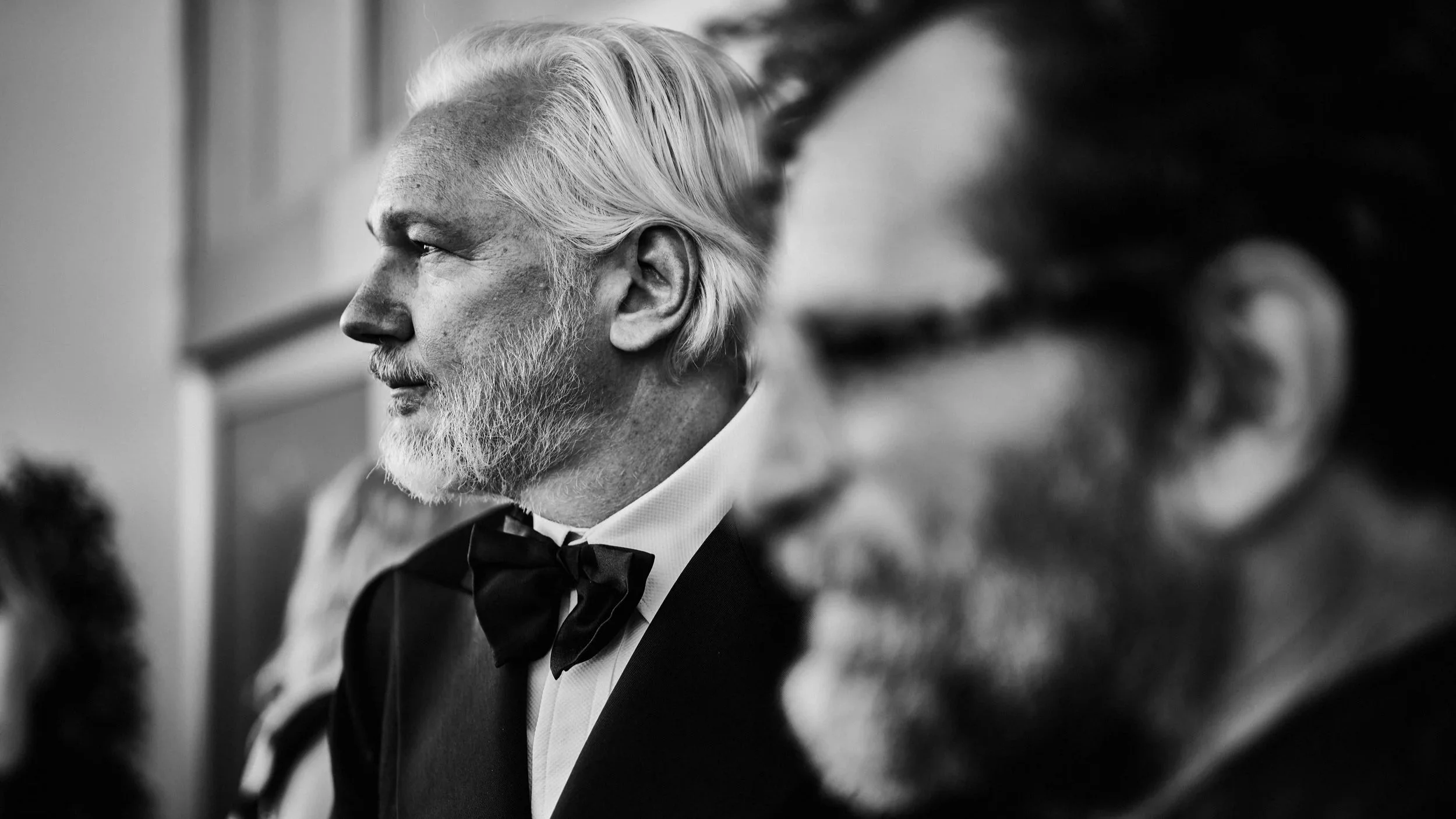
Image courtesy of Watermelon Pictures.
by MANSEL STIMPSON
The first feature film by the documentarian Eugene Jarecki to obtain a cinema release in the UK was 2012’s The House We Live In and this deeply considered polemic against America's War on Drugs was so well made that it immediately stood out. A few years later Jarecki followed it up with The King (2017) and, although that was a film centred on the life of Elvis Presley, it was a work which viewed him as a victim of an exploitative capitalist society. That approach was one which enabled the film to incorporate a critical view of America during Trump's first term as president thus confirming that social and political issues lie at the very centre of Jarecki’s films. His latest work is clearly a continuation of that: the shorter version of its title, The Six Billion Dollar Man, if intriguing is also in itself cryptic but the film’s subtitle Julian Assange and the Price of Truth defines its subject matter. Even so, it could lead to a misunderstanding as to the film’s chief concern because, despite telling Assange’s story, its purpose is such that to regard it simply as a biopic would be to give too little recognition to its wider aims.
This studiously researched film is in three parts. The first, ‘How It All Began’, starts in 2010 when the website WikiLeaks, founded by Assange some four years earlier, released a video revealing US airstrikes killing civilians and journalists in Iraq in July 2007. When Alex Gibney came to make his detailed and very effective documentary We Steal Secrets: The Story of WikiLeaks (2013) a number of key elements in Assange’s story had already occurred: the claims against him in America for breaching the country’s security by releasing hacked documents through WikiLeaks, the accusations of rape following sexual encounters with two women in Sweden and the sanctuary offered to Assange when political asylum was granted to him by Ecuador enabling him to take shelter in that country’s London embassy. These matters are inevitably revisited here and, indeed, this film’s Part II, ‘A Safe Place’, is concerned with the time that he spent in the embassy.
However, what happened within that embassy was hardly anticipated then since for his own security Assange would remain indoors there for almost seven years during which time his condition deteriorated. At the outset he had received genuine support from Ecuador's president (that being Rafael Correa who appears in the film). However, when Correa’s successor Lenín Moreno took over as president in 2017 the country acquired a leader ready to make a deal with Trump. Indeed, the title of this film is a reference to the belief that Ecuador’s receipt of financial aid from the IMF to the tune of six billion dollars was in return for terminating Assange’s right to asylum. This revocation occurred in 2019 and Assange was arrested and taken to Belmarsh prison. There he awaited a hearing in which Woolwich Crown Court would in due course consider the request for extradition received from America where Assange had seventeen charges against him under their Espionage Act originally set up in 1917. These developments and their eventual outcome are central to the second half of Jarecki’s film including the whole of its third section, ‘The Delivery of Julian Assange’.
After Gibney’s film appeared it was followed by another take on the story and that was Risk made by Laura Poitras in 2016. Then – as now – Assange was a highly controversial figure, a man admired by many for what he achieved through WikiLeaks but regarded as a traitor by others and further condemned by those who believe that the sex claims in Sweden, albeit eventually dropped, were nevertheless valid and not contrived to discredit him. Getting a clear focus on Julian Assange is far from easy as these three films show. That by Gibney attempted to take a broader view of the WikiLeaks saga and gave space to the hacker Bradley Manning but Risk was centred very much on Assange himself and he was literally its central presence. Yet it found Laura Poitras admitting that in spite of having been drawn to make a film about him out of admiration she had in time come to reassess him. Consequently, her film – which did not please Assange himself – worked as a compelling study which left it up to each viewer to form their own opinion of the man.
It seems fair to say that Jarecki’s view of Assange is more positive but, while he is given both the first word and the last, he is not brought forward to tell his own story and most of what we see of him here consists of old images be they archive footage or videos taken inside the Ecuadorian embassy. The majority of those interviewed for the film are sympathetic to him including in particular Nils Melzer who, noted in the field of international law, was sceptical when first asked to consider if the lack of privacy and the treatment of Assange in the embassy amounted to torture. Nevertheless, Melzer came to believe that such a claim could be justified. We hear, of course, from Assange’s lawyer Jen Robinson and from another lawyer, Stella Moris, who eventually married him, but other friends and colleagues who contribute make it clear that Assange could be a difficult and unpleasant person at times. The most hostile of those interviewed is Sir Alan Duncan who was a British Foreign Minister in 2019 and his relish over Assange being arrested is such that he encourages one to side unreservedly with the man whom he scorns.
The Six Billion Dollar Man is well worth seeking out. Long as it is (129 minutes), it is admirably made and its team of editors ensure that it moves well throughout. The fact that it can bring Assange's story up-to-date is an asset in itself and there is plenty of striking new material not least through the inclusion of a former associate in WikiLeaks, Sigurdur Thordarson, who turned informant and whose statement to the FBI played a crucial part in the framing of the charges against Assange but who now admits that he lied. It may in one sense be a drawback that Assange remains something of an enigma and that the film ignores some points that have been raised against him. Nevertheless, the crucial fact about this work is that it looks back from the present day. That means that, with Trump's America being what it is, any dubious aspects about Assange’s character and activities are overshadowed by the increasing importance and relevance of the vital belief which he acted on, namely that transparency in matters of government and telling the truth are key to democracy and to what should be published. Trump is not the only political figure who emerges badly from how Assange was treated, but now that America seems to have become a country in which telling the truth can be treated as a crime Julian Assange, whatever failings he may have, deserves to be admired for the stance that he took.
Featuring Julian Assange, Stella Assange, Jen Robinson, Nils Melzer, Rafael Correa, Chris Hedges, Naomi Klein, Sir Alan Duncan, Joseph Farrell, Sigurdur Thordarson, Jeremy Scahill, Edward Snowden, Pamela Anderson, Daniel Ellsberg, Holger Stark, Trevor Tinn, Jameel Jafar, Aitor Martinez, John Young.
Dir Eugene Jarecki, Pro Kathleen Fournier and Eugene Jarecki, Screenplay Noel Sheehan and Joe Fletcher, Ph Joe Fletcher, David McDowall, Jack Harrison, Derek Hallquist and Juan Passarelli, Ed Martin Reimers, David Fairhead, Simon Dopslaf and Zora Schiffer, Music Niklas Paschburg, Akin Sevgör, Robert Miller and Belief Defect.
Charlotte Street Films/Edgewood Way-Watermelon Pictures.
129mins. USA. 2025. UK and US Rel: 19 December 2025. Cert. 15.
