
The Summer Book

Glenn Close is the main appeal in a gentle family drama directed by the son of Mary Steenburgen and Malcolm McDowell.
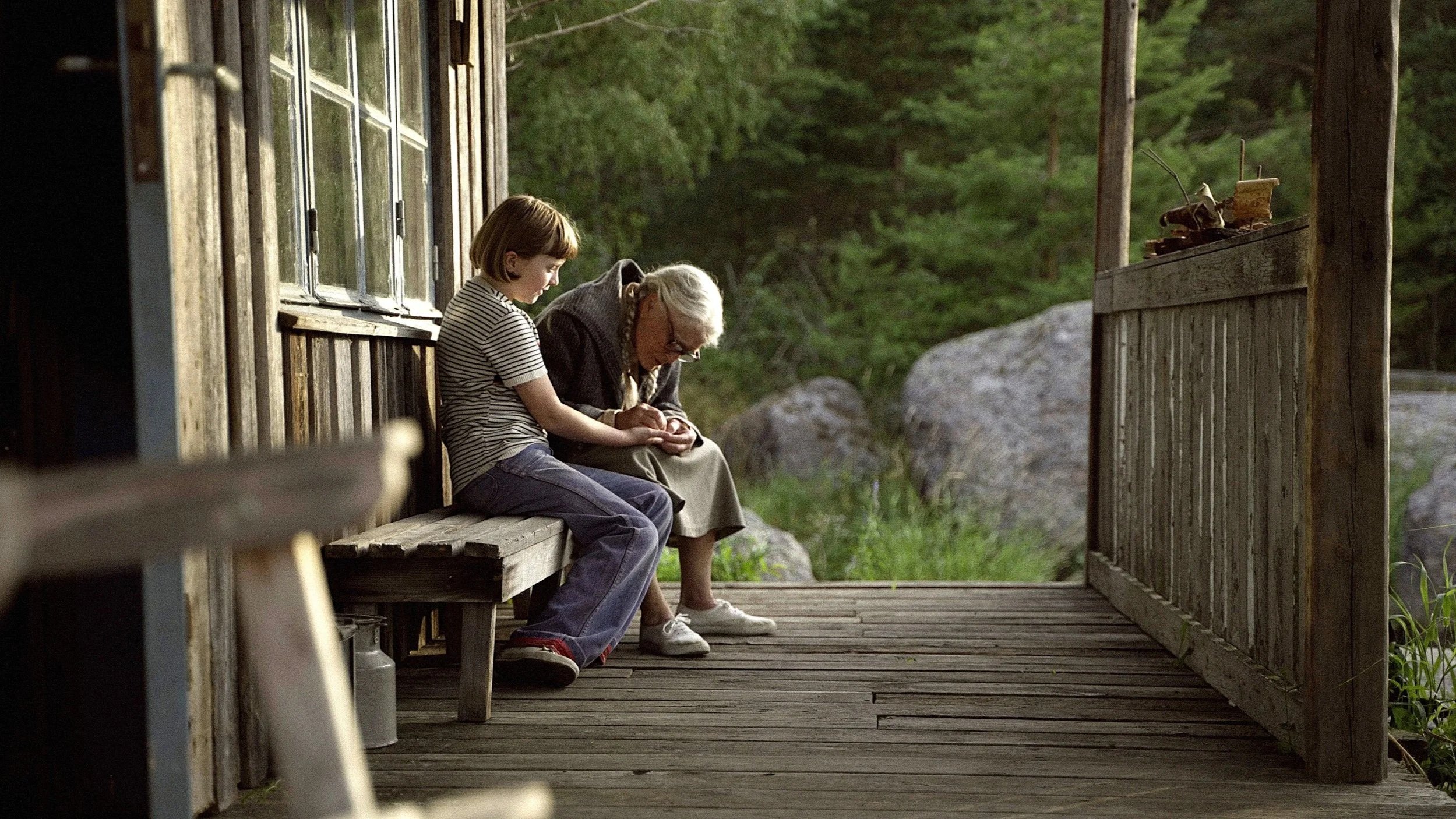
Emily Matthews and Glenn Close
Image courtesy of Conic.
by MANSEL STIMPSON
Not least for older cinemagoers this is a film which in prospect must seem very alluring. It is a work which is centred on the bond between a young girl and her aged grandmother and the setting in which this plays out is a small Finnish island which provides the film with an unusual and attractive location. Next, there is the fact that, although the child, Sophia, is played by Emily Matthews who was a total newcomer when shooting took place in 2023, the role of the grandmother is taken by an actress possessed of star quality, Glenn Close. She will probably be the main draw, but even without her the very title, The Summer Book, would cast its own appeal suggesting as it does a relaxing and lyrical work. As it happens, the film is one which retains the title of the book on which it is based and which was well received when it was published in 1972. The author, Tove Jansson, best known as the creator of the Moomins, here gave us a work of a very different kind. It was a semi-autobiographical novel in which the figure of the grandmother was based on her own mother and the child on her niece. That connection is in no way key to its appeal, but nevertheless those who admire Jansson’s other works may well be attracted to the film even if they have not read the book.
That said, it may seem surprising that I regard this film by Charlie McDowell as one which may well divide audience opinion. That likelihood is partly explained by Jansson's novel being constructed in an unusual way. Apparently, it offers a series of vignettes, each a short chapter or section in itself, which means that it eschews any conventional plot and lacks a narrative arc as such. It offers instead subtle insights into the perceptions of its two central characters. Consequently the book captures both the world of a young child (in the book Sophia is six) and that of an aged woman not far short of ninety and it was acclaimed for its evocative use of small details which conveyed all this through the use of finely crafted prose. That being the nature of the book, it was inevitably a huge challenge when it came to converting it into film terms that sought to be equally effective.
It is only right to stress here that both McDowell as director and Robert Jones as the author of the screenplay give the impression of seeking to be true to the spirit of the original. There is no attempt to create a strong story that will provide action and tension: the film is rightly at the opposite extreme from that. It is quite unhurried and content to simply portray the day-to-day existence of family members on a visit to the modest abode which they have long kept as a summer residence on what is otherwise an uninhabited island. They are now three in number since Sophia's father (Andreas Danielsen Lie) is there with his daughter and with his mother-in-law. Notably missing is Sophia's mother because she has recently died. Indeed, the one element in the piece that could be thought of as a plot thread develops from the way in which, despite deeply loving his daughter, the father has allowed grief and self-pity to take over his life. He has work to do as an illustrator of scientific magazines and largely shuts himself away to do it while choosing to rely on granny to look after Sophia. Not being able to truly understand why her father is distancing himself like this, she declares at one point "My father doesn't love me since she died". Granny seeks to give her reassurance, but it takes time and the drama of all three being caught up in a passing storm before the father manages to engage more fully with his young child.
The slow pacing of the film is the more marked because in many passages the amount of spoken dialogue is limited despite the focus being tied so closely to the three main characters (the only subsidiary figures are a local man who visits on occasion and a couple with a young son who have their own holiday house built on a grander scale on another small island nearby). In the case of the father, one finds that the screenplay holds back on developing this character very fully. Nevertheless, Anders Danielsen Lie is able to give an effective performance and one that is entirely in keeping with the film’s understated tone. While the child actress Emily Matthews is a convincing presence, the film absolutely belongs to Glenn Close. Playing a role older than her own age (the actress is in her seventies) she captures every nuance in the character of the caring and sometimes outspoken nonagenarian. Aware of being near the end of her own life, she is equally very conscious of Sophia being at an age when she needs guidance and support, this being a time when she is discovering the world around her and starting to become her own person. Close takes full advantage of the extent to which facial expressions convey so much that is felt but is not expressed in words.
I suspect that some viewers will simply find that in the absence of big dramatic events the film is too slow to suit their taste. Furthermore, when presented as a single work rather than as a series of related but distinct vignettes, The Summer Book never quite defines what it is trying to achieve. The film certainly captures the benefit of being in tune with the natural world and the photography by Sturia Brandth Grøvlen catches the changing character of the sea. Perhaps the film wants us to recognise the quiet but happy moments of life that can be taken for granted but which mean so much. However, that aspect hinted at by the title doesn't co-exist as meaningfully as it should with the downsides in life that are exposed here (in particular granny’s realisation that some memories are now lost to her and her awareness of impending death). Missing on screen is the deftness of touch which Jansson’s prose demonstrates if one reads her description of what has become the film's final scene but which here feels decidedly heavy-handed by comparison.
There is another issue too that could divide opinion. Although I am personally very ready to adapt to a slow film if it is handled with subtlety and depth of feeling, I was resistant in this case. That was largely because of the film’s use of music. Featuring old recordings which sometimes play over one scene and are then carried forward behind the next one is at odds with the realism of the piece. But even more striking is the significant overuse of a music score by Hania Rani. The fact that a number of passages play out with limited dialogue makes one all the more aware that music is being poured over so many scenes and that it prevents anything poetic or subtle being achieved. This particular reaction on my part is almost certainly a matter of taste. But, if that may well apply to other aspects of this film too, the performance by Glenn Close is certainly one that likely to win unanimous applause.
Cast: Glenn Close, Emily Matthews, Anders Danielsen Lie, Ingvar Sigurdsson, Pekka Strang, Sophia Heikkilä, Theo Zilliacus.
Dir Charlie McDowell, Pro Kath Mattock, Kevin Loader, Alex Orlovsky, Duncan Montgomery, Charlie McDowell, Aleksi Bardy, Helen Vinogradov and Glenn Close, Screenplay Robert Jones from the novel by Tove Jansson, Ph Sturia Brandth Grøvlen, Pro Des Linda Nordqvist, Ed Jussi Rautaniemi, Music Hania Rani, Costumes Tiina Kaukanen.
Free Range Films/Stille Productions/High Frequency Entertainment/Helsinki filmi/Case Study Films-Conic.
95 mins. USA/Finland/UK. 2024. US Rel: 19 September 2025. UK Rel: 7 August 2026. Cert. PG.
