
The Uninvited

A Hollywood party sets the scene for Nadia Conners’ well-acted but not always persuasive comedy-drama.
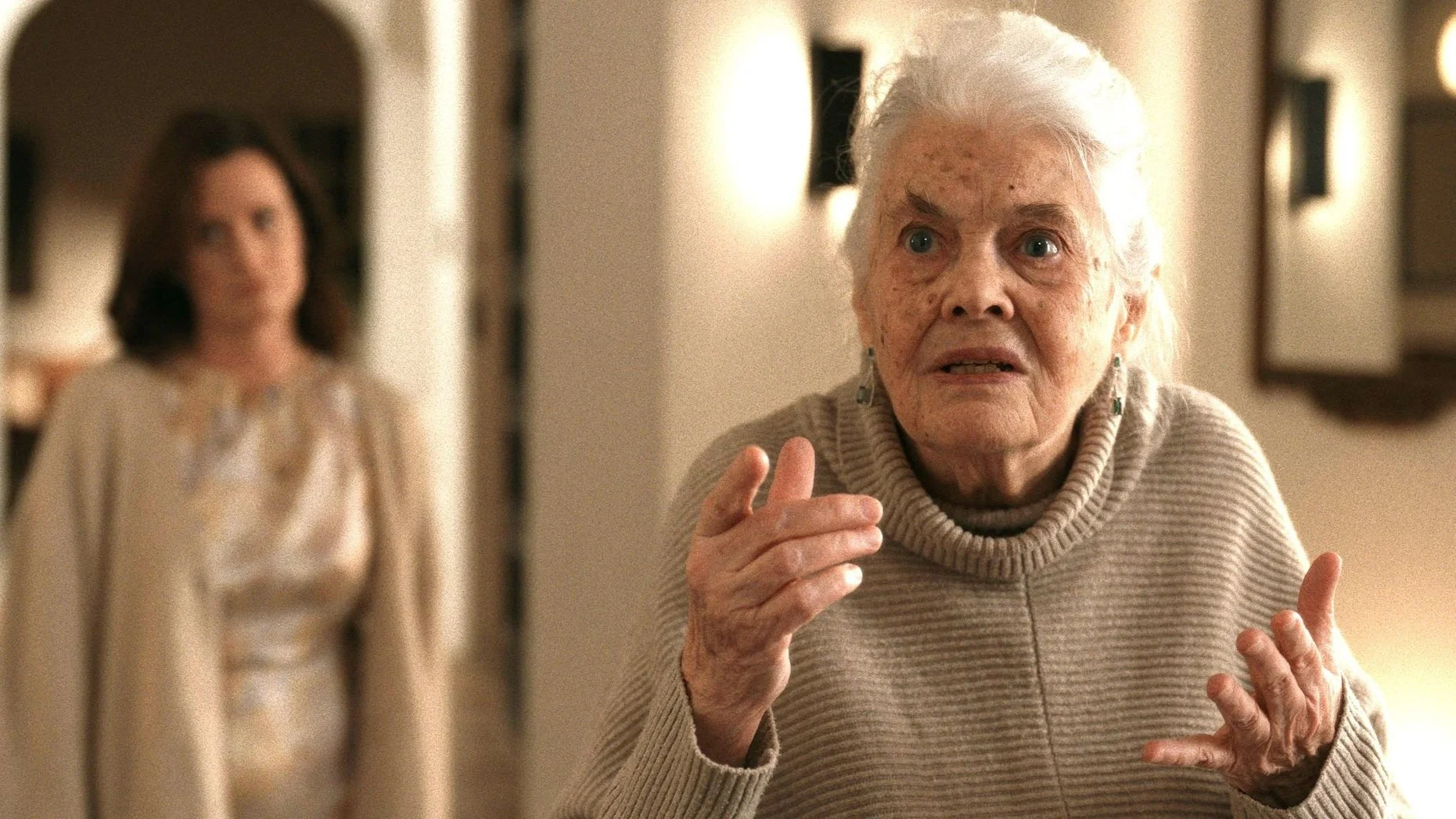
Lois Smith
Image courtesy of Foton Pictures.
The one great pleasure afforded by The Uninvited is the opportunity that it gives us to see that splendid actress Lois Smith, now aged ninety-four, in another leading role. It is also the case that she is in good company here. The Uninvited is a tale set in the Hollywood Hills and centred on a party being given by Rose Wright (Elizabeth Reaser) and her husband Sammy (Walton Goggins). They are the key characters along with Helen (that’s Smith’s role). She is a stranger who turns up unexpectedly and it is she who is doubtless referenced in the film’s title. As for the guests, Sammy who is an agent has specially invited two of his chief clients, one being Gerald, a film director played by Rufus Sewell, and the other a successful actor who has become a big movie star, Lucien (Pedro Pascal). Also turning up for the party is a young actress from Italy, Delia (Eva De Dominici), who we soon learn is about to play opposite Lucien in a film version of the play which originally had Rose, then doing well as an actress, in the role now to be taken by Delia. The film mainly takes place inside the Wright family home which also contains their six-year-old son Wilder (Roland Rubio) and his nanny (Kate Comer) but the party itself is taking place outside in the adjoining yard.
When faced with a title like The Uninvited one could readily expect a horror film and, not being a fan of that genre, I was pleased to learn that the writer/director Nadia Conners was offering us something very different. But in the event, I feel that this is a case of a highly talented cast being let down by a screenplay which works much less well than it should. This is in fact the first time that Conners, who doubtless wrote with Goggins in mind for the role of Sammy Wright (she is his wife), has delivered a screenplay for a cinema feature and it has been acknowledged that initially the piece was conceived as a work for the stage. That potential alternative form has led to Conners as director trying rather too hard at times to conceal it, but the writing itself all too often has the heightened tone that can play well on the stage but which sounds somewhat artificial on screen and makes the characters feel less than real.
It was in 2017 that Lois Smith was lucky enough to find her greatest screen role in Marjorie Prime, an offbeat independent movie that played out in a limited setting. In theory The Uninvited is similar in character however different its theme, but in the earlier film the writing was spot-on and everything fell beautifully into place. In contrast to that, Nadia Conners offers a concept less clearly focused and less adroitly handled. As a take on Hollywood her film is often satirical in tone as in its view of the party’s extravagance extending to the presence of a spirit photographer (Michael Panes) hired to capture the aura of all the guests and in showing the strategy on Sammy's part that underlies the party. Sammy is planning to break away from his firm and set up his own agency and sees this as an opportunity to talk Gerald and Lucien into signing up with him personally. To this end, he is ready to put aside the fact that in earlier times his wife Rose had been Lucien’s lover and that their involvement could start up again (it is obvious that Sammy’s marriage has become a very uneasy one and is possibly only continuing because Rose has a young son who needs her). As is often the way with dramas built around a gathering, in the course of it hidden secrets will emerge and to some extent we are meant to care about these people even though the satire extends to very unflattering portraits of both Gerald and Lucien. Yet another aspect in play is the opportunity that the film takes to make critical observations about Hollywood attitudes. For example, the point is made that Lucien is to replay his old stage role because a man can get away with that whereas Rose's former role is going to the ingenue Delia. Furthermore, Rose's career had dried up due to age prejudice as is epitomised by the fact that she, the mother of a six-year-old, has been told that she would be too old to be suitable for a role in which she would have a six-year-old child!
Although these various elements are all present, they don't readily fuse together and it is even rather uncertain what the chief focus of the piece is. One tends to feel that it should reside in Helen's impact. The title would support this and the writing at times suggests that she is more than she appears to be. Helen is introduced as somebody who once lived in the house owned by Rose and Sammy and who drives up under the delusion that she still lives there, her mental state being such that she believes that her late husband, another Sammy, is still alive. Rose takes her in regardless of the party going on and looks after her pending the arrival of a woman summoned to take her home. This takes so long to happen that in the meantime Helen talks not only to Rose but to the other main characters too. In Rose's case a rapport grows from echoes between Rose and Helen's earlier history (Helen too had once been an actress). Indeed, the effect that Helen has on the others is such that at one point the film hints at a possible comparison between her and the angel Clarence in Capra’s It’s a Wonderful Life (1946). For that matter Helen brings to mind the seemingly supernatural figure of the policeman in J.B. Priestley’s An Inspector Calls, but this aspect is never really crystallised and it works as well as it does only because Lois Smith inhabits the role so skilfully that she does not need to rely on the dialogue to bring the character fully to life.
Lois Smith is certainly triumphant and in the later stages Reaser (adept at expressing the various sides of Rose) and Eva de Dominici as Delia involve us too. Furthermore, Conners successfully moves the action around the various parts of the house and yard in a way that prevents the film from suggesting a work playing out on a single stage set. She is also successful in a late episode which in a non-theatrical way plays to a recording of ‘When It's Sleepy Time Down South’ by Louis Armstrong. But, on the other hand, it feels totally out of keeping when a story being told to the child, Wilder, is illustrated by intercut images of it on the screen. Like the three actresses, Walton Goggins has a chance late on to find an effective emotional side to his character, but it is too late for the role to seem a rewarding one. Too often the film fails to find a unified convincing tone and a clear focus, but I have to welcome it for enabling Lois Smith to show that as a nonagenarian she has lost none of her remarkable skills.
MANSEL STIMPSON
Cast: Elizabeth Reaser, Walton Goggins, Lois Smith, Eva De Dominici, Rufus Sewell, Pedro Pascal, Kate Comer, Roland Rubio, Annie Corzen, Michael Panes, Bobby Burkich, Emma West.
Dir Nadia Conners, Pro Rosie Fellner, Carlos Enrique Cusco and Ari Taboada, Screenplay Nadia Conners, Ph Robert Leitzell, Pro Des Chad Tatham, Ed Patrick Walsh and Todd Zelin, Music Eric Avery, Costumes Donna Lisa.
Foton Pictures/Rosebud Pictures-Foton Pictures.
98 mins. USA/UK. 2024. US Rel: 11 April 2025. UK Rel: 9 May 2025. UK VOD Rel: 11 June 2025. Cert. 15.
