
The Venus Effect

Anna Emma Haudal’s Danish coming-of-age romcom is an affectionate and appealing tale of lesbian love.
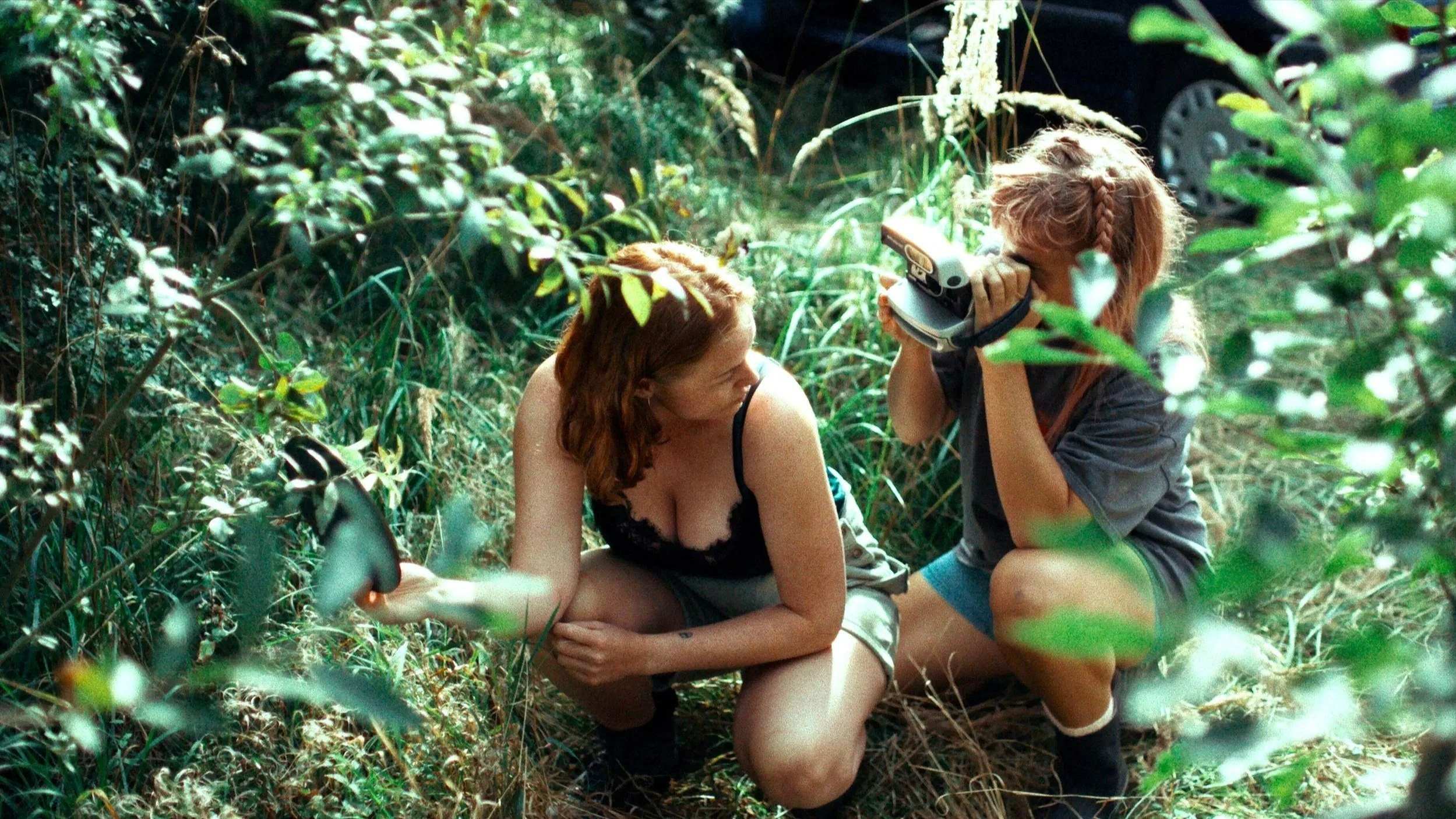
Image courtesy of NQV Media.
Each year BFI Flare, London's LGBTQIA+ film festival, seeks to offer a balanced programme but when it comes to actual distribution of films in the UK lesbian audiences are often short-changed. In the case of the Danish film The Venus Effect they have had a long wait since it was made in 2021 and is only now appearing on platforms here but they should certainly welcome it. And that’s so even if the first half is decidedly the better of the two.
The Venus Effect, directed by Anna Emma Haudal and written by her with Marie Limkilde, is very much a work which falls into two parts. The first of these possesses a rare sense of warmth and affection for the material and it tells the story of how Liv (Johanne Milland) who is in her early twenties comes to recognise her feelings for women. Initially we see her in a family context. Her father is Klaus (Lars Mikkelsen) who runs a farm, her mother is Gitte (Sofie Gråbøl) and she has a brother, Jonas (Morten Hee Andersen), who is gay and has a partner (Alvin Olid Bursøe), their relationship being one accepted by Klaus and Gitte. But Liv herself is involved with a boyfriend, Sebastian (Clint Ruben), and it is only a chance meeting with Andrea (Josephine Park), who is quite open about her sexuality, that results in Liv responding to such an extent that she breaks off her relationship with Sebastian. However, this element of self-discovery will only gradually lead to Liv coming out to her parents and her close family ties make her hesitate to go too far too soon. She and Andrea have become lovers but the more experienced Andrea, although living alone in a camper, has a lifestyle in which those closest to her are lesbian friends long at ease with their sexuality.
There is a strong sense of Haudal wanting to tell an appealing romantic tale despite the setbacks that may occur as the story develops. There is a brightness here which draws on the country setting and the film contains many references to plants which offer a simple yet heartfelt metaphor for the growth and development happening to Liv. In this role Johanne Milland is very well cast while Josephine Park’s Andrea is suitably contrasted and apt. This may be a drama but it is told with a comparatively light touch which comes across all the more because this is a portrait of Danish society in which gay and lesbian characters may provoke comment but nevertheless seem to be readily accepted by the community at large. From time-to-time Haudal chooses to add song snatches on the soundtrack and, while I always find this a device counter to the realism of whatever tale is being told, it is not out of keeping with the positive tone that Haudal is embracing.
This approach makes for a genuinely heart-warming film, but its second-half finds the piece faltering. For just under an hour Liv’s developing relationship with Andrea comes across as a tale ideal for Haudal’s purpose but by then it feels complete in itself. This means that in order to keep the story going difficulties and conflict have to be introduced and it is here that the screenplay becomes unconvincing. The parents who had been present as background figures suddenly play a greater role. Out of the blue Gitte tells her husband that she wants a divorce based solely on a realisation that she might want to do other things in her life. This is all too vague to make good sense and it seems even more contrived when Liv starts to blame herself. We are asked to believe that she has persuaded herself that her admission regarding her sexuality is responsible for Gitte's decision. She is telling herself that Gitte is seeing her life as empty because with the knowledge that neither of her children is heterosexual the likelihood of having a grandchild is reduced. This crisis is also a situation which results in Gitte wanting to sell the farm and it leads too to Klaus quickly accepting what is happening and taking up with another woman, Susanne (Anette Støvelbæk). Unfortunately none of this is very convincing and seems set up in order to create tensions which will threaten Liv’s relationship with Andrea even if we hope that they will be resolved.
If the plotting in the second half makes it harder to go along with The Venus Effect, the fact is that the success of its first hour and the appeal of its leading players encourages one to make allowances. It's also the case that Haudal delivers the right ending for this kind of film. However imperfect this piece when considered as a whole, its appeal when at its best is so strong that its target audience should be well pleased to have found it.
Original title: Venuseffekten.
MANSEL STIMPSON
Cast: Johanne Milland, Josephine Park, Sofie Gråbøl, Lars Mikkelsen, Morten Hee Andersen, Clint Ruben, Andrea Øst Birkkjær, Anette Støvelbæk, Alvin Olid Bursøe, Anne Sofie Wanstrup, Ulver Skuli Abildgard, Camille Lau, Amanda Radeljak.
Dir Anna Emma Haudal, Pro Rikke Sasja Lassen and Lise Orheim Stender, Screenplay Anna Emma Haudal with Marie Limkilde, Ph Valdemar Cold Winge Leisner, Pro Des Sabine Hviid and Helle Lygum Justesen, Ed Sofie Marie Kristensen, Music Jenny Rosander, Costumes Sascha Valbjørn.
Motor-NQV Media.
105 mins. Denmark. 2021. UK Rel: 2 June 2025. No Cert.
