
The Weight

Padraic McKinley’s action-drama set during the Great Depression reveals the excellent Ethan Hawke in a whole new light.
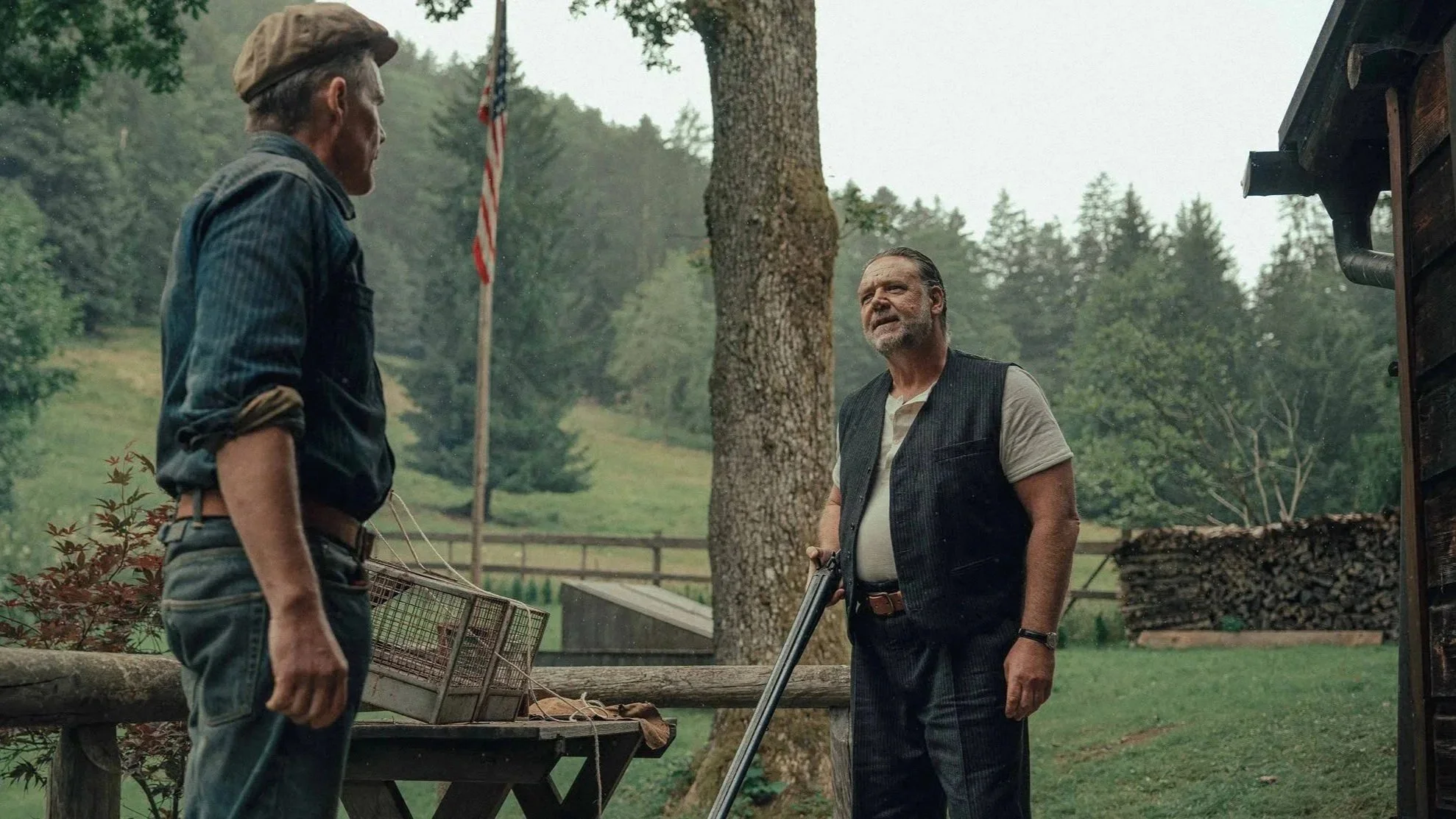
Ethan Hawke and Russell Crowe
Image courtesy of MetFilm Distribution.
by MANSEL STIMPSON
The Weight comes as something of a surprise since one would not expect its leading actor Ethan Hawke to be starring in an action-adventure tale and that is what this movie proves to be. It is indeed a competent example of the genre with impressive performances and confident work by the well-established editor Padraic McKinley directing a cinema film for the first time. However, the piece does possess an unusual feature due to the fact that its character takes some time to emerge. A fairly substantial opening section which plays ahead of the title coming up suggests a very different kind of picture altogether. We are told that we are in Oregon in 1933 some four years into the Great Depression. Hawke appears as Samuel Murphy, a widower struggling to get by, a man who, having been given notice to vacate his apartment, runs into trouble with the police, is convicted and finds himself in a labour camp. The worst part of all this is that it separates him from his young daughter, Penny (Avy Berry), to whom he is devoted and it seems likely that he will not be released in time to re-establish their relationship and thus prevent her from being placed with adoptive parents.
The Weight proves to be a work which reminds one of several classic movies and, given its period setting and the emphasis on the father/daughter relationship, this opening puts one in mind of 1973’s Paper Moon. But, while Samuel’s desperate need not to lose Penny is his key motivation throughout the story, the film quickly changes its character. It is halfway into that when it comes to the scenes of harsh life in the labour camp where Samuel finds himself under the savage eye of its warder, J. J. Clancy (Russell Crowe). Having recognised that the quiet and thoughtful Murphy is both intelligent and tough, he picks him to lead a mission to transport gold from a mine before it is removed by government order. The venture is obviously dangerous as well as illegal but Murphy agrees to take it on. It’s not really done for any share of the gold but because, if Clancy’s scheme succeeds, he promises that he will release Murphy and that should be in time for him to reunite with his daughter.
It is when this plan is put into operation that the basic nature of The Weight becomes fully clear. Getting to and from the mine in question involves travelling through treacherous territory and this becomes central to the film bringing to mind the life-threatening drive undertaken in Clouzot’s 1953 classic The Wages of Fear. In this instance the danger is not only the hazards of the route but the lure of gold itself. Murphy has with him three fellow prisoners (Austin Amelio, Avi Nash and Lucas Lynggaard Tønessen) together with Clancy’s tough representative (George Burgess) chosen to watch over them. But can Murphy be sure that all of these companions will resist the urge to seize the gold at the expense of the others? And what of the possibility that a stranger who encounters them (Cameron Brady) will be sufficiently aware of the gold that they are carrying to make it likely that he will return with others ready to seize it by force? The theme of gold driving men to extremes echoes John Huston’s The Treasure of the Sierra Madre (1948) while the film’s river scenes and its portrayal of violence met on a journey have prompted some to reference John Boorman's Deliverance (1972).
This film has an original screenplay by Matthew Booi and Shelby Gaines and it is written in a way which quickly gives life to the numerous characters. While various aspects of the tale bring older movies to mind, a more modern feature of it which works well is the introduction of a strong native woman, Anna. Having been spotted by the group and being a runaway herself, she joins up with them and in the process proves to be a valuable addition to the team. Julia Jones makes a strong impression in this role. Another feature of the film is the inclusion of certain conversations en route, especially those featuring the Indian American Singh who has socialist beliefs (that’s Avi Nash’s role). These scenes are relatively brief but ensure that this tale of the 1930s has things to say about wealth and exploitation that can be considered relevant now. Such elements are distinctive enough for one to view Ethan Hawke’s turn as Murphy as not being wholly akin to Liam Neeson's unexpected late emergence as a tough guy in action thrillers. Indeed, one suspects that this will be a one-off for Hawke albeit that, despite the all-round quality of the acting, it is his presence and what he conveys in a role in which words are relatively limited that hold the film together (incidentally regardless of Russell Crowe getting high billing his role, which finds him on fine form, is really a supporting one).
The director, Padraic McKinley, can be well satisfied with what he has pulled off and The Weight should give pleasure to its audiences. At the same time it needs to be acknowledged that, although the story blends its various elements well, it lacks the unnerving impact of The Wages of Fear which made that film so memorable. Indeed, the same point emerges if one compares it with another recent drama in which the characters undertake a dangerous journey. Oliver Laxe’s Sarāt (2025) had one on the edge of one’s seat in a way that made it unforgettable. We are not in that territory here, but perhaps McKinley was not seeking quite that degree of tension. In any case The Weight can be regarded as successful on its own terms and for the many admirers of Ethan Hawke this film along with last year's Blue Moon provides welcome evidence that, fine as this actor has always been, he can be even more versatile in his roles than one had supposed.
Cast: Ethan Hawke, Russell Crowe, Julia Jones, Austin Amelio, Avi Nash, Lacad Lynggaard Tønessen, George Burgess, Alec Newman, Sam Hazeldine, Avy Berry, Dylan Page, Peter Lewys Preston.
Dir Padraic McKinley, Pro Simon Fields, Nathan Fields, Ryan Hawke, Jonas Katzenstein and Maximilian Leo, Screenplay Matthew Booi and Shelby Gaines from a story by Matthew Booi, Leo Scherman and Matthew Chapman, Ph Matteo Cocco, Pro Des Cora Pratz, Ed Padraic McKinley and Matthew Woolley, Music Lathan Gaines and Shelby Gaines, Costumes Esther Walz, Sound Thomas Neumann.
Fields Entertainment/Under The Influence/Augenschein Filmproduktion/Construction Film-MetFilm Distribution.
113 mins. Germany/Canada/USA. 2026. US Rel: 18 September 2026. UK Rel: 2 October 2026. Cert. 15.
