
The Montenegrin winner of this year’s Grand Jury Prize at Sundance blends documentary with true art.
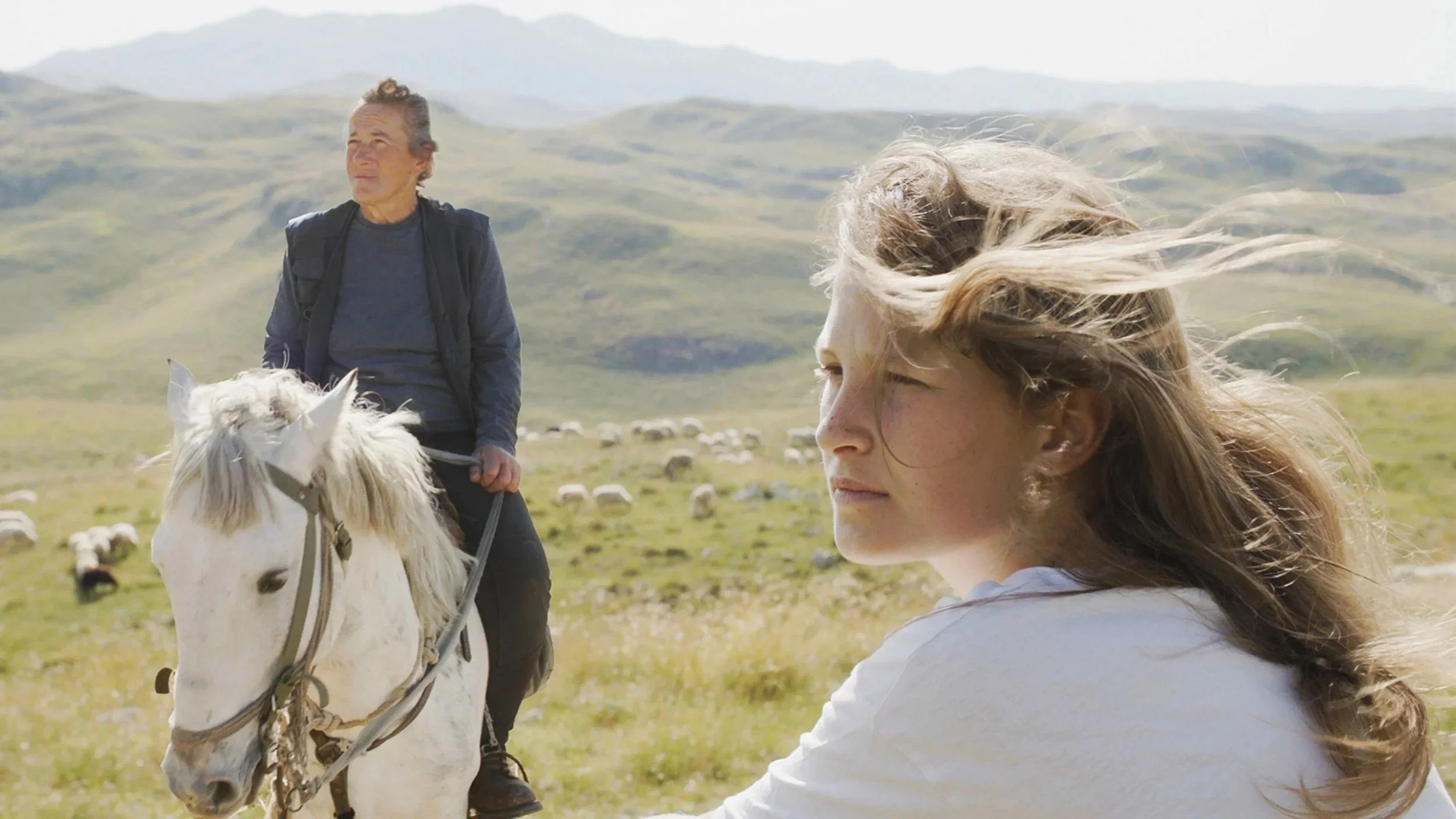
Image courtesy of Metfilm.
by MANSEL STIMPSON
This is the documentary that won the Grand Jury Prize at Sundance this year and, while their names may not be familiar to us, this work shot in the highlands of Montenegro offers clear evidence that its directors, Biljana Tutorov and Petar Glomazić, and its photographer, Eva Kraljević, are indeed true artists. The work which they have made together is a study of a spirited woman named Mileva Gara Jovanović who is very much a daughter of the region and is an established farmer and animal herder. Gara – as she is known – is one of the most engaging characters in recent documentaries and her bond with 13-year-old Nada Stanišić, a girl who likes to call Gara her mother, only adds to the film’s appeal.
Even if these qualities have yielded a work that falls short of being a masterpiece, its memorable aspects are undoubtedly potent enough to make To Hold a Mountain a rewarding watch. It is a film of unusually mixed elements and to my mind it doesn't quite come together as a whole but, as against that, films shot in Montenegro are rarely on offer and this one offers not just pretty views of the location but images which in both their composition and their atmospheric sense capture the character of this rural area and its people. Fitting in with this is Draško Adžić’s music score with its pleasing emphasis on cellos. Furthermore, on occasion Gara sings to herself in a way that adds to the local colour.
Indeed, at the start I was ready to regard To Hold a Mountain as an example of documentary cinema which, eschewing any commentary, hones in on the daily routines of rural life. That is an accurate description of much of it but, far from that proving to be a limitation, to see it done with the artistry present here makes for a satisfying experience. The landscape itself - the main setting is the Sinjajevina plateau - is deeply impressive and the film’s portrayal of the farm life undertaken by Gara with Nada assisting is observed in well edited scenes (George Cragg won an award for it). Here we witness the regular routines of herding, milking and making cheese. The now elderly Gara is a wonderful presence, a great face, and young Nada displays the freshness of youth in a way that comes across as natural and unforced.
The film’s two central figures with their intense feelings for the place and for each other soon ensure that the viewer feels strongly involved with them and the personal bond even extends to being expressed in a kind of running gag: Gara repeatedly encourages Nada to say out loud that she loves her mum and the child responds by regularly declaring that if she is asked to say it yet again she will leave. The depth of the love between the two is absolutely apparent. So too is the fondness they display for all the animals around from the cows known by name to pet cats. But, effective and affecting as all of this is, one is expecting more dramatic developments to arise and thus to ensure that To Hold a Mountain has the ability to sustain its running time of 105 minutes.
In this connection, I do wonder if the film’s publicity has been well judged. It makes a point of stressing the fact that Gara will be a rallying figure in encouraging protests necessary to defend the character of the region (the film’s very title is linked to that notion). We learn that this is an area in which certain families have worked the land for generations and are ready to take a stand on learning that the Montenegrin government is planning to turn what is theoretically UNESCO protected land into a NATO military training area which would disrupt the way of life there and distress the animals. Relatively early on we see Gara choosing to speak out at a rally against this proposal. Being aware from the publicity that this issue would come up, I had expected to find the second half of the film building up this conflict, but in the event this element despite being touched at moments never becomes the big dramatic feature that one expects it to be.
In the event To Hold a Mountain relies rather more on another turn that it takes. This concerns family events, some way back in the past and others comparatively recent. There is dramatic point to this certainly, but the way in which the film handles it often leaves something to be desired. The more distant events are the ones that emerge straightforwardly and they come up when Gara considers her own early life and that of her parents. They had divorced when her father, quite unreasonably in her opinion, had suspected her mother of having had an affair and had decided to break up the marriage. It illustrates the position of women living in a male world lacking any say in matters and it leads to Gara declaring that a mother should be strong like a lioness (a belief that she has clearly practised herself).
The more recent drama turns on events that occurred some twelve years earlier and which carry the same kind of lesson. In this instance what occurred is gradually revealed during the course of the film, but with hints arising early on (Gara’s house contains a picture of someone who could be a dead daughter of hers). The writing of To Hold a Mountain plays around with this aspect with lots of rather confusing namedropping and a lack of easily grasped details and, while the gist of it becomes clear, this treatment of it prevents the film from achieving the full emotional impact that it deserves.
Ultimately I felt that the three threads – the daily life, the past personal injustices and the political protests – failed to merge and build as well as they should have done. But, if that prevents this film from achieving its full potential, it cannot dim the impact made by Gara and Nada themselves, nor does it undermine the degree of artistry on display especially in visual terms. As it is, the film’s emotional heart is most fully apparent in a sequence in which Gara and Nada journey out to find a cow whose calf has been trampled but may be capable of rescue. Their behaviour and their emotions speak eloquently here even if at times To Hold a Mountain proves less adroit than had seemed likely.
Original title: Planina.
Featuring Mileva Gara Jovanović, Nada Stanišić.
Dir Biljana Tutorov and Petar Glomazić, Pro Biljana Tutorov, Petar Glomazić, Quentin Laurent and Rok Biček, Screenplay Biljana Tutorov and Petar Glomazić, Ph Eva Kraljević, Ed George Cragg, Music Draško Adžić.
Wake Up Films/Les Films de l’Oeil Sauvage/Ardor Films/Cvinger Film-Metfilm.
105 mins. Montenegro/Serbia/Croatia/France/Slovenia. 2026. UK Rel: 27 November 2026. Cert. 12A.