
Two to One

Oscar nominee Sandra Hüller returns to comedy in a German period piece reminiscent of the Ealing Studio heyday.
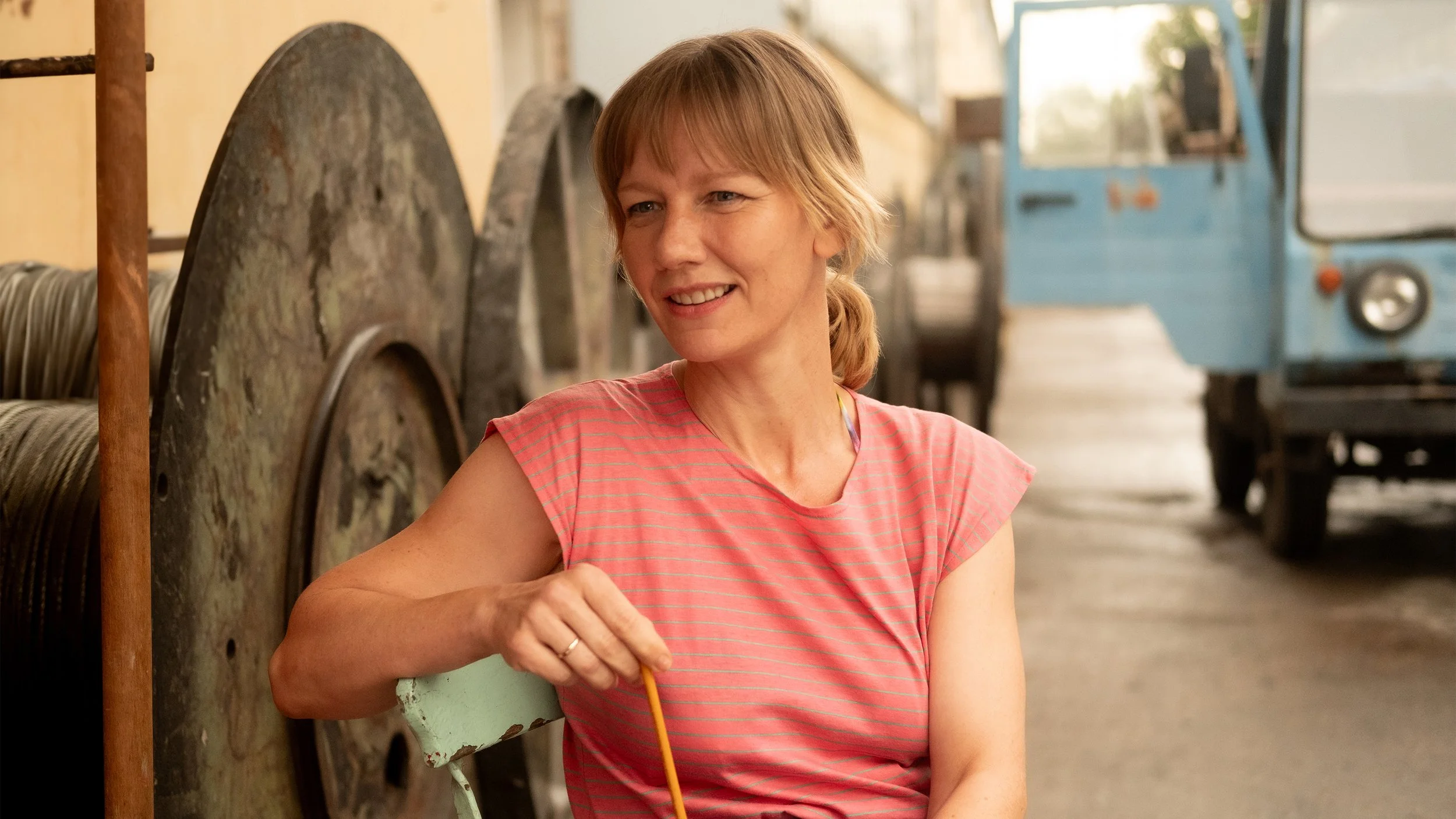
Sandra Hüller
Image courtesy of Tull Stories.
From time to time a new screen comedy appears and leads to some critic describing it as being in the Ealing tradition. More often than not the claim is misguided if not downright bizarre, but in the case of Two to One it is true – a fact all the more remarkable because Two to One (Zwei zu eins) is a film from Germany. It is the work of Natja Brunckhorst best known internationally for her acting role when in 1981, then a teenager herself, she played the title role in a provocative drama about a young heroin addict entitled Christiane F. made by Uli Edel. In Germany she is well known for her later acting roles in films and on TV as well as for her work as a writer. It was in 2021 following an earlier short that she made her first feature as director working from a screenplay that she co-wrote. But now with Two to One she goes the whole hog since this is a comedy on which she carries the sole credit for both the writing and the direction. It has proved a notable success at the German box office and is now gaining international distribution.
It might have seemed unlikely that the film would travel well because it is rooted in a situation that arose in the summer of 1990 as part of German reunification after the fall of the Berlin wall. East Germans had a new currency imposed on them in the form of Deutschmarks and had just a short time to hand in what remained of their old Ostmarks which were about to become worthless (the film's title is a reference to the poor rate of exchange involved in this arrangement). Loosely based on a true story, Brunckhurst sets her film in the town of Halberstadt and centres it on three characters. One is Maren (Sandra Hüller), the second is her husband Robert (Max Riemelt) and the third is Robert's former rival for her affections, Volker (Ronald Zehrfeld), who has just returned to Halberstadt (some years earlier he had suddenly decided to go off and work abroad). Maren and Robert have an adolescent son, Jannick (Anselm Haderer) and there’s also a daughter aged ten, Dini (Lottie Shirin Keiling), who could well have been fathered by Volker. However, this situation simply provides a setting against which the main plot plays out. Robert has an uncle, Markowski (Peter Kurth), who works in an underground military bunker in the area and curiosity as to what may be hidden there leads Robert to pressure him into being let in. What he discovers is that it contains stacks and stacks of the old money that is now considered worthless. But, having helped themselves for fun, Robert and the family suddenly realise that there are still three days left during which the old money remains operational. This means that they have an opportunity to share the old notes with their neighbours with the idea that all of them can go on a purchasing spree after which they will be able to sell what they have acquired to West Berliners payment for which will be made in the new money.
All of this may sound light years away from being Ealingesque yet what it brings to mind is the earliest of the famed Ealing comedies, 1949’s Passport to Pimlico. That comedy also reflected a real-life state of affairs in the sense that it was based on a community’s rebellion against post-war austerity. Buried ancient documentation is unearthed proving that the area of Pimlico is not only not part of London but not part of England either because it belongs to Burgundy. Taking advantage of this, the citizens seize their entitlement as Burundians to challenge the red tape of the English authorities and to run things their way (an early step is to abolish food rationing). The rebellion led by Maren, Robert and Volker is in much the same spirit and an apt comic tone is immediately set by the music score composed by Hannah Von Hübbenet and Amaury Laurent Bernier. Furthermore, although we know Sandra Hüller and Ronald Zehrfeld for their fine dramatic performances, they, ably sported by Max Riemelt and Peter Kurth, seem to relish this change of tone and add to the mood of the piece in just the right way.
If in many ways Two to One is more engaging than one might anticipate, one advance fear proves all to justified. This kind of light comedy always gains from being relatively compact and the fact that this film runs for almost two hours stands out as a warning. Admittedly the second half is able to widen the story’s satirical element when what is going on is discovered and it becomes necessary to bribe the authorities and bring high officials on board by letting them too take advantage of the situation. If one continues to have Ealing in mind the material moves closer to The Man in the White Suit (1951), a very different beast from the much more light-hearted Passport to Pimlico. But Brunckhorst’s screenplay fails to find any apt variant in the comic tone and everything becomes less sure-footed adding to our sense that the piece has become over-extended. There is, for example, a second bid to extract more notes from the bunker but this time around it is played less for comedy than for drama (there is even an uneasy moment of violence). But where a touch of seriousness might have been justified it is lacking: the romantic triangle looks set to be a strong sub-plot but, instead and despite the running length, it never becomes really meaningful in any way at all. Elsewhere a few songs on the soundtrack don't quite fit the style of the piece and, while the film ends up appropriately striking the right note back in Halberstadt, it only does so after a brief scene in the Baltic in which a large toy bear is allowed to play an unexpected but significant part. There is quite a lot to enjoy in Two to One, but most of it is in the first half.
Original title: Zwei zu eins.
MANSEL STIMPSON
Cast: Sandra Hüller, Max Riemelt, Ronald Zehrfeld, Ursula Werner, Peter Kurth, Lotte Shivin Keiling, Anselm Haderer, Uwe Preuss, Yorck Dippe, Hilmar Eichhorn, Martin Brambach, Kathrin Wehlisch.
Dir Natja Brunckhorst, Pro Susanne Mann, Karsten Stöter, Paul Zischler and Martin Rehbock, Screenplay Natja Brunckhorst, Ph Martin Langer, Pro Des Jenny Roesler and Florian Kaposi, Ed Ramin Sabeti, Music Hannah Von Hübbenet and Amaury Laurent Bernier, Costumes Anne-Gret Oehme.
Zischlermann Filmproduktion/The Playmaker Munich/Row Pictures/ ZDF/Arte/Lichtblick Film-Tull Stories.
115 mins. Germany. 2024. UK Rel: 2 May 2025. Cert. 12A.
