Winter of the Crow

Lesley Manville appears in fresh territory in a Polish drama set in 1981, but without the screenplay she deserves.
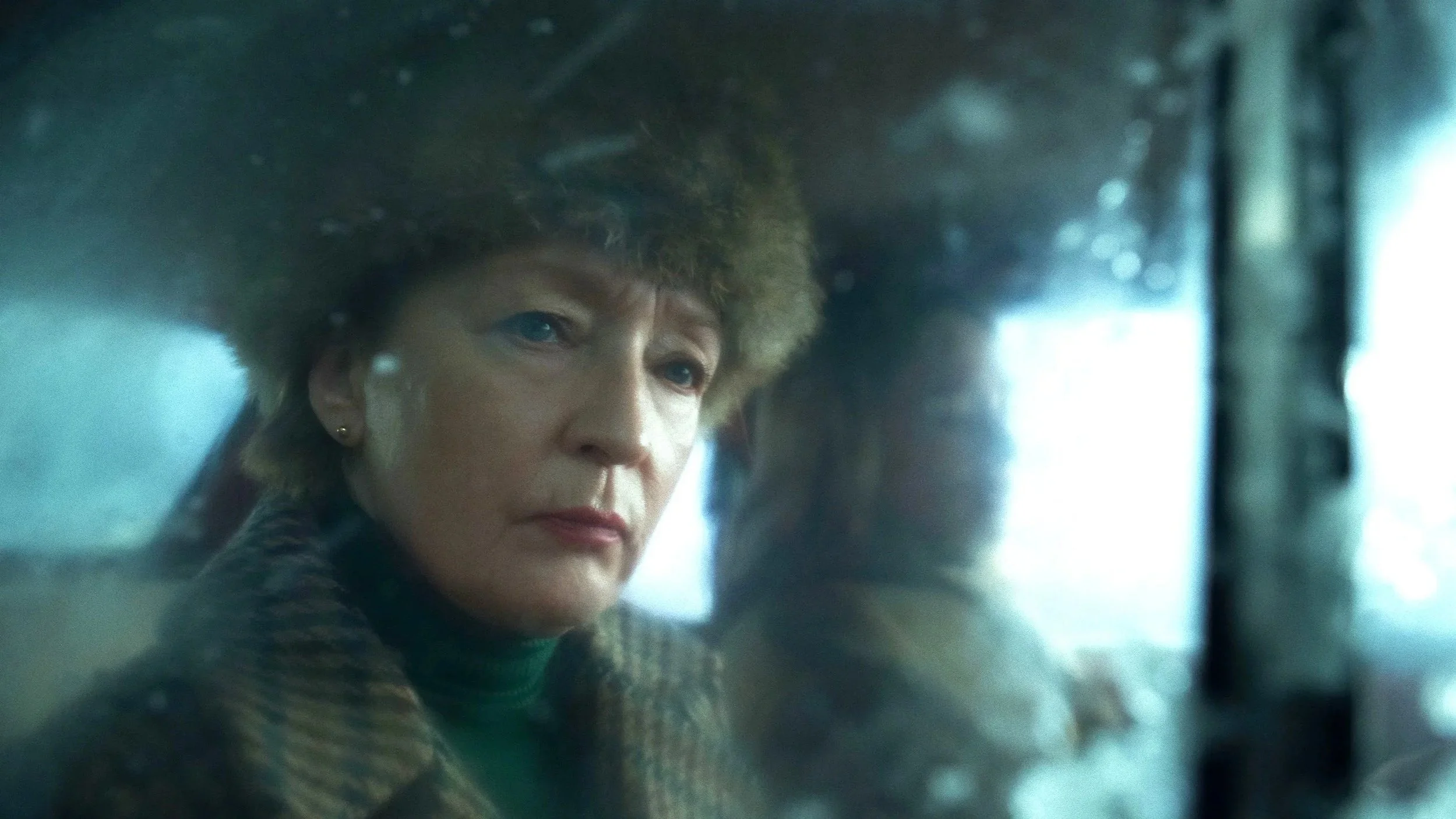
Lesley Manville
Image courtesy of Signature Entertainment.
by MANSEL STIMPSON
What I first heard about Winter of the Crow left me with mixed feelings. The story that it tells is set in Poland in December 1981 and concerns a visit to Warsaw where a British professor of psychology, Joan Andrews, has been invited to give an address about her researches to students at the city’s university. Joan cannot speak the Polish language but the other figures in the story mainly belong to that country. Consequently, an indication that most of the dialogue is in English made me fear that this co-production could be one of those works which can be dismissed as a Europudding. But, on the other hand, I noted that the role of Joan Andrews was being taken by Lesley Manville and her presence is in itself a promise of quality. That possibility was further supported by my finding a few advanced reviews on the internet which spoke highly of the film. But, having thus been encouraged ahead of my viewing of Winter of the Crow, I was in the event surprised to feel that the film was undeserving of the praise bestowed on it even though, predictably enough, Manville's performance is once again quality work.
It appears that the origin of this piece is a short story by Olga Tokarczuk entitled Professor Andrews in Warsaw although the adaptation is a relatively free one and includes making the professor female whereas in the original the character was male. Having introduced us to Professor Andrews in London, the film quickly finds her arriving in Warsaw and being met at the airport by a student named Alina (Zofia Wichłacz) who has been deputed to look after her. Being a stranger in a foreign country without being able to speak the language, Joan needs Alina's help. That’s so even though she is somebody who has always made her own way in life, a woman who takes no nonsense and could be regarded as something of a tough cookie. When she realises on arrival that her luggage has gone missing her reaction is caustic. But in the event she now finds herself out of her depth: it's largely a matter of timing since there is real unrest in Poland as becomes apparent when her address is interrupted by student protesters supportive of Solidarity, the trade union and social movement opposing authoritarian Communist rule. Initially Joan simply expects her speech to be rescheduled for the following day but it is the 13th of December 1981 and General Jaruzelski announces the imposition of martial law. That involves tanks in the streets, the sealing of national borders and the arrest of activists with the Military Council of National Salvation wielding the power.
Given that the filmmaker here, Kasia Adamik is herself Polish (indeed she is the daughter of the distinguished director Agnieszka Holland who is herself one of this film’s executive producers) and that Olga Tokarczuk is Polish too, one might suppose that making these events part of Professor Andrews’s story would mean that Winter of the Crow would play as a significant evocation of this history in the tradition of the late Andrzej Wajda. Indeed, the grey, chilly atmosphere conjured up in the photography of Tomasz Naumiuk and the production design by Aleksandra Kierzkowska feeds into that possibility. But what we get instead is a relatively small-scale work. The film plays as a thriller in which Joan gets caught up in what is happening, witnesses a killing of which she has actual photographic evidence and is consequently pursued by the authorities as she desperately tries to find a way to board a plane which will take her home.
In point of fact some of the approving reviews which I had read before seeing the film concentrated on the unusual fact of Lesley Manville having a role in which she had action scenes which brought her close to being a female version of John Wick. Consequently, I was indeed ready to view Winter of the Crow as a thriller entertainment rather than something more significant. But, instead of finding that it worked well on that level, I felt that the screenplay (which is by a team of three, namely the director, Lucinda Coxon and Sandra Buchta) let it down. Its strongest point lies in the adroit way in which it convincingly handles the language issue. It plays out in a context where some Poles would be able to speak English, features scenes in which others struggle to understand what Joan is saying and just now and again has them speaking Polish with subtitles added because their words need to be understood by the viewer. But in other respects, judgment goes awry - and that’s so even though the storyline ably introduces us to such additional characters as Alina's brother Marek (Jakub Guszkowski), her partner Jan (Miron Jagniewski) and others who, like Alina herself, are members of Solidarity. Even the brief opening segment in London which establishes Joan as somebody absorbed in her work but not adept in relationships is unclear in that it introduces a character who may be a student but could be her own daughter or an assistant. Once in Poland with Joan trying to find her way in a city in chaos, she seems to chance on people in unlikely ways while her penchant for taking Polaroid photographs although key to the plot feels contrived in these circumstances.
Other elements too fail to mesh. At times Adamik opts to include dream sequences including one in which Joan finds herself in a concrete labyrinth and there is stylisation of another kind when it comes to the crows that feature. In an echo of the title these birds often appear over the city and, since the Military Council of National Salvation was known as WRON and wrona is apparently the Polish word for crows, their presence becomes self-consciously symbolical (and you can be sure that, however distraught she may be, Joan stops to take a Polaroid of them!). The film is more successful when showing how the peril that she shares with Alina opens up Joan so that for once she creates a personal bond (the able performance by Zofia Wichłacz is an aid here). But, by the time it comes to a race to get away on a plane before the authorities can prevent it, one is aware that we have reached a standard fictional climax that is far too familiar. All of which is disappointing because throughout the film Lesley Manville has been playing her lead role with all the care and subtlety that one would expect. That being so, she emerges with credit. But nevertheless, I felt there was a losing battle against the contrivances and confusion which made it difficult to give yourself over to this piece.
Cast: Lesley Manville, Zofia Wichłacz, Tom Burke, Miron Jagniewski, Andrzej Konopka, Sascha Ley, Jakub Guszkowski, Rhianne Barreto, Melissa Dalton, Magdalena Smalara, Janina Rachon, Danuta Piszek.
Dir Kasia Adamik, Pro Olga Chajdas, Stanisław Dziedzic, Katarzyna Ozga, Nicolas Steil and Samantha Taylor, Screenplay Kasia Adamik, Lucinda Coxon and Sandra Buchta, from the short story Professor Andrews in Warsaw by Olga Tokarczuk, Ph Tomasz Naumiuk, Pro Des Aleksandra Kierzkowska, Ed Andonis Trattos, Music Emre Sevindik, Costumes Virginia Ferreira and Krzysztof Loszewski.
Wild Mouse Productions/Film Produkcja/Iris Productions-Signature Entertainment.
112 mins. Poland/UK/Luxembourg. 2025. US Rel: 9 October 2026. UK Rel: 16 October 2026. Cert. 15.