
Zodiac Killer Project

The English documentarian and multimedia artist Charlie Shackleton visits the San Francisco Bay Area to make a film about the eponymous serial killer, albeit not the one he intended.
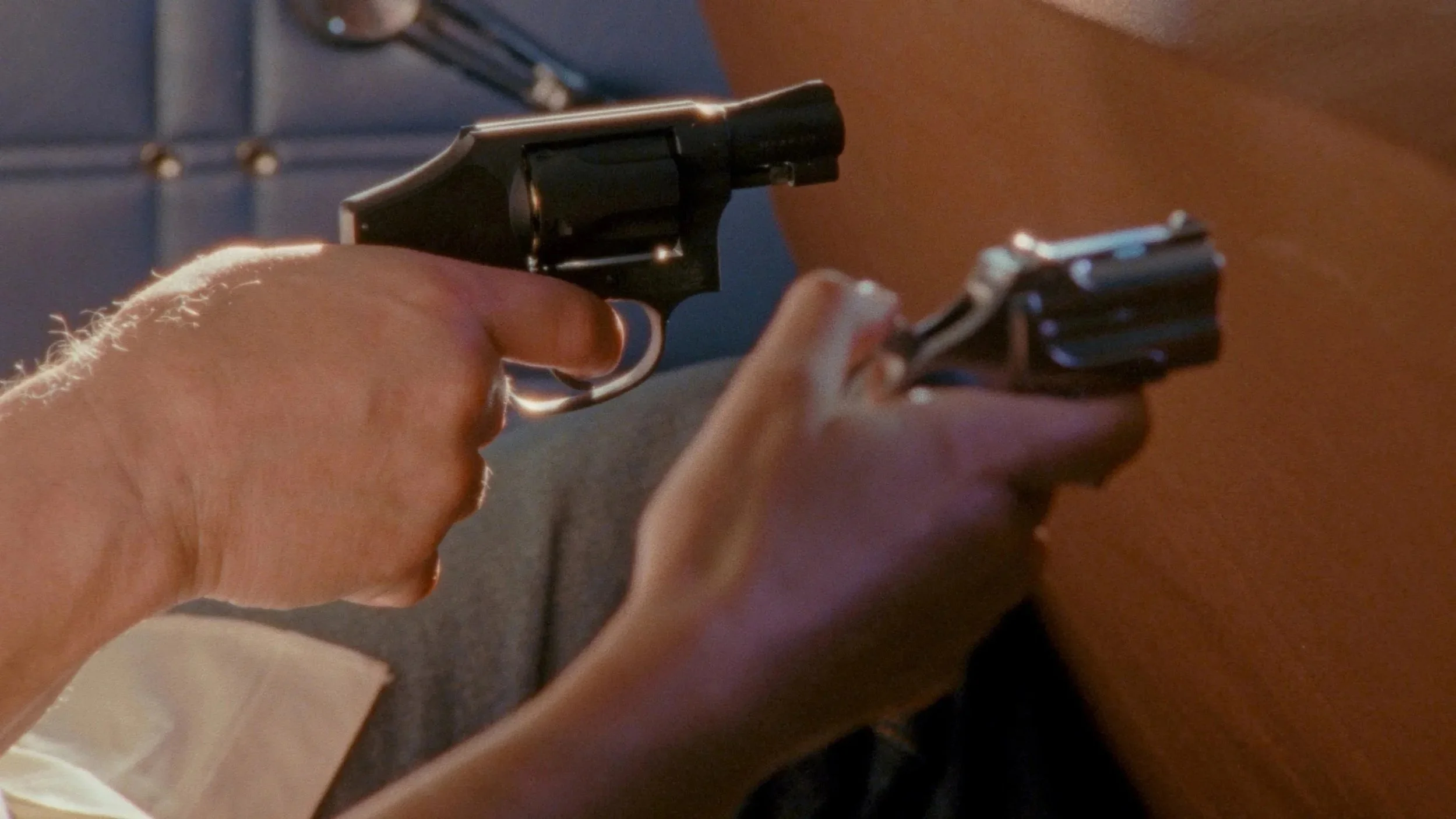
Image courtesy of Loop Projects.
In 2002 Terry Gilliam made the documentary Lost in La Mancha, an account of his ill-fated attempt to make a film about Don Quixote with Jean Rochefort in that role. It had been abandoned after the actor was unable to continue after six days of shooting and it was not until many years later that Gilliam did film a reworked version, The Man Who Killed Don Quixote. In part, Charlie Shackleton's Zodiac Killer Project carries an echo of that being a documentary drawing on his failure to make an enacted drama centred on efforts to identify the man who, known as the Zodiac Killer, committed a series of murders in the San Francisco Bay Area in the late 1960s. They were of course the crimes that became the basis of David Fincher's 2007 film Zodiac in which Jake Gyllenhaal played Robert Graysmith who worked on the case and subsequently wrote books about it. But it was not until 2012 that Lindon E. Lafferty, a former cop who had subsequently entered into his own personal and obsessive pursuit of the killer, published a fresh account under the title of The Zodiac Killer Cover-up. It was on this book that Shackleton intended to base his proposed film and that meant that, whereas Graysmith regarded the one officially named suspect, Arthur Leigh Allen, as the likely culprit, Shackleton would follow Lafferty in suggesting that someone else was probably guilty, this man being given the pseudonym of George Russell Tucker.
However, Lafferty himself died shortly after publication of his book and, while it appeared that his family were ready to give the rights to filming it to Shackleton, they suddenly changed their minds. No filming had taken place – not even six days of it – but this meant that Shackleton was left with a screenplay based on the book that could not now be enacted. In Gilliam's case making Lost in La Mancha when it had seemed unlikely that he would ever shoot the film he had planned was a means of ensuring that all the work he had done on it would not entirely go to waste. Similarly, Shackleton refused to simply abandon what he had written and, being to some extent an experimental film maker, he came up with the novel notion of describing what he would have shown us had his intended feature gone ahead but to do so without actors filling out the roles (only documentary-style reconstructions without dialogue are included). That is to say that in Zodiac Killer Project Shackleton would be heard (and eventually be seen as well) describing scene by scene in chronological order what would have been shown had that been possible. Each location would be seen on 16mm. footage shot by Xenia Patricia but it would be Shackleton's words which gave us a storyline to follow in addition to spoken quotes from Lafferty’s book within the limits allowed by law. In addition to this he would also give his film another layer by incorporating a critical commentary on films based on real-life crimes.
All this is a fascinatingly original approach although in truth it does yield a film that is trying to do two rather disparate things at once. On one level we do find that the central thread here is the story as originally conceived, but Zodiac Killer Project is also a clever dissertation about documentaries dealing with actual killings. Shackleton is concerned with the way in which they can mislead or be exploitative and is also very critical of the clichés which abound in films of this type. This last element is reflected not only in his personal comments but by the inclusion of brief extracts from actual films in this genre. In addition he offers examples of particular images and effects which recur again and again in such works and he had me laughing out loud at some of these (certain readers aware of how I am often critical of the way in which reconstructed scenes in documentaries are set up will not be surprised at how readily I relished the put-downs to be found here).
At times this critical analysis by Shackleton for all its entertainment value does mean that the story of Lafferty’s investigation is somewhat put on hold. However, there are other times when there is a kind of interplay between the two elements and it is this which yields a late sequence which is the most effective in the film. At the outset despite the absence of actors there is an emphasis on authenticity. It is here that we have Shackleton describing how Lafferty’s belief that Tucker could well be the Zodiac Killer arose when he spotted him in a parked car and it is stressed that the location shots that we are viewing are of that exact place. Somewhat later it is explained that what is portrayed as being Tucker's house is not the real one, but a substitute chosen as being more atmospheric. Consequently, Zodiac Killer Project is here falsifying the material in a way not uncommon save for the fact that in this instance the cheating is acknowledged and discussed.
With tricks like this revealed and explored, you might well think that Shackleton was undermining the effectiveness of such devices, another of which is the use of dramatic music used to enhance re-enactments. Yet that scene towards the end of Zodiac Killer Project which has the most power is in fact a night scene in a car involving both Lafferty and Tucker and their wives too and it is one in which a sense of potential violence is built up by exactly that method. Not only that but Shackleton is simultaneously telling us in voice-over that as the director here he is pushing the tension as far as it will go. He is clearly fully aware that he is utilising the tricks of the trade that he has been exposing and in so doing is proving that paradoxically they still work even when acknowledged for what they are.
There is no doubt that Zodiac Killer Project is an intriguing novelty although I feel that its innovations don't cohere in a way that renders it in any sense a weighty work. Quite possibly it is even a matter of taste as to whether or not one considers it worth the price of admission to a cinema now that the cost is so high. Nevertheless, it is quite different from anything else you are likely to have seen and, having set out to make a film about the Zodiac Killer, Charlie Shackleton has indeed given us just that even if one far removed from the treatment that he first intended. It is even possible that this is a more entertaining movie than the presumably far more conventional one that he had in mind originally.
MANSEL STIMPSON
Featuring Charlie Shackleton, Guy Robbins and Lee Nicholas Harris.
Dir Charlie Shackleton, Pro Catherine Bray, Anthony Ing and Charlie Shackleton, Ph Xenia Patricia, Ed Charlie Shackleton, Music Jeremy Warmsley.
Loop/Field of Vision-Loop Projects.
92 mins. UK/USA. 2025. US Rel: 21 November 2025. UK Rel: 28 November 2025. Cert. 15.