
Apache │ Eureka Entertainment
Courtesy of Eureka Entertainment
by JAMES CAMERON-WILSON
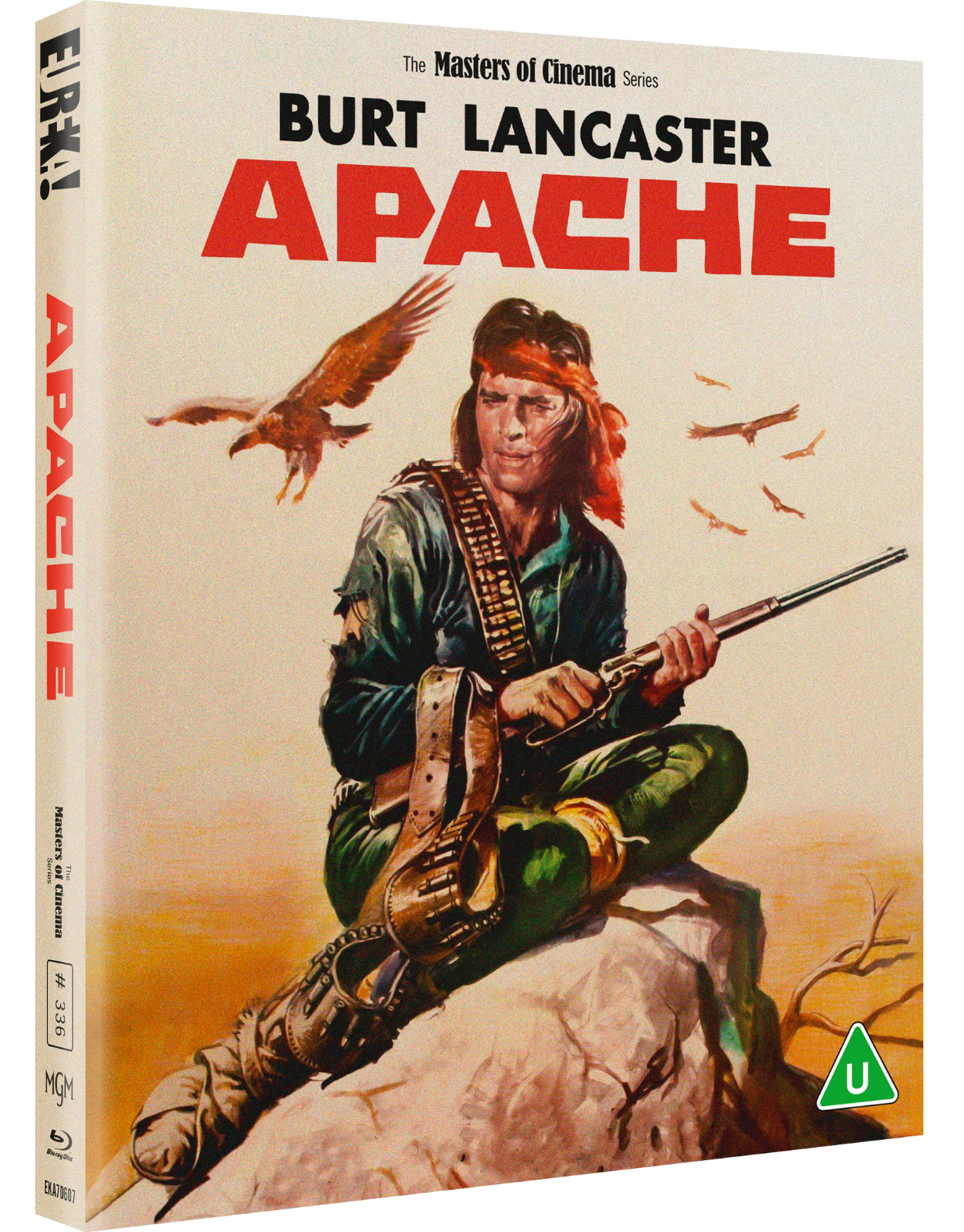
Robert Aldrich’s Apache is a 1954 Western released on Blu-ray for the first time in the UK as part of The Masters of Cinema series from Eureka Entertainment. Considering the film’s vintage, it was perhaps a step in the right direction.
Like fellow Hollywood stars Charlton Heston, Rock Hudson and Robert Taylor, Burt Lancaster was a white actor playing a Native American, albeit with the bluest eyes this side of Paul Newman in Hombre. What is more, the romantic interest, a fellow Apache played by Jean Peters, also has surprisingly blue eyes (as contact lenses weren’t as user-friendly then as they are today in film). The romantic interest is surprising, in that the director Robert Aldrich largely stuck to same-gender casts in his films, be it the testosterone-oozing stars of The Dirty Dozen, The Flight of the Phoenix and The Choirboys, or the female-laden Hush...Hush, Sweet Charlotte, The Killing of Sister George and What Ever Happened to Baby Jane?
I once asked Aldrich about this and he answered bluntly that it had never occurred to him before. Be that as it may, he is pretty much known as a man’s man’s director, working with everybody from Gary Cooper and Kirk Douglas to Burt Reynolds and Harrison Ford. He also made six Westerns in his career, of which Apache was the first, being the story of a ‘redskin Rambo’ with Burt Lancaster in varying hues of greasepaint, along with those piercing blue eyes. Looking back now, it is easy to mock Apache, for its rather sloppy and improbable fight scenes and misogyny, but that is not to detract from its interest as a microcosm of attitudes at the time. It’s considered to be one of the first of the ‘pro-Indian Westerns’, along with Delmer Daves’ Broken Arrow and John Ford’s Cheyenne Autumn, in that its protagonist is Native American, albeit a destructive, vengeful warrior called Massai.
I have to admit that I thought Massai was an odd name for an Indian warrior, only to discover after some research that the character was based on a real Apache warrior, the last of Geronimo’s tribe, who really did escape captive while Geronimo and others were shipped across American to a Florida reservation. Nowadays, the film would open with the caption, ‘Inspired by a True Story,’ but nowhere on the Blu-ray is this apparent, not even in the informative to-camera essays delivered by Austin Fisher and the always encyclopaedic and engaging Sheldon Hall.
If Apache, the movie, was intended as a pro-Native American picture, I found it hard to empathise with Massai for two reasons. He is depicted here as an inflexible savage whose modus operandi is to hunt and to kill, and within whom vengeance runs like the blood in his veins, and who threatens his own kind. The other thing I found hard to swallow was his attitude to women and a line like, “Squaws are for men,” you would never hear in a movie today. There is one scene in which he ties up Nalinle – the Apache woman played by Jean Peters – between a tree and a river, with her head just one foot away from the water, when we know that she is dehydrated and is desperate for a sip. This is not just bondage, but a brutal form of cruelty, while he also beats her with a stick, throws her around like a sack of potatoes and discards her moccasins so that her bare feet are cut on the sharp rocks on which she walks. He really is a beast. Yet Nalinle sees something in him, even though she knows that he intends to kill her.
Many of the supporting Native American characters are bestowed with an uncharacteristic degree of dignity for the time, including Charles Bronson as an Indian scout, which was sort of a turning point. It was to be many years until Hollywood gave Native Americans their full due, so it is important to look back and learn from our mistakes, when even a film considered pro-Indian was in fact this patronising to the peoples of America so exploited by the country that was once their own. To end on a positive note, there is a wonderful scene when, after he has escaped from that Florida-bound train, Massai wanders through the streets of St Louis, awestruck by this multi-cultural metropolis: a piano that plays by itself, a Chinese laundry, the outlandishly impractical women’s fashions of the time, and a shoeshine dwarf – a world completely at odds with his own.
Eureka Entertainment’s release of ‘Apache’ is now available on Blu-ray
EUREKA ENTERTAINMENT is the leading independent distributor of classic silent/early films in the UK. In 2004, Eureka! established the award winning Masters of Cinema Series, a specially curated director-led Blu-ray and DVD collection of classic and world cinema using the finest available materials for home viewing. In 2014, Eureka! established Eureka! Classics intended to highlight a broader selection of classic and cult cinema, and in 2017, Eureka! established Montage Pictures, a label celebrating ground-breaking and thought-provoking world cinema from new and upcoming directors.