
Even as a Shadow, Even as a Dream : ‘Hamnet’ Photographer Agata Grzybowska
by CHAD KENNERK
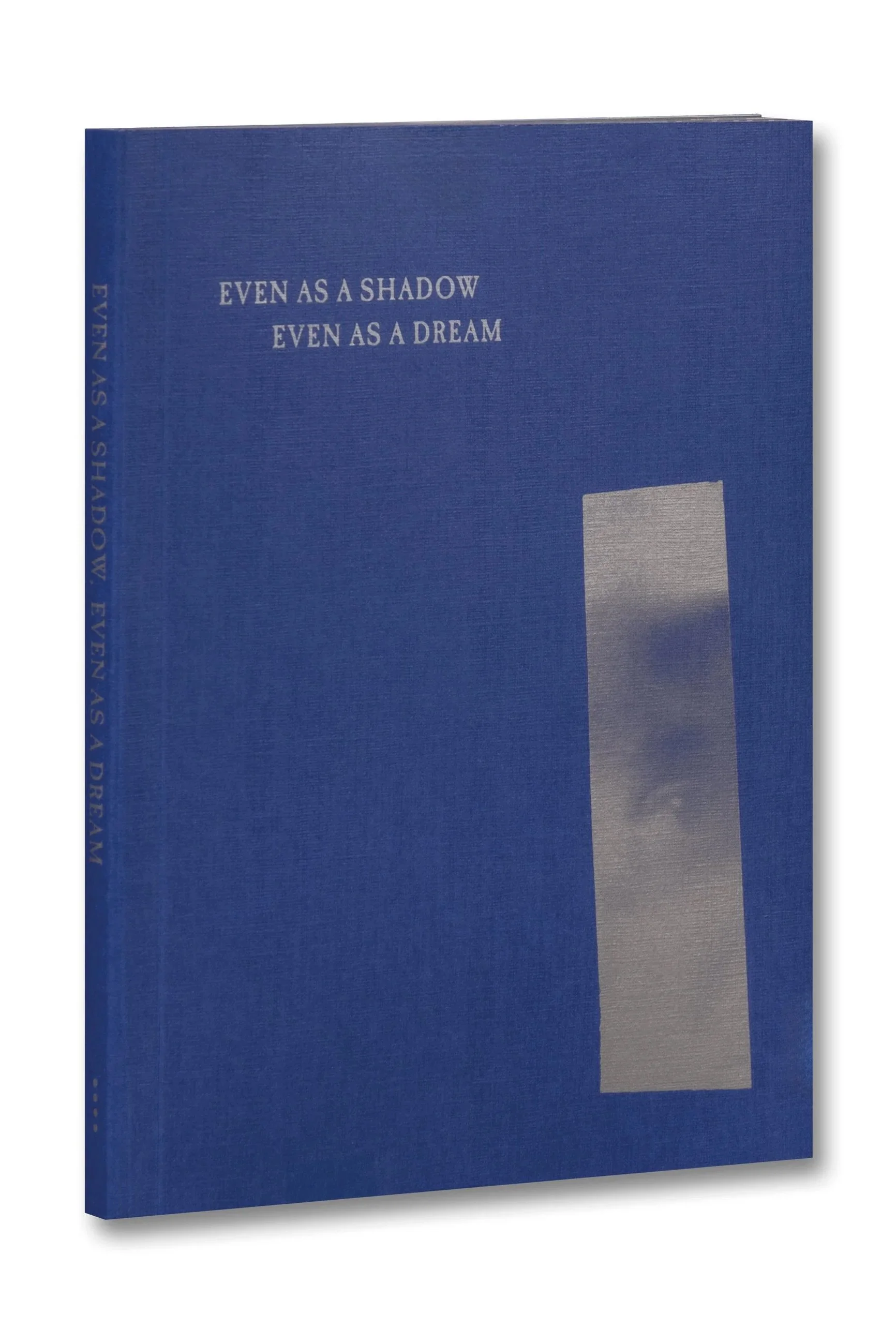
The transcendent alchemy of Chloé Zhao’s Hamnet now fills the pages of a distinctive new companion volume. Long before the cameras stopped rolling, Zhao, Jessie Buckley, and on-set photographer Agata Grzybowska began shaping a parallel work born from the same artistic dreamscape as the film itself.
A prominent Polish visual artist and documentary photographer, Agata Grzybowska is an award-winning photojournalist known for telling powerful stories through intimate portraits of the human experience. Recently they have collaborated with directors such as Jonathan Glazer on The Zone of Interest, Jesse Eisenberg on A Real Pain, and now, Chloé Zhao.
Published by MACK books, Even as a Shadow, Even as a Dream is a haunting complement rooted in the trio’s filmmaking journey. Drawing on Zhao’s intuitive creative process, Buckley’s intimate writings, and Grzybowska’s evocative on-set photography, the book offers a lyrical reimagining of the world behind and through the camera. Like Hamnet, adapted by Zhao and Maggie O'Farrell from O’Farrell’s book, Even as a Shadow, Even as a Dream serves as a meditation on love, loss, and the healing power of creation.
In conversation with photographer and author Agata Grzybowska
Film Review (FR): When you arrived on the set of Hamnet, how did you locate yourself within the creative ecosystem, and what did it mean to be invited into that space with such openness — especially under Chloé Zhao’s ethos of “You can do whatever you want”?
Agata Grzybowska (AG): When I arrived on the set, I didn’t immediately notice the creative ecosystem — I think that developed over time. When people work together for such a long period, they naturally become closer, and that closeness gradually becomes visible. Chloé is such a distinct visual filmmaker, and each day I got to understand more about her approach, creative process, her rhythm and the way she sees the world. It was truly extraordinary and special.
I work in a very specific way. I am an introverted person, usually quiet at the beginning, so I might seem a bit withdrawn or distant. I needed to be focused to feel the atmosphere, to observe and to understand the evolving energy around me. On the first day we met, Chloé told me, “You can do whatever you want.” I was genuinely grateful for that trust — it allowed me to listen to myself and follow my instinct. Over time I became someone quietly moving within the pulse of the film set, witnessing and contributing in equal measure.
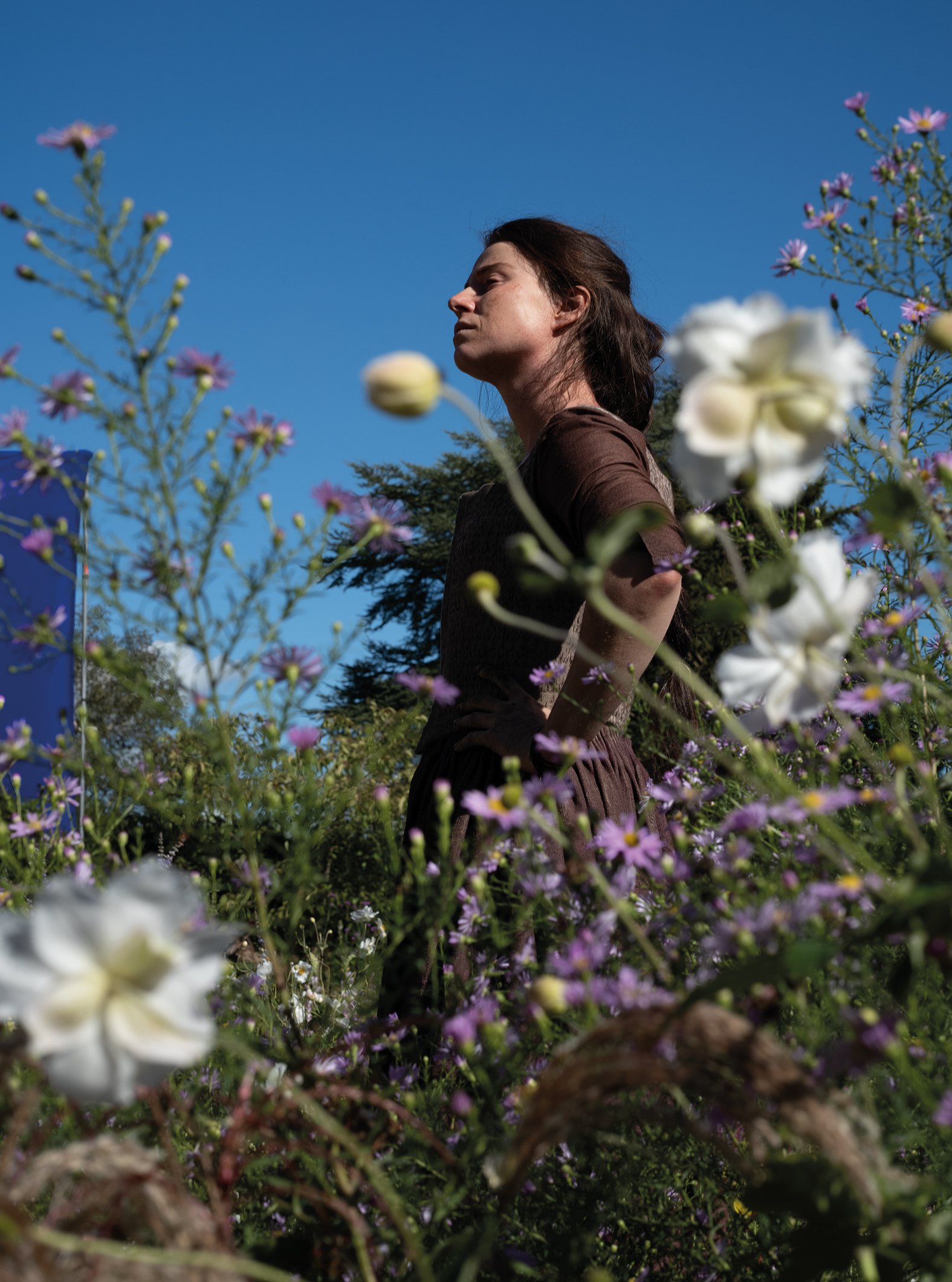
Agata Grzybowska, from Even as a Shadow, Even as a Dream (MACK, 2025). © Focus Features LLC. Courtesy of the artist, Focus Features LLC, and MACK.
(FR): Your images often photograph what isn’t immediately visible but capture emotion and atmosphere. How do you approach capturing the ephemeral?
(AG): I think being a documentary photographer means being present — an observer, a witness to history happening right before your eyes. It’s about patience, being careful and sensitive to small details and to the stories of others. Today, attention is so easily scattered — across phones, notifications and endless screens. But when someone opens their life to you, even for a moment, it becomes a sacred responsibility: to listen, to see deeply, and to carry their story forward with care.
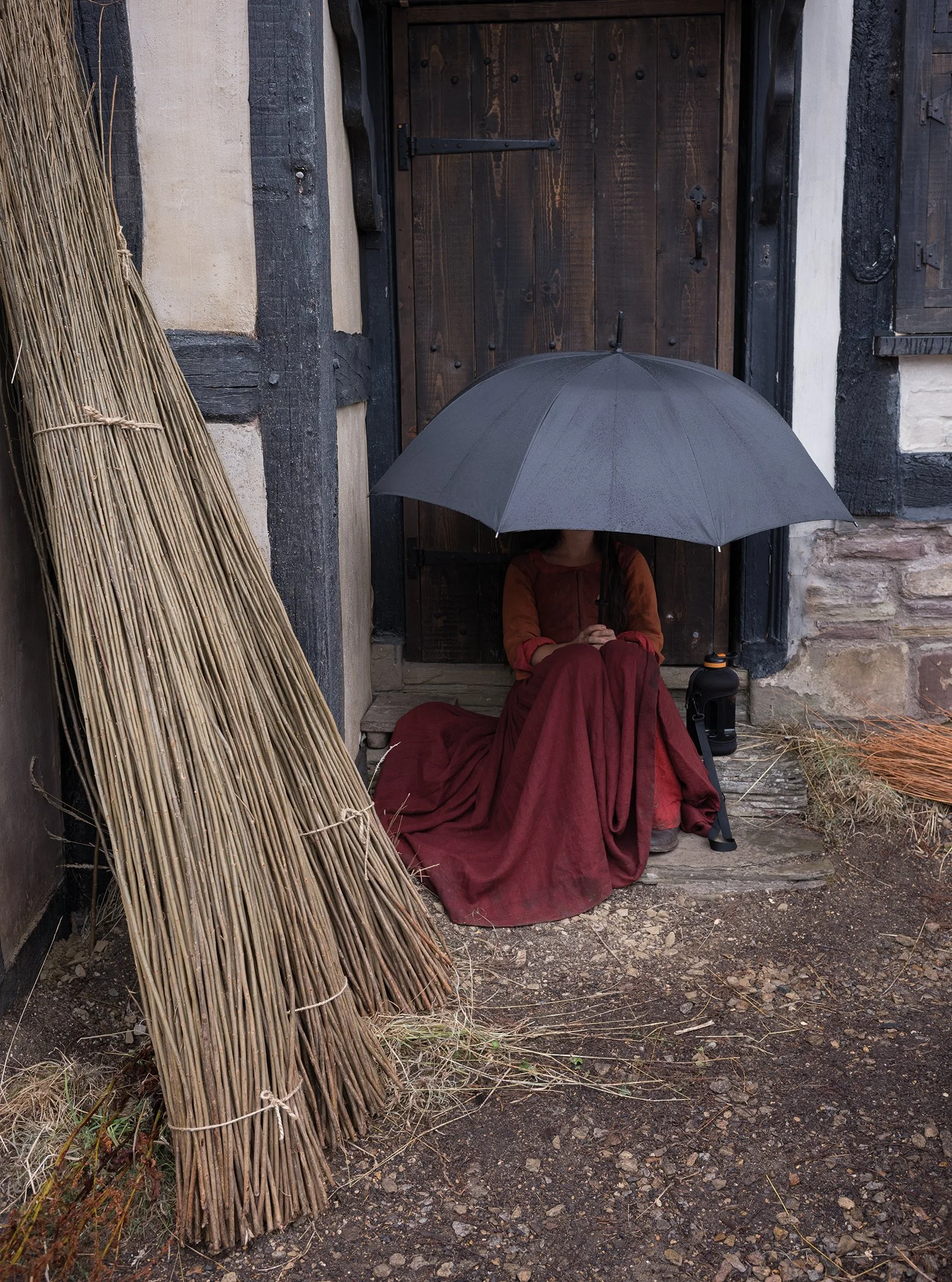
Agata Grzybowska, from Even as a Shadow, Even as a Dream (MACK, 2025). © Focus Features LLC. Courtesy of the artist, Focus Features LLC, and MACK.
Capturing the ephemeral is not about pressing the shutter at every moment. It’s about holding still, breathing with the scene, and allowing the subtle emotions and the quiet atmospheres to emerge on their own. Only then does the image speak not just of what is visible, but of what is felt.
(FR): Did you ever feel the camera risked breaking the spell of what was unfolding on set? If so, how did you negotiate being an observer while also being a present collaborator?
(AG): If I ever felt that the camera risked breaking the spell of what was unfolding on set, I simply did not take the picture. I believe you cannot — and should not — dare to do it. There are moments that are too fragile, too alive, to be interrupted by the act of photographing. Sometimes taking a photograph is not worth it. Sometimes it is more important to stay, to be present, to witness what is happening without trying to fix it into an image. Presence, in those moments, becomes a form of collaboration.
I never saw myself as a detached observer on set. Being close, attentive, and responsive was part of the work. Very often, the most incredible and beautiful things emerged precisely from that sensitivity — in the fragile space between reality and fiction, where trust is built and the spell is allowed to continue rather than be captured too early.
(FR): The book isn’t a conventional making-of document but something more meditative. How did you and curator Łukasz Rusznica find the visual language of the book and decide what to include?
(AG): It was a long process. I gave Łukasz a hard drive with a selection of raw photographs. He looked at them repeatedly and then invited me to Wrocław, [Poland]. We spent several sessions together, going through the images again and again. During this time, we were searching for connections between the photographs. While working with Łukasz, I opened up a new way of thinking — how an additional layer can be built, how a story and narrative can emerge differently.
While working on the film set, alongside digital photography, I also shot around seventy rolls of film. I wanted to include test prints, damaged silver prints, and various darkroom experiments with developers and fixers — things that might usually be considered waste or leftovers. For me, these are important notes of my working process.
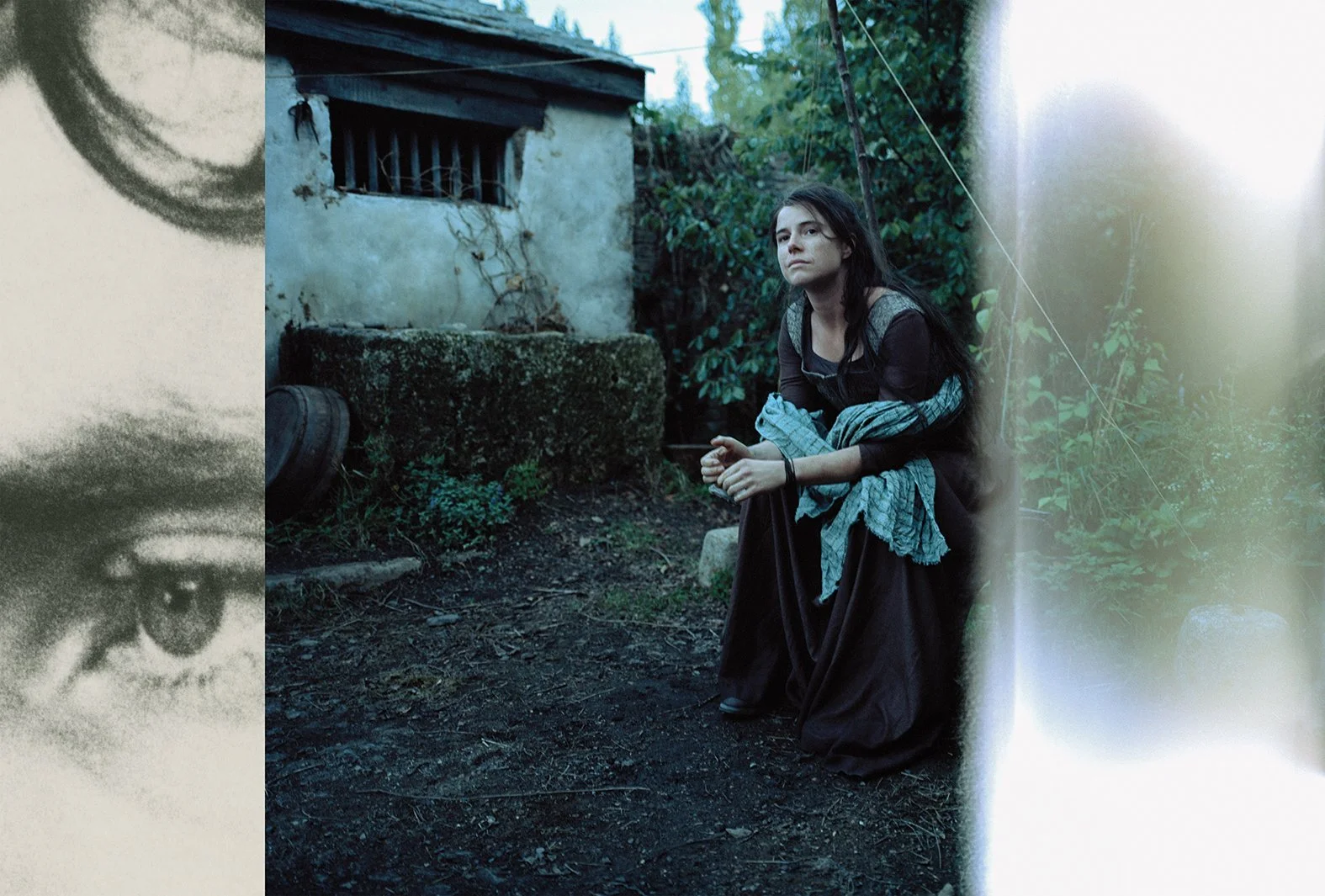
Agata Grzybowska, from Even as a Shadow, Even as a Dream (MACK, 2025). © Focus Features LLC. Courtesy of the artist, Focus Features LLC, and MACK.
We created hundreds of PDF versions while developing the book’s narration. Later, the work became about editing — cutting pages so the story would not be too long and could remain balanced. Łukasz decided to use full-bleed images without borders, allowing the photographs to extend into the viewer’s imagination.
At the beginning, we had no clear idea what the final outcome would look like. What mattered most was the process and the journey. Over time, the selected images began to speak to one another, and each photograph became an integral part of the story. Together, we wanted to create a reimagining of the narrative — something that exists on the threshold between worlds: between waking and dreaming, reality and illusion, life and death. This sensibility guided our decisions about what to include and what to remove.
(FR): How would you describe the creative process between Chloé, Jessie, and yourself?
(AG): One day at Lydney Estate, while we were shooting in the forest, Chloé told me that Jessie had been writing every morning. She shared an idea of creating a book that would bring together my photographs and Jessie’s texts. We returned to this idea later, while shooting in London. That’s when the three of us truly began to conspire together — almost like a coven. The thought of creating a Polish–Chinese–Irish book felt genuinely exciting to all of us. Jessie shared her texts with me, and I found them deeply inspiring. She would wake up and begin writing almost in a fever dream, continuing her dreams as if she were still inside them. We started by exchanging ideas and references, but very quickly the process became intuitive. Our shared aim was to capture something that exists in-between — beyond the realms of the real and the imagined.
Even as a Shadow, Even as a Dream is an intimate story of Agnes and her inner world, but at the same time, it opens a door to our own emotions. It became a testament to a creative process shared between a director, an actor, and a photographer. Each of us brought different sources of inspiration, and there was a natural flow between us. Chloé and Jessie introduced me to the work of Anne Carson, while I shared my particular reading of Meena Kandasamy with them. From that point on, the process was guided less by structure and more by feeling.
When I returned to Warsaw after the shoot ended, Jessie sent me a book she had assembled from her texts and notes written on set — The Book of Agnes. It included her writing, drawings, and photographs that had inspired her during the process. It was extraordinary, and it became an incredibly important source of inspiration for me.
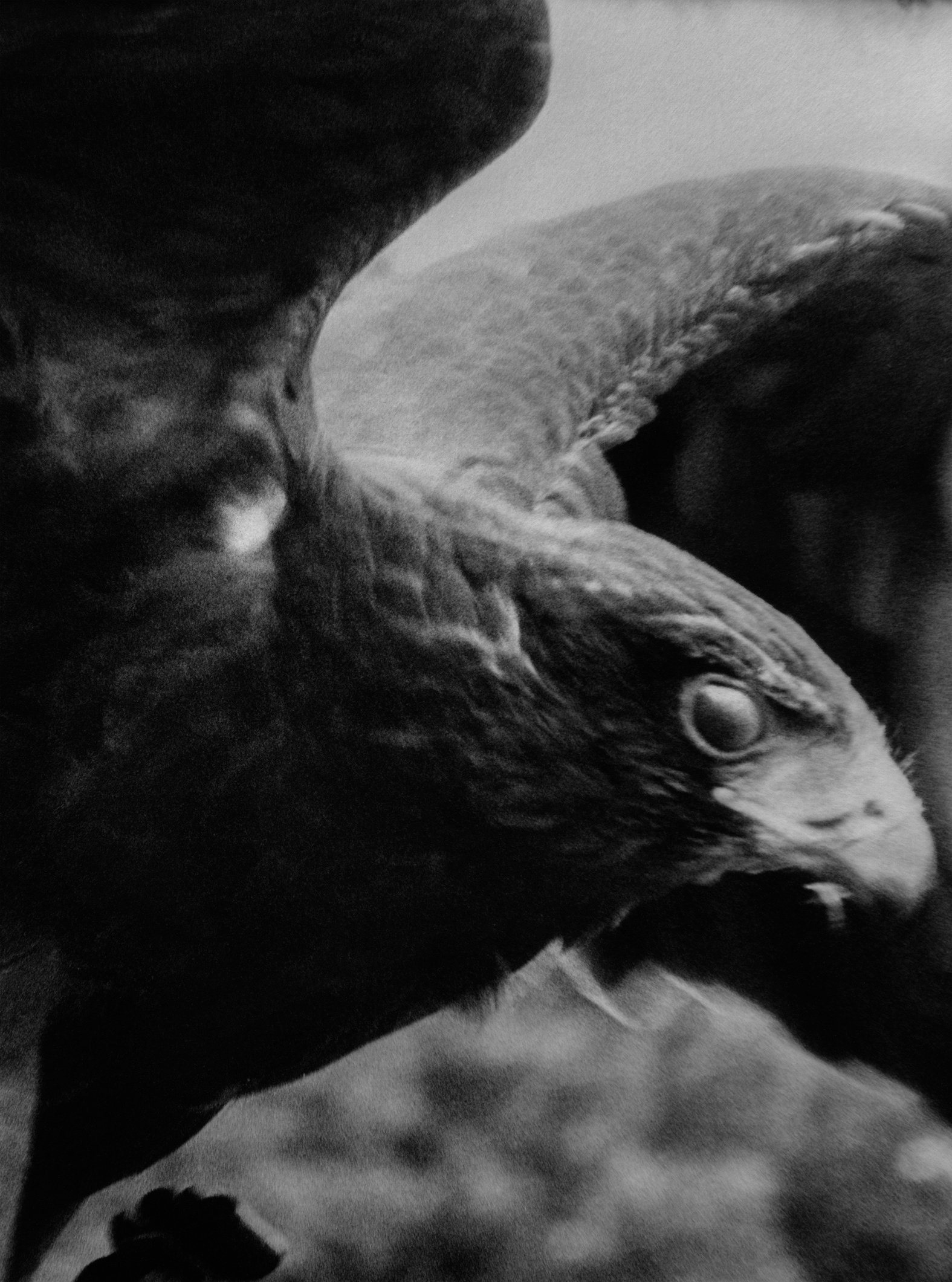
Agata Grzybowska, from Even as a Shadow, Even as a Dream (MACK, 2025). © Focus Features LLC. Courtesy of the artist, Focus Features LLC, and MACK.
(FR): How much of your process on this project was deliberate versus instinctive? Can you recall an image that surprised you after the fact?
(AG): I think that most of the process of editing and creating the book was instinctive. The deliberate part came earlier — in the preparation. Much of that work happened in the darkroom. I prepared prints and then subjected them to a kind of controlled destruction of the silver, experimenting extensively with developers and fixers. That stage required intention, repetition, and structure. Once those materials existed, the process shifted. Editing, sequencing, and selecting images became much more intuitive. It was about sensing when an image needed to appear, disappear, or remain unresolved — rather than explaining it.
Working closely with Łukasz Rusznica played a crucial role in this phase. Through his pairings and connections between images, I often began to notice a completely unexpected emotional charge — something I hadn’t seen when looking at the photographs in isolation. Images I initially thought of as secondary or incomplete suddenly carried a new weight once they entered a dialogue with others. That balance between preparation and instinct is essential to my process. I try to create conditions that allow intuition to take over — and then trust what emerges.
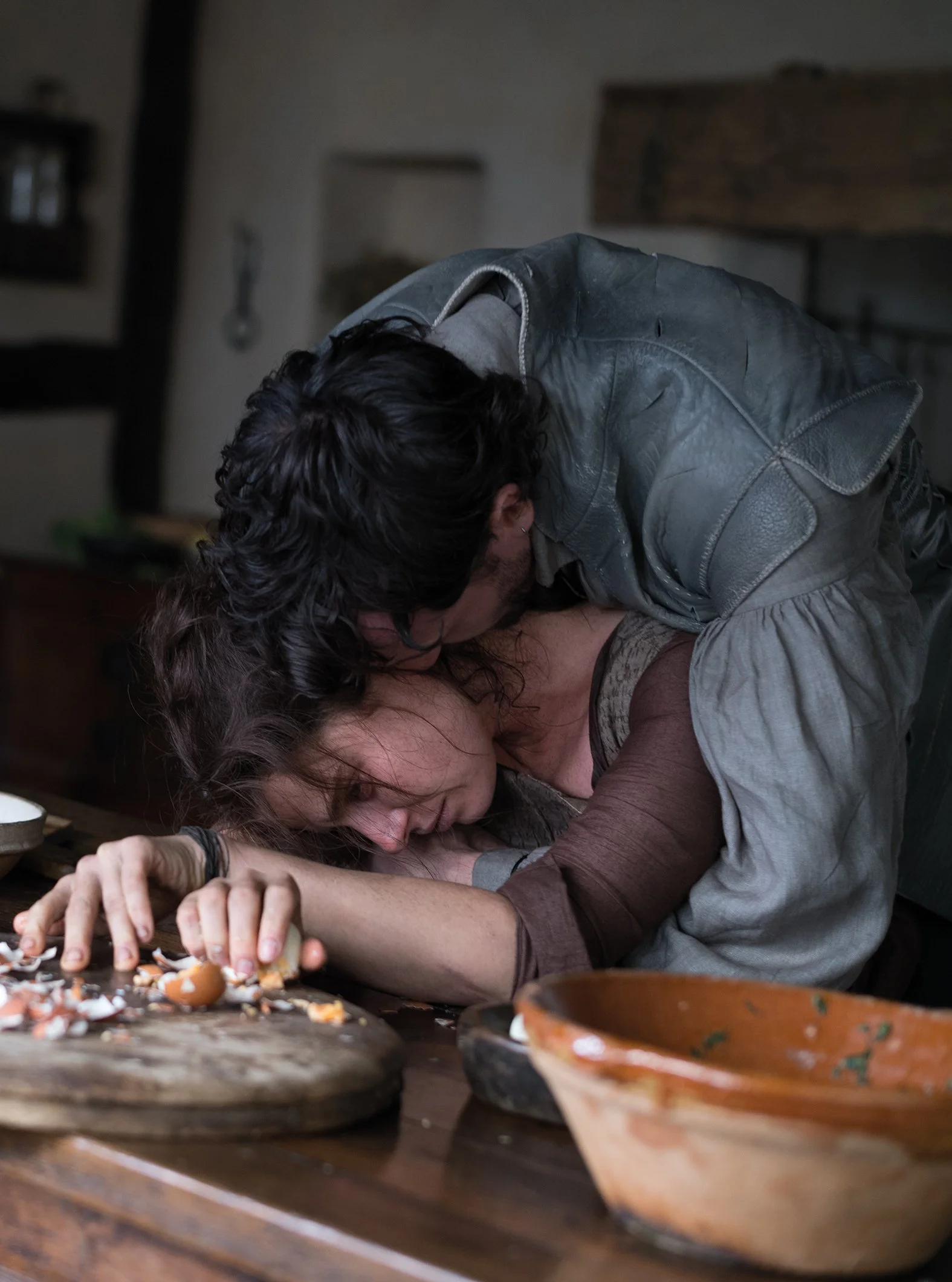
Agata Grzybowska, from Even as a Shadow, Even as a Dream (MACK, 2025). © Focus Features LLC. Courtesy of the artist, Focus Features LLC, and MACK.
(FR): The project exists alongside a film about grief, loss, and love. As someone coming from conflict and documentary work, how was capturing this vulnerability different — or the same?
(AG): My approach to work doesn’t really change. People and their stories are always at the centre of what I do. The main difference between documentary work and a film set is that one deals with reality, and the other with fiction. I don’t pretend to fully understand acting, but I don’t think you can defeat or measure suffering and loss when someone is performing it. Even if it is ‘only’ acting, in that specific, concrete moment the emotion is real. And it can become real for someone else, for the viewer.
In conflict zones, I am with people in their pain and their loss, often in situations that are dangerous or impossible to fully comprehend from the outside. My intention there has always been the same: to listen, to stay close, and to tell stories that are so often unheard. I deeply believe that everyone has the right to their own story and that we have a responsibility to listen — because their lives and experiences matter.
On Hamnet, the difference was that I was constantly moving between two worlds — fiction and reality — and trying to honour the truth that exists in both. I tried to remain careful but close, giving space for love, grief, and loss to exist within the frame. In the end, whether documentary or fiction, I stay with the people, the emotions, and the stories — all the way through.
(FR): What was your experience of the London exhibition Even as a Shadow, Even as a Dream, curated by Simindokht Dehgani?
(AG): I am very proud to be represented by Simin Dehghani, and I was equally proud that she was curator of the London show. It was not our first visual journey together. In 2019, she curated the show of my personal project 9 Gates of No Return at Ag Gallerie in Tehran. It turned out to be not only a mind-blowing, inspiring experience but also the beginning of a long-lasting friendship and exchange of thoughts.
For me, the exhibition Even as a Shadow, Even as a Dream was another journey — beyond the film, beyond the book. Simin described it as “a meditation on presence and absence, on grief transfigured through art”. The exhibition placed us in a position where we begin to consider how grief is not only endured but also rehearsed, performed, and revised. In that process, we encounter something profoundly ephemeral: the dead are not restored, but they are made visible — if only for a moment. Like a shadow. Like a dream.
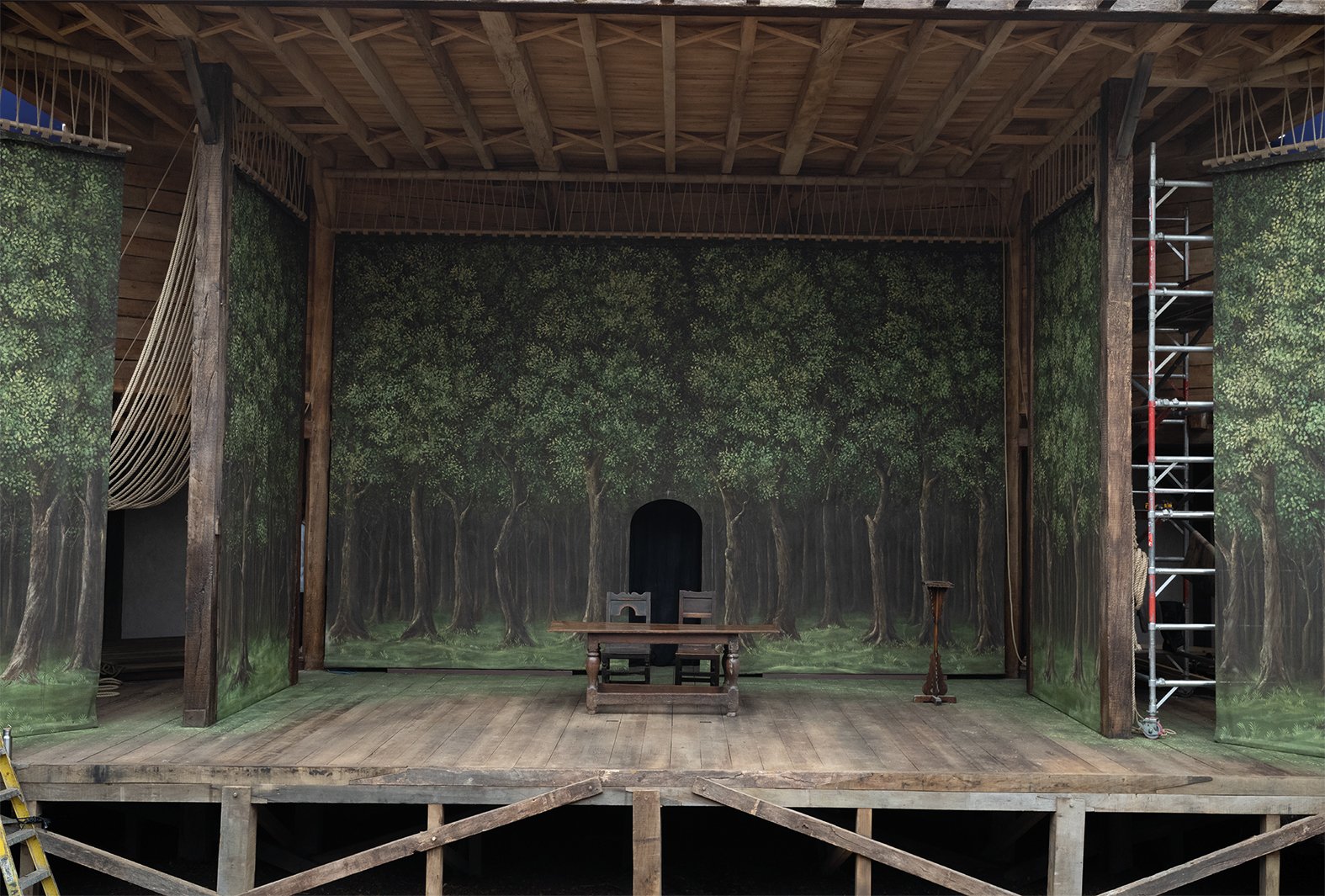
Agata Grzybowska, from Even as a Shadow, Even as a Dream (MACK, 2025). © Focus Features LLC. Courtesy of the artist, Focus Features LLC, and MACK.
(FR): What do these images mean and symbolise to you?
(AG): The images have their source from the story of Hamnet, and then we move away from it, and we do it a number of times. So we work on a very classic story, whether it’s Hamnet, Orpheus and Eurydice, or the story about love and loss, and consider where we are in all this. Images are also a set of afterimages: they hold the residue of emotion, the echo of a moment that has already passed.
Photography, for me, is always connected to memory. An image is not the event itself but a fragile surface where memory settles. It becomes a mark, a trace — evidence that something was felt, witnessed, shared. In that sense, these photographs are not only about Agnes or about the film; they are about how we remember, how we carry absence, and how we live alongside what is no longer there.
I hope that when someone encounters these images, they do not simply see a narrative but recognise their own afterimages within them — their own memories, their own losses. Because ultimately, the photograph is only a beginning. What completes it is the memory the viewer brings to it.
To learn more and read the book, visit www.mackbooks.co.uk (UK) or www.mackbooks.us (US)
Follow @mack_publishing on Instagram
AGATA GRZYBOWSKA is a Polish visual artist and documentary photographer based in Poland and represented by Ag Galerie in Iran. In their work, they are interested in people. They travel across the world depicting individuals in difficult, often life-threatening situations. While working, their principle is to get as close as possible to people and their stories. They consider themselves a medium which enables other, underprivileged voices to be heard. They strongly believe that everyone has the right to their own story. They graduated from the Direction of Photography at the Polish National Film, Television and Theatre School in Lodz. They have shown their works in Poland, Sydney, Los Angeles, Tokyo, Tehran, Moscow, Madrid, Athens and Arles. Recently they have collaborated with such film directors as Jonathan Glazer, Chloé Zhao, Jessie Eisenberg and Charlie Kaufmann.