The Man Who Came to Dinner │ Warner Archive Collection
Courtesy of Warner Bros. Entertainment
by CHAD KENNERK
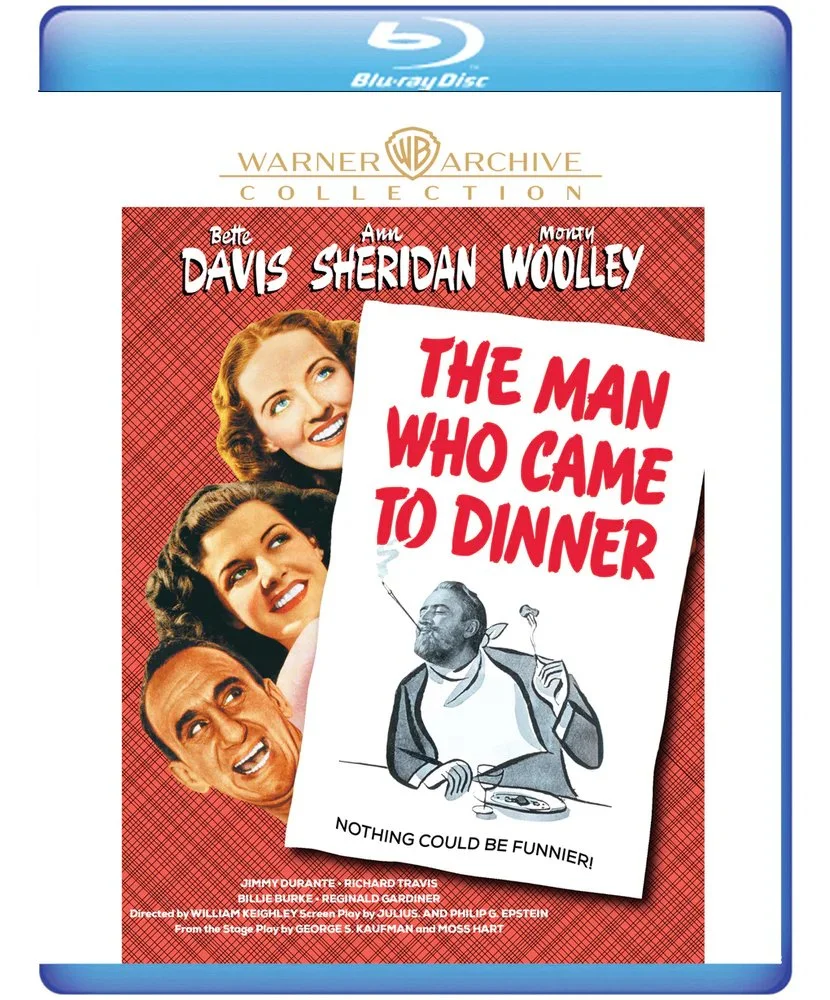
After seeing the Broadway production of George S. Kaufman and Moss Hart’s comedy The Man Who Came to Dinner, screen star Bette Davis pursued the film adaptation, wisely clocking the role of secretary Maggie Cutler as a great change of pace for her career. She campaigned for the legendary John Barrymore to co-star as the man in question, but his screen test apparently led the studio to pass. The test still exists and once cropped up at a MoMa screening of the film, which reportedly validated Davis' rage at the studio for not giving Barrymore the part. Other actors, including Charles Laughton and Orson Welles, were considered before producer Hal B. Wallis cast Monty Woolley, who originated the role on stage. Davis strongly opposed the decision and remained disappointed, once reflecting, “I felt the film was not directed in a very imaginative way. For me, it was not a happy film to make – that it was a success, of course, did make me happy. I guess I never got over my disappointment in not working with the great John Barrymore.” Boasting a starry ensemble cast that includes Ann Sheridan, Jimmy Durante, Billie Burke, Mary Wickes and more, Davis stands out as the real highlight.
The production also gave Bette Davis something of a full circle moment when the stage actress Laura Hope Crewes appeared on set, playing an uncredited role as one of Whiteside’s many fans. Crewes was a big stage star back when Bette was an usherette at the Cape Playhouse. As Davis describes it in her 1962 autobiography, The Lonely Life, Crewes was both starring in and directing A.A. Milne’s Mr Pim Passes By and decided that the company’s ingenue was not right for the part of Dinah, a young English girl. Davis was desperate for the role and was put up as a possible replacement. Crewes gave Davis the next-to-impossible task of learning an obscure song by the following morning, which, against all odds, Davis did. Davis won the role, but Crewes was apparently less than kind. One example saw her slapping Davis’ hand for being too expressive during the final dress rehearsal.
When Davis encountered Crewes years later on the set of The Man Who Came to Dinner, this is what she had to say about the encounter: “Past all power and desire to slap ingenues, she was now coaching them in speech and accepting small parts in films. Here was another moment of possible revenge. I think she fully expected most anything from me. I had dreamed of a reversal of positions for many years. It never stopped shocking me that great theatre names whose heights once seemed too inaccessible were reduced to playing bits on the screen. I was having my day as they had had theirs, but such an encounter would always make me feel uncomfortable.” Davis went on to say that she decided to kill her with kindness. “I couldn’t have been dreamier. This, I decided, was truly the greatest punishment of all. Turning the other cheek! When the picture was over, Miss Crewes came to my dressing room. She handed me a box – and was gone. I opened it and inside was the most beautiful watch – pearls and diamonds on the back – that I have ever seen. This was her belated apology. She died six months later. It is one of my truly cherished possessions.”
Several of the central characters in The Man Who Came to Dinner were modelled on real-life figures, including critic Alexander Woollcott, who was the basis for the insufferable Sheridan Whiteside (and later played him on stage!). Other real-life personalities under the satire’s lens included actress Gertrude Lawrence (in the form of Lorraine Sheldon), playwright Noël Coward (Beverly Carlton), and comedian Harpo Marx (Banjo). Like the parody films of today, some of the context for the specific satire is a little lost to time, such as with the Christmas gift from the “Khedive of Egypt”, but it’s hard to ignore madcap comedy, especially when written by the likes of Kaufman and Hart. If you can stomach the irrepressible curmudgeon Sheridan Whiteside, then you might be among those that find this classic a treat. It certainly looks good, thanks to a recent 4K scan of its original nitrate negative. It’s great when archival special features from the DVD are carried over to the Warner Archive Collection Blu-rays, such as the featurette here, Inside a Comedy Classic. There’s also the short Glen Gray and the Casa Loma Orchestra; the 1942 The Wabbit Who Came to Supper, featuring Bugs Bunny and Elmer Fudd; and archival radio broadcasts of the play from the Hotpoint Holiday Hour and Lux Radio Theater.
The Man Who Came to Dinner is available on Blu-ray 31 March from Warner Archive Collection.
Order your copy from Movie Zyng
WARNER ARCHIVE COLLECTION offers thousands of film and TV series direct from Warner’s studio vault. With a particular emphasis on high-quality restorations and remasters on Blu-ray disc, Warner Archive Collection brings rare and hard-to-find classic motion pictures and television series to home video. Often appearing for the first time on Blu-ray, titles are chosen each month from the unparalleled library of Warner Bros. Entertainment, which spans more than 100 years of cinema history.
MOVIE ZYNG offers more than 37,000 in‑stock titles, carefully curated to make discovery easy, intuitive, and genuinely enjoyable. Instead of endless search results, Movie Zyng has organised their catalogue into thoughtful collections by genre, era, studio, filmmaker, format, and fan interest. Movie Zyng is designed to help you discover films you’ve never seen, rediscover favourites and build a collection. Remember the video store? That sense of discovery, excitement, and connection has largely disappeared from modern online shopping — and that’s exactly what Movie Zyng aims to bring back. Start your collection today!