
Abode

The Irish filmmaker Liam Ó Mocháin presents five tales of what home means to very different characters.
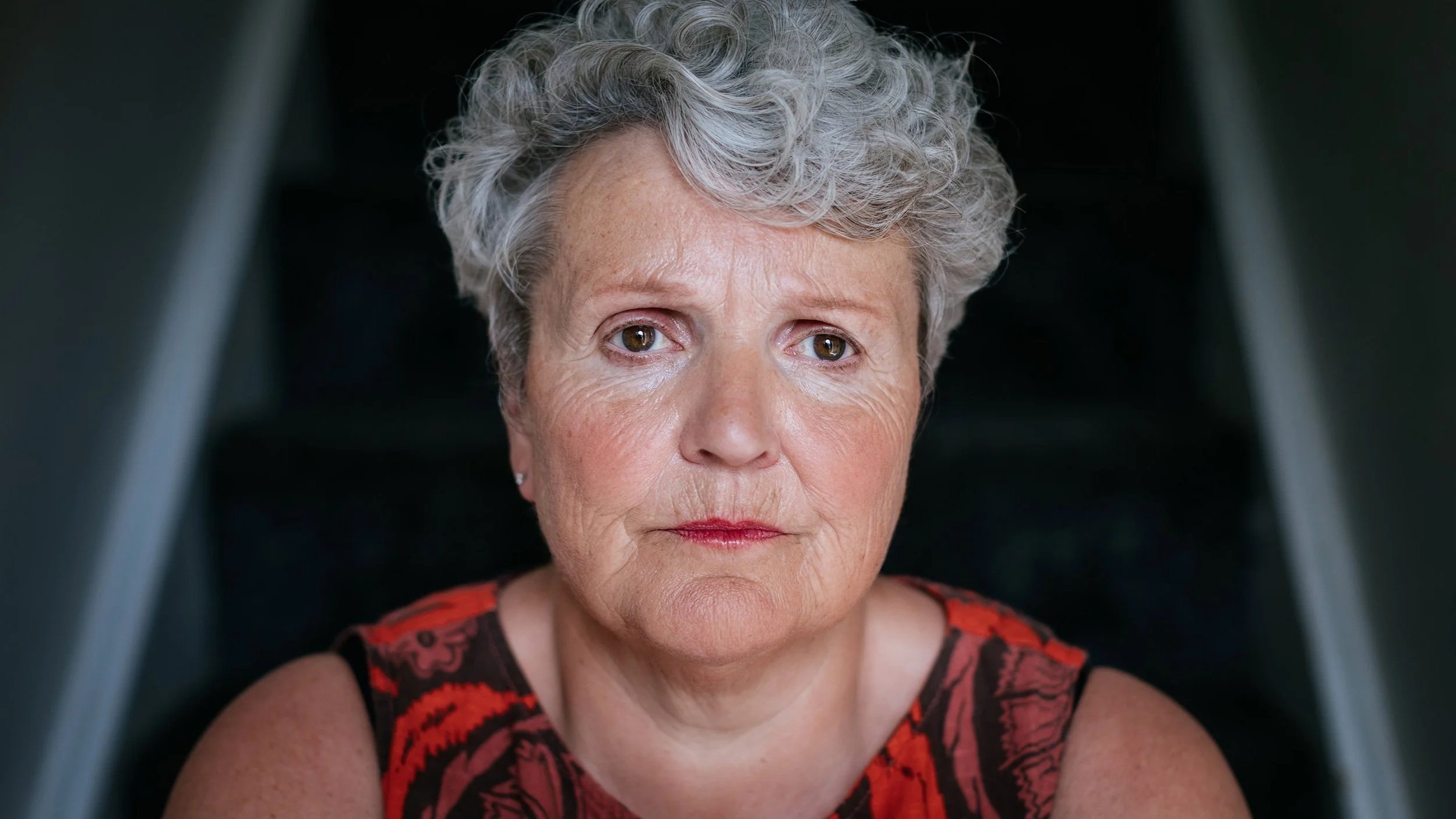
Rosemary Henderson as Molly
Image courtesy of 606 Distribution.
by MANSEL STIMPSON
Liam Ó Mocháin's Abode is largely set in Dublin and features players well established in Ireland, among them Ó Mocháin himself, but most of them could well be unfamiliar to viewers elsewhere. That makes it something of a gamble for a distributor to give it to a UK release and one wonders how it will fare. Within the last month a comparable release has been given to another film set in Ireland, The Spin. In that instance the warmth and appeal of its comedy together with the delightful pairing of Brenock O'Connor and Owen Colgan could mean that, regardless of any passing weaknesses in the film, it is well fitted to give pleasure in these troubled times. Abode is also a work that seeks to be an example of engaging popular cinema, but it is not a comedy and may prove to be a somewhat harder sell although it has roots in a form of cinema that had great popular success in the now distant past.
Abode is a film made up of a group of tales and that was a format which had its heyday over fifty years ago. It could well be that in this sphere Britain led the way. If Ealing’s brilliant Dead of Night (1945) was a precursor, one in which distinct stories were inserted into an equally eerie surround narrative, it was the success of bringing together separate tales by Somerset Maugham starting with Quartet (1948) which led in the ensuing years to a spate of films which followed that pattern and came from a range of countries including America, France and Italy. Much less common today, it is a format which clearly appeals to Ó Mocháin since, like Abode, his 2017 feature Lost & Found, which was not released in the UK, was in the same mould. But in his case the stories brought together are all by Ó Mocháin himself and in addition to being the sole director involved he also appears as an actor. Indeed, like some of the other players in Abode, he takes on more than one role.
It is never surprising with this genre to find that the results are uneven because all too often some of the stories incorporated are better than others. That strikes me as being the case with Abode which contains five distinct sections. The film’s title derives from the fact that home features in each tale all of which are said to be inspired by true stories. In the first piece, the home element is crucial if ironic. Its central character whom we meet on Christmas Eve is a homeless woman who sleeps on the streets, Carol (Marion O’Dwyer). She unexpectedly gains access to a restaurant through an unlocked door and, with the establishment being closed for Christmas Day, she is able to invite other homeless acquaintances to join her there to party and to make it a one-day home. Ó Mocháin appears as the owner who discovers what has gone on, but it is O’Dwyer who roots this tale. The second segment is more of a double act with Mary McEvoy and Brendan Conroy both suitably engaging. She plays a middle-aged widow and he her aging one-time lover who seems keen to ingratiate himself with her again despite the hostility of her adult son. The eventual payoff to this tale makes it the one most akin to the short stories of Somerset Maugham.
When it comes to the third tale, it is back to a woman being very much the key character. Here it is Molly (Rosemary Henderson) who is preparing for a special occasion that is due to take place at the local church. Her family may be going with her but it is only gradually that we discover exactly what the occasion involves. This is a simple but effective narrative which, like the homelessness issue of the opening segment, is tied in to something which is a serious actuality.
Thus far Abode has come across as able filmmaking enhanced by the players and especially by the three actresses that I have mentioned. One aspect that I found less effective was the rather self-conscious music score which is overused by Ó Mocháin to fill in scenes without dialogue. But the real disappointment here lies in the last two tales. The fourth is obviously intended to provide a contrast but defies the notion that a true story lies behind each piece. It provides a comment on modern technology contained in products for the home, in this instance an oven, and in doing so it introduces some humour into the film. But the form taken is that of a satirical comedy which turns macabre in a way that might once have been chilling but no longer has any bite or impact. As for the fifth section, the home element would seem to lie in the impact on a marriage of looking after two young sons when that has come to dominate everything including the sex life of their parents. That may be the theme but we actually see the couple away from home and for once without the children. However, what we are shown plays more like the introduction to a longer work yet to be developed. As a short story it fails to satisfy.
Ultimately Abode can be seen as a mixed bag and the fact that it tails off adds to one’s sense of disappointment with it. Even so, there is much here that in its relatively modest way is quite effective and enjoyable.
Cast: Liam Ó Mocháin, Marion O’Dwyer, Anthony Morris, Brendan Conroy, Mary McEvoy, Rosemary Henderson, Donncha Crowley, Gail Brady, Matthew O’Brien, Mary Murray, Stephen Jones, Sinead O’Riordan, Karl Argue.
Dir Liam Ó Mocháin,Pro Bernie Grummell and Liam Ó Mocháin, Screenplay Liam Ó Mocháin, Ph Joshua Bourke, Pro Des Martin Cahill, Ed Ciara Brophy,Music Richie Buckley and Daniel Horn, Costumes Tara Gannon Carr.
Siar A Rachasmúid Productions/Ó Mocháin Grummell/Screen Content Ireland/Hyper Films-606.
81 mins. Ireland. 2025. UK Rel: 20 March 2026. Cert. 15.
