
Dead Man’s Wire

Bill Skarsgård stars as a hostage-taker in Gus Van Sant's multi-levelled true-life crime drama.
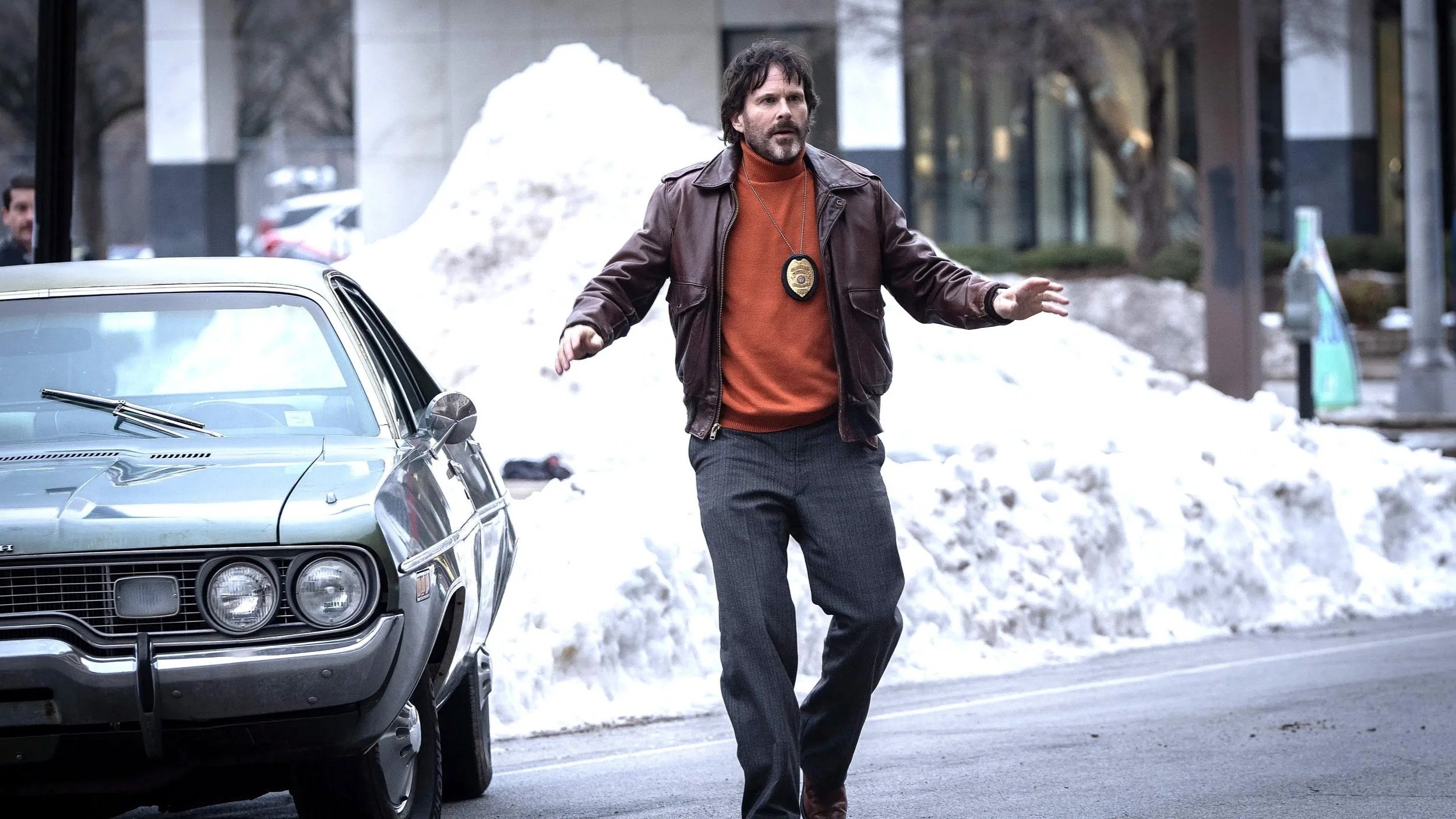
Cary Elwes
Image courtesy of Vertigo Releasing.
by MANSEL STIMPSON
Now in his seventies, Gus Van Sant offers us Dead Man's Wire, his first cinema feature since 2018. Unlike many of his best-known films, this is not one of those on which he is also the writer (that being Austin Kolodney) and indeed the project was one which was to have been directed by Werner Herzog with Nicolas Cage as his leading man. Delays occurred which meant that Cage was no longer available and at that stage Van Sant stepped in as director with Bill Skarsgård replacing Cage. For all its initial problems the film has in the event been generally well received although its subject – the telling of a real-life crime that occurred in 1977 – is not one which seems an altogether characteristic choice for either Van Sant or Herzog.
The central figure here is a man named Tony Kiritsis who became famous due to his actions when in Indianapolis he kidnapped a mortgage broker named Richard O. Hall (Dacre Montgomery). He held him hostage for some sixty-three hours and the drama was all the more intense because when seizing the broker Kiritsis had wired the muzzle of a shotgun to the back of his head and connected the trigger to the wire. This meant that if Hall tried to get away or if the police were to shoot Kiritsis the hostage would die. The film concentrates on this particular period of time and there is no attempt to portray the background to what happened earlier through flashback scenes or by way of any preliminary introduction.
That's a sound approach because the incident in February 1977 is portrayed in a way which makes it quite clear that Kiritsis had acquired land in order to create a shopping centre but believed that he had been taken advantage of by the mortgage company he had approached and to whom he was in debt. He accused Meridian Mortgage of taking steps that interfered with his planned development and was claiming compensation for money lost while also demanding a personal apology from the company’s head man, Richard’s father M.L. Hall (Al Pacino). In taking these steps to show up the company, Kiritsis wants to publicise what they have done and what he is doing about it. Accordingly, it is he who contacts the police, encourages TV reportage and ultimately approves the idea of a live broadcast for which he and Richard Hall will be present. He anticipates that he will then receive an on-air apology and be granted immunity regarding the actions he has taken.
On one level Dead Man’s Wire can be regarded as a straightforward re-enactment of an old crime and one sufficiently in the past for many viewers to be in a state of suspense not knowing how things will work out. But, in fact, this is a movie that works on more than one level since in addition to retelling a real-life tale it has two other concerns. One of them is to appeal to movie fans familiar with successful Hollywood films of the 1970s and in the process to evoke that era memorably. Thus it is that the film is soaked in music of that time. This is mainly achieved by utilising the fact that everybody in Indianapolis would spend much of the day listening to a popular DJ (Colman Domingo). In due course Kiritsis’s admiration for this DJ will lead to him becoming more directly involved in the story but meanwhile his broadcasts provide a way for hits of the period to be heard and to add to the atmosphere. On other occasions, however, Van Sant just adds recordings to footage that has no natural source for it and this can be at odds with the realism of the drama. Similarly, the idea of evoking a past age by including a number of black-and-white archive shots is misjudged since the switch away from the colour photography of Arnaud Potier, itself suitably atmospheric, disrupts our acceptance of the re-enactment. Far more telling are other touches that further evoke the 1970s through movie associations. Thus, the very style of the film often echoes the cinema of that decade, a line of dialogue in which Kiritsis is described as being "mad as hell" directly recalls Peter Finch in Network (1976) and the very presence in the cast of Al Pacino is a reference to another crime drama, Dog Day Afternoon (1975).
But for all the emphasis on this being a period piece one senses that Kolodney and Van Sant also want to make this a story which resonates all the more strongly when retold again today. Even in 1972 the American people were divided in their reaction to Kiritsis. Whilst some saw him simply as a deranged kidnapper there were others who viewed him as a put-upon victim who in challenging the mortgage company was something of a hero. Rather than being didactic as to what response it expects of us the film leaves somewhat open the question of how we should view Kiritsis. Nevertheless, Bill Skarsgård gives an excellent performance which is often engaging and brings out the humour inherent in Kiritsis being an everyday guy who finds himself acting out the role of a menacing criminal. Furthermore, I understand that, in line with the statement in the closing credits claiming that this is a work of fiction, the degree of corruption claimed here on the part of the company is not as close to the truth as the action depicted. However, this emphasis fits well with today's world and the gap, not least in America, between those involved in companies and corporations and the everyday people who struggle to get by.
Whatever aspect of Dead Man’s Wire you choose to focus on, it comes across as a film of interest that is nevertheless a bit uneven. The situation at its heart is one which would gain in tension if the film were a little bit shorter and tauter. In terms of performance, however, it could hardly be better acted and that extends beyond those mentioned above to Myha’la as a rookie reporter latching on to the story and to Cary Elwes as a cop who is personally known to Kiritsis. Good as everybody is one is inclined to regard it as Skarsgård’s film but at the same time, although Pacino's role is little more than a cameo, his appearance in it is a forceful reminder that age cannot wither that sheer sense of screen presence. As a drama Dead Man's Wire is quite good without being really memorable, but as an example of skilled acting it is great.
Cast: Bill Skarsgård, Dacre Montgomery, Cary Elwes, Myha’la, Al Pacino, Colman Domingo, Kelly Lynch, John Robinson, Vinh Nguyen, Todd Gable, Mark Helms, Michael Ashcroft, Daniel R. Hill, Neil Mulac.
Dir Gus Van Sant, Pro Cassian Elwes, Joel David Moore, Mark Amin, Sam Pressman, Tom Culliver, Matt Murphie and others, Screenplay Austin Kolodney, Ph Arnaud Potier, Pro Des Stefan Dechant, Ed Saar Klein, Music Danny Elfman, Costumes Peggy Schnitzer.
Elevated Films/Pressman Film/Balcony 9 Productions/RNA Pictures/Pinstripes Production-Vertigo Releasing.
106 mins. USA. 2025. US Rel: 9 January 2026. UK Rel: 20 March 2026. Cert. 15.
