
Jeanie Finlay enhances her reputation with her impressive but downbeat and occasionally placid documentary about environmental chaos in the waters off the North-East English coastline.
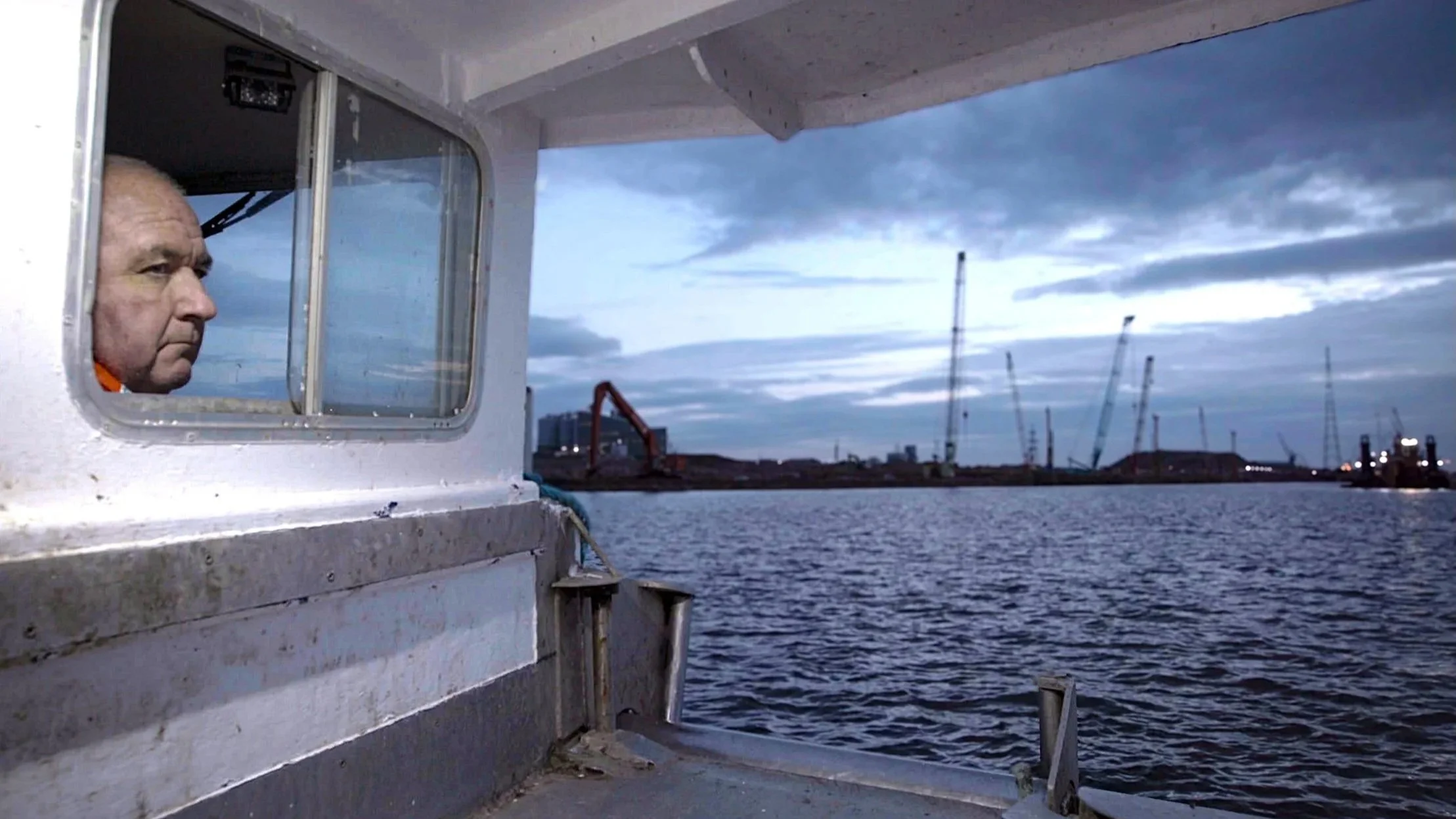
Image courtesy of Glimmerama.
by MANSEL STIMPSON
I have rarely encountered a film which aroused in me such conflicting responses. There is a great deal here that is very impressive and yet ultimately I felt that something had gone awry. But let us begin with what excited me about this documentary. First of all, there is the sense that Jeanie Finlay, who is one of the photographers as well as being the director here, was the ideal person to make this film. All Rivers Spill Their Stories to the Sea is set in that part of north-east England where the Tees river meets the North Sea. The community central to it is that of Hartlepool and its special focus is its fishing folk. Many of them belong to families who for generations have gone out to catch the lobsters and crabs for which this coast has always been famous. Finlay was born in that region in the market town of Stockton which lies on the river’s northern bank. Her feeling for the area and her natural rapport with its inhabitants are always apparent here and that is greatly to the film’s advantage.
Early on we see footage dating from September 2021 when a local resident was taken aback to find that what at first sight appeared to be masses of seaweed washed up proved instead to be piles of fish twitching or already dead. What follows shows how over the next few years these crustacean deaths built up threatening the very livelihood of the fishermen and we are introduced to Stan Rennie who is the central figure here. A fisherman himself, he formed the North East Fishing Collective to push for a thorough investigation into the pollution that had brought about this change. In point of fact, Stan and his friends had little or no doubt what was responsible being aware of what was involved consequent on Boris Johnson's government choosing to transform the area by creating there the largest free port in the UK. The collective knew of the dredging which, in order to keep a clear channel for shipping vessels, was removing virgin sand brought in by the tide and which led to four times more sediment being dumped in the sea than had previously been the case. In seeking to prove that this was the cause of the contamination the collective liaised with scientists from five universities who were able to carry out tests independently. However, what might have sounded a straightforward way of establishing the truth proved anything but. It led instead to struggles to be heard in Westminster, to a finding by DEFRA (the government’s department dealing with policy and legislation relating to the environment) which put the blame on red algae and to a general sense that the government was determined to ignore any views that might interfere with its own plans for the area.
In telling this story Finlay’s documentary touches on the past history of the region. It incorporates footage from an old promotional film which sold the North East as the Land of Opportunity and notes how it became a base for both the oil industry and the chemical industry but later suffered unemployment in the Thatcher era. When it came to Brexit, there was strong support for leaving the European Union, but in terms of what happened subsequently Stan Rennie speaks for many when he says that they were sold down the river over Brexit. He declares that he will never vote Conservative again and there is no doubt that this film sees the mayor for the Tees Valley, Ben Houchen now Lord Houchen, as its villain (his peerage was granted by Boris Johnson). He is convincingly shown as a man determined to support the government programme while ignoring the concerns of the fisherfolk who, unvisited by him, were in his eyes fit only to be branded as activists. Nor do things improve when, with questions on their behalf put in the House of Commons at last, the Conservative environment secretary, Thérèse Coffey, attacks the speaker outright for challenging the views of scientists in her department.
All of this comes across as very involving. That response is further encouraged by the appeal of Stan Rennie himself and by that of others featured here such as Dr Sue Wilson, a researcher whose special concern is the fate of seals in the Tees. But, in addition to that, this film stands out as a comment on the extent to which the real needs and concerns of local communities can so easily be overridden by schemes pursued by centralised government. These issues at the heart of All Rivers Spill Their Stories to the Sea ensure that it is a valuable social document, but there is also the extra bonus that it impresses as cinema. Back in 2023 I saw an earlier film by Jeanie Finlay entitled Your Fat Friend and found it a sympathetic piece competently made, but I regard this new work as a far more impressive example of her skills. The images here are so splendidly judged and so well put together to catch the character of Hartlepool that this film comes over as being the work of a true artist.
With so much in this film's favour being apparent from early on, I was taken by surprise when my feelings changed. In part that is down to circumstance: the endeavour by Stan Rennie and his collective seem to lead nowhere and consequently over the film’s 99 minutes that makes watching it a downbeat experience. The fact that Stan Rennie develops health issues adds to that sense and, while to offer false hope would be ridiculous, I was left pondering how the material could have been handled without that feeling coming to dominate. I did wonder if, had the piece been made for television, the same points could have been made in a programme lasting an hour, but Finlay's images do cry out for the big screen. As it stands, there is ultimately a sense that the film is rather drawn out but that is surely due to its increasingly depressing tone. One factor that may contribute to that lies in the fact that, despite the fishermen recognising their situation as one that threatens their livelihoods acutely, the film lacks any real sense of tension and urgency. Even the music score by Loman Campbell has a rather gentle, lyrical quality that seems too placid to be apt. However, I find it difficult to be constructive as to how a different approach might have been more effective. It is true that in the film’s final minutes Dr. Sue Wilson for one speaks out defiantly refusing to give up. Nevertheless, a 2025 postscript refers to seal pups being found dead and to the fact that more free ports are planned in the UK. In watching this work I had certainly seen some great filmmaking applied to material which, taken as a warning, is undoubtedly valuable. Even so, the film’s portrait of decline and failure felt overwhelmingly depressing.
Featuring Stan Rennie, Sue Wilson, Sharon Bell, Leigh Jones, Marc Evans. John Wallace, Gary Caldwell, John Bothwell, Rodney Forster, Chris Adnett, Dave Roberts, Jim McMahon, Jonathan Brash.
Dir Jeanie Finlay, Pro Jeanie Finlay and Charlie Phillips, Screenplay Jeanie Finlay, Ph Jeanie Finlay and Adam Mendum, Ed Nicole Hálová, Music Lomond Campbell.
Glimmer Films & I Am Charlie/Screen Scotland/BFI/Chicken & Egg Films/Jyoti Film/Varda Pictures-Glimmerama.
99 mins. UK/Germany/France/USA. 2026. UK Rel: 23 October 2026. Cert. 12A.