
Paweł Pawlikowski explores Thomas Mann’s 1949 trip to Germany with his daughter in an atmospheric, defiantly intellectual drama.
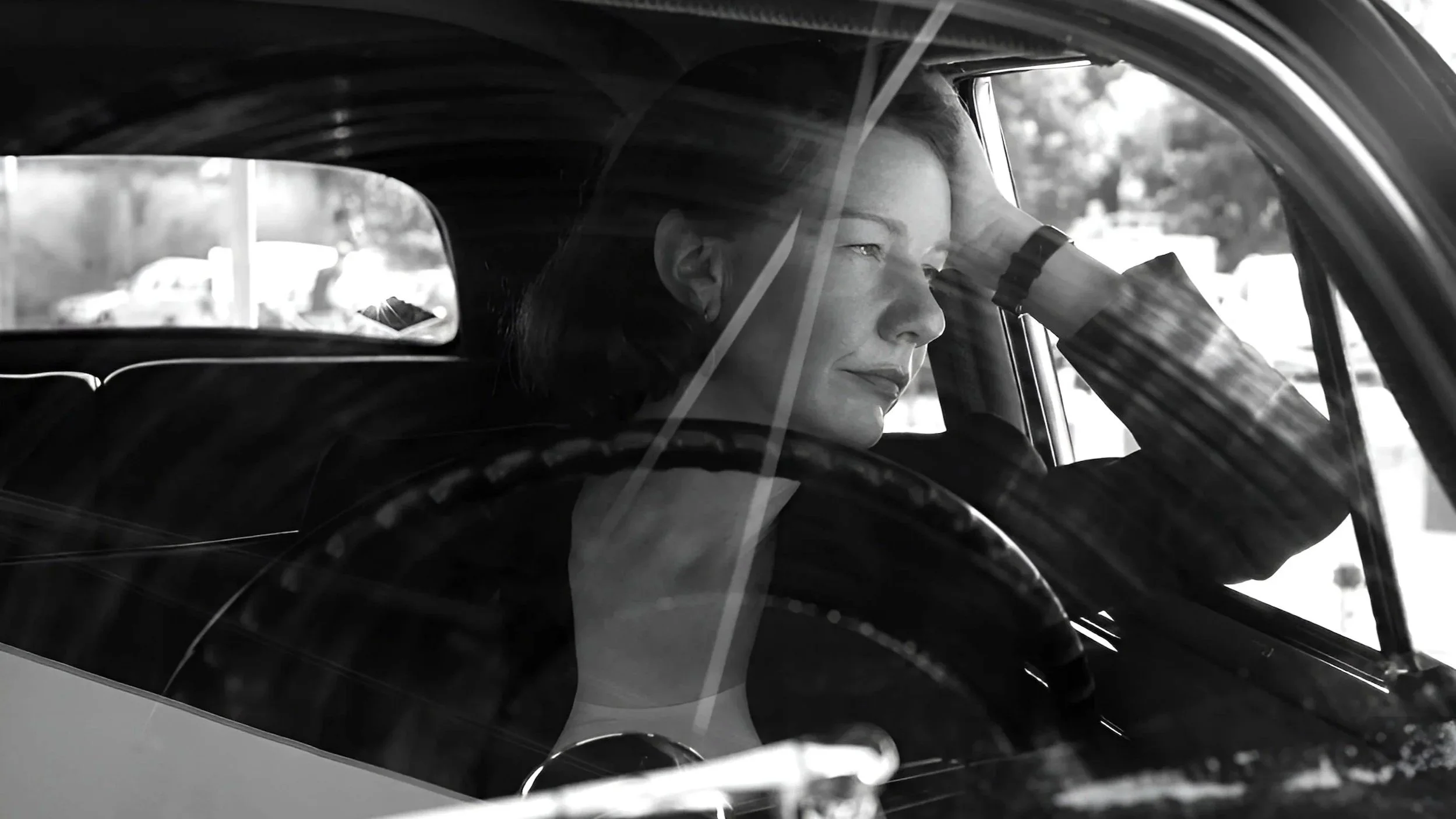
Sandra Hüller
Image courtesy of Mubi.
by MANSEL STIMPSON
Although Paweł Pawlikowski made a name for himself when he was working in Britain (both 2000’s Last Resort and 2004’s My Summer of Love were very well received), his career nevertheless reached new heights with his return to the country of his birth, Poland. First with Ida (2013) and then with Cold War (2018) he gave us memorable subtitled works which told stories that reflected the many post-war tensions that had been experienced by those living in Poland, the earlier work being set in 1962 and the latter between 1949 and 1964. In many respects this new piece, Fatherland, can be seen as a continuation of that pattern despite it being set in Germany. The year is 1949 and the style adopted by Pawlikowski – his decision to shoot in the old Academy ratio and to opt for black-and-white photography – remains the same. Indeed, he continues to work with the same collaborators, the photographer Łukasz Żal, the production designers Katarzyna Sobańska and Marcel Sławiński and the costume designer Aleksandra Staszko. Nevertheless, and despite reviews of Fatherland largely implying that the films are three of a kind, I do believe that in important ways this one is different.
It is indeed the case that, unlike its two immediate predecessors, Fatherland portrays real life figures instead of telling a wholly fictional tale. Admittedly some of the details have been changed, but in essence the film portrays correctly the situation in which the celebrated author Thomas Mann found himself when, having lived in America since 1938, he took a journey back to Germany to accept the Goethe Prize. His visit would take him first to Frankfurt where Goethe had been born and then to Weimar where he had died and in the Germany of the immediate post-war years that meant being present first in capitalist West Germany and then in communist East Germany. Both were places where those in charge wanted to claim the famed Thomas Mann for themselves. In fact, having abhorred the Nazis and what they had done to Germany, he had subsequently become deeply critical both of post-war war American capitalism and of the path down which Soviet Russia had taken communism. Consequently, while receiving the Goethe Prize fitted in with his constant concern that his own standing in literature should be fully recognised, he saw himself as someone who might be an influential advocate for a different philosophy of life. It was one which he regarded as drawing on the balanced and humane ideas of Goethe himself. It was an outlook which believed in the complexity of life and in the importance of art and love while claiming that to believe that any system was pure ignored the fact that, far from being wholly good or bad, one always encountered ambiguity in any ideology. But, if Thomas Mann himself hoped that his speeches in Germany could have a real influence, there were others around him who were far less optimistic.
In concentrating on this very short period in Mann's life Pawlikowski is able to bring out his personal viewpoint while doing so in a precisely realised setting (both period and place are marvellously captured in the production design). The writing and direction also express wonderfully well how post-war Germany could be viewed with distinct unease. That's not just because one encounters surviving Nazi supporters who are in denial – men such as Erika Mann’s first husband, the actor Gustav Gründgens (Joachim Meyerhoff) - but because there is an underlying sense that Germany had not in reality fully thrown off the attitudes of the Nazi era and its proud military core.
In addition to capturing this atmosphere Pawlikowski's focus extends to Thomas Mann's relationship with his family, in particular with his daughter Erika and his son Klaus. The latter only appears here in a brief prologue after which we soon learn that he has committed suicide in Cannes but his sister features prominently. In this version of events, it is Erika who accompanies her father to Germany and these two figures dominate the film. As played by Sandra Hüller and Hanns Zischler, both perfectly cast, they are utterly persuasive as the film observes closely a key contrast in their personalities We recognise the grief that Erika feels over the death of Klaus to whom she had always been close (Hüller is exceptional in the moments when Erika's ordered manner gives way to deep emotional distress that wells up from deep inside). We compare that with the way in which the father pushes away any such feelings as he recalls the faults and weaknesses that he had seen in his son.
All of this gives us plenty to take on board and to think about but – and this I think needs to be stressed – Fatherland does not have a clear and compelling narrative in the way that both Ida and Cold War did. That makes it far less easy this time for a general audience to get into it. Here more than ever before Pawlikowski adopts a tone that is defiantly intellectual. That may fit with taking the Manns as his subject, but he makes no concessions to allow for viewers who are unfamiliar with them. There are no flashbacks here and no scenes set up to help today's audience more readily grasp the political realities of that distant time. Indeed, the prologue may flummox anyone who doesn't know about the family. That’s because this introductory scene virtually opens with a telephone conversation in flow and leaves it to us to work out who it is between and exactly what the situation is. Examples of that refusal to clarify continue to come up at intervals. There is, for example, a striking sequence of Erika walking through woods containing statues which is likely to mean much more to those who can identify the site and what it represents. Even the film’s final scene plays out in an unidentified setting which is in itself puzzling: an organist plays in what looks to be a large rural church otherwise empty but for Erika and her father. Nevertheless, this last sequence is rich and satisfying since the impact of great music on Thomas Mann himself provides confirmation that his belief that the best art can speak to us meaningfully and significantly was not misplaced.
What this all means is that Fatherland is likely to be a film that divides its audiences but which should be deeply satisfying for viewers who like to work hard in interpreting the subtleties and aims of what is patently a distinguished achievement. It bears the stamp of a major director offering us a true work of art, the kind of thing we used to have with the films of Ingmar Bergman (in passing images of Thomas Mann travelling by car happen to evoke scenes in Bergman's Wild Strawberries). Pawlikowski’s mastery is evident in many ways including his use of images which emphasise the space between the characters and his remarkable skill in finding existing music that can play a key role here. The latter extends from such classical extracts as organ music by Messiaen and Bach to a work rich in period atmosphere, namely the pop tune ‘Tiger Rag’ broadcast on that radio station of the day, the American Forces Network.
The film’s studied tone, its strong sense of atmosphere and its concise scenes (sometimes potentially enigmatic but always considered) point to an unexpected influence, or if not that to a parallel. I refer to the work of another intellectual filmmaker, Jean-Marie Straub, and in particular to his memorable 1965 film made in Germany Nicht Versöhnt (Not Reconciled). No less precise yet often difficult to decipher and even more compact than Fatherland, that work has haunted me sufficiently to make me return to it many times. One could say that the challenges of Pawlikowski’s brilliantly acted film amount to being a weakness, yet if one is willing to make the effort one might come to think that his latest offering could well be his greatest. To decide if that is indeed the case would take repeated viewings which might well reveal more each time - provided that is that one has the right temperament for works of this kind. I would gladly view it again.
Cast: Sandra Hüller, Hanns Zischler, August Diehl, Devid Striesow, Anna Madeley, David Menkin, Joachim Meyerhoff, Enno Trebs, Theo Trebs, Waldemar Kobus, Milan Peschel, Daniel Wagner, Joanna Kulig.
Dir Paweł Pawlikowski, Pro Mario Gianani, Lorenzo Mieli, Ewa Puszczynska, Jeanne Tremsal, Edward Berger, Dimitri Rassam and Lorenzo Gangarossa Screenplay Paweł Pawlikowski and Henk Handloegten, Ph Łukasz Żal, Pro Des Katarzyna Sobańska and Marcel Sławiński, Ed Paweł Pawlikowski and Piotr Wojcik, Costumes Aleksandra Staszko.
Extreme Emotions/Nine Hours/Our Films/Chapter 2/Mubi/Arte France Cinéma/Pathé-Mubi.
82 mins. Italy/Poland/Germany/France/UK/Finland. 2026. UK and US Rel: 23 October 2026. Cert. 12A.