
Along Came Love

Inspired by pages from her own family album, Katell Quillévéré’s period drama is distinguished by excellent performances.
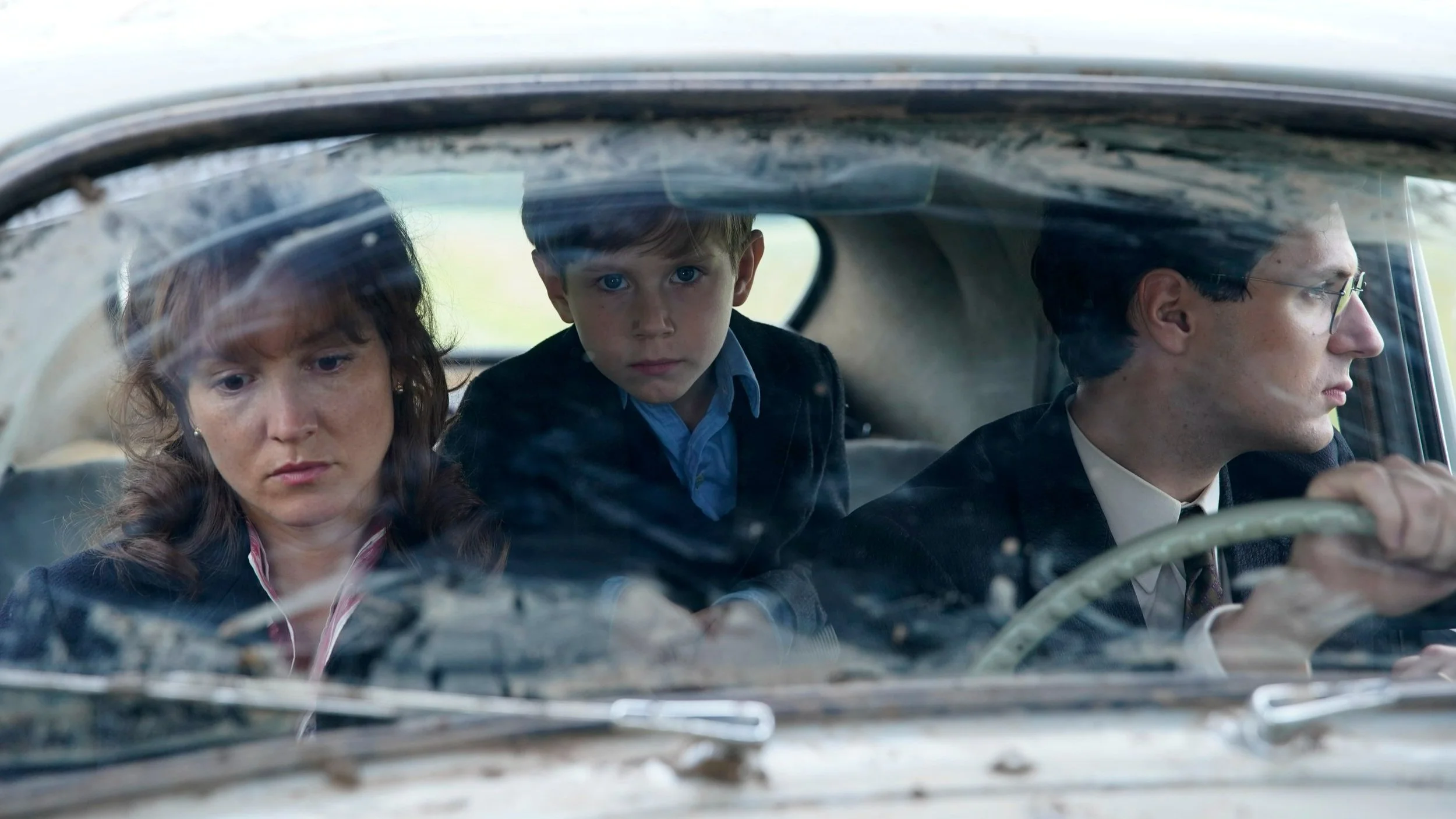
Anaïs Demoustier, Hélios Karyo, Vincent Lacoste
Image courtesy of Curzon.
The French filmmaker Katell Quillévéré has said that this latest film of hers, Along Came Love originally entitled Le temps d’aimer, was inspired by her belated discovery that her own grandmother had had a child by a German soldier during the Second World War. That was something that she had chosen to keep hidden and Quillévéré recognised in this situation a story well worth the telling. But in the light of that knowledge one of the things that one finds surprising about her film is that this theme is only part of the story and that it often loses out to a drama of a different kind with which it has been linked.
The opening of Along Came Love finds the film at its most effective and here at least it is this real-life event which is indeed its basis. Although for the most part this is a work photographed in colour, it starts with black-and-white images which take us back to 1945 and show the French not only celebrating the end of the war but also turning on women who had been sexually involved with Germans and humiliating them by shaving their heads. Here archive footage is closely blended with shots featuring our main character and thus begins the story of Madeleine (Anaïs Demoustier) who in this way has given birth to a son named Daniel.
We first see the child at the age of five played by Hélios Karyo when his mother is claiming that the boy’s father had died in the war although Daniel himself is reluctant to accept this. The narrative continues around 1947 when Madeleine is working as a waitress in a hotel restaurant in Brittany while later events will carry us through to the 1960s so that we eventually see Daniel at ten (Josse Capet) and then at eighteen (Paul Beaurepaire). Daniel’s desire to know more about the father his mother refuses to talk about remains an issue and as the boy grows up we witness the lack of warmth in Madeleine's treatment of her son. It could be that she lacks any strong maternal feelings, but it is perhaps more likely that her attitude stems from her sense of shame over the circumstances in which Daniel had been born. There is, however, less detail given here than one might expect.
It is during her time in Brittany that Madeleine encounters a well-off visitor to the area, François Delambre (Vincent Lacoste) and a bond between them is soon formed and leads to their marriage. It is indeed their relationship which becomes the central focus of the film and there is strong potential in this since the film becomes a study of a couple who share a real affinity and ease which cause them to see each other as soulmates while at the same time the sexual side of their relationship turns out to be decidedly problematical. Their marriage prompts a jealous and violent reaction from a man named Nicolas (Eugène Marcuse) and it becomes clear to us that he and François had been lovers. Given the decade in which this happens, we can ponder whether this means that François is a gay man who has married Madeleine either as a front or in an attempt to deny his sexuality or if instead we are to regard him as somebody who is bisexual. We do witness the wedding night when François fails to consummate the marriage and actually vomits although in time he and Madeleine will have a daughter, Jeanne (Margot Ringard Oldra).
To focus on the relationship of a loving couple who mean so much to one another despite not being able to find sexual satisfaction together could be a rewarding and touching tale and that makes it all the sadder that Quillévéré does not handle it more effectively. We do see how a few years on from the marriage the couple opt to run a dance hall in the city of Châteauroux which is frequented by American GIs from a local base. One of these is a black man from Idaho, Jimmy Wayle (Morgan Bailey), who becomes a friend. He is sexually drawn to Madeleine when she unexpectedly flirts with him and this leads to a sex scene which at her instigation turns into a threesome with Jimmy then becoming outraged when it becomes clear that François is turned on by him. As handled this scene lacks conviction but its inclusion, which is of course in keeping with sexual frankness in cinema today, makes one question why the film is so vague where it really matters which is in depicting what is happening between Madeleine and François in bed. This is a crucial element in a tale that lacks full clarity without it.
Another issue that arises is the tone of the film. A review of Along Came Love in The Hollywood Reporter suggested that its French title was a deliberate echo of Douglas Sirk’s 1958 movie A Time to Love and a Time to Die. Sirk was, of course, famous for melodramas and there are indeed times - the scenes concerning the jealous Nicolas, the sexual threesome – when Along Came Love takes on that tone but more often it plays in a relatively naturalistic mode. Yet at the same time despite passing through more than two decades the story finds Demoustier and Lacoste never seeming to age at all. Furthermore, given the stress on the marriage it hardly feels like a natural progression when the last section of the film suddenly reverts to placing the mother/son relationship screen centre. Overall, this is a film which feels somewhat ill-judged even if there is enough material to sustain its length and its heart is clearly in the right place given its sympathy for homosexuals at a time when gay sex was illegal in France. It is also the case that it is well acted, especially by the two leads, but as a whole the film achieves much less than one would have hoped.
Original title: Le temps d’aimer.
MANSEL STIMPSON
Cast: Anaïs Demoustier, Vincent Lacoste, Morgan Bailey, Hélios Karyo, Josse Capet, Paul Beaurepaire, Margot Ringard Oldra, Adrien Casse, Eugène Marcuse, Ambre Gollut, Anne See, Susana Alcantaud.
Dir Katell Quillévéré, Pro David Thion, Justin Taurand and Philippe Martin, Screenplay Katell Quillévéré and Gilles Taurand, Ph Tom Harari, Pro Des Florin Sanson, Ed Jean-Baptiste Morin, Music Amine Bouhafa, Costumes Rachèle Raoult..
Les Films du Bélier/Les Films Pelléas/Frakas Productions/France 2 Cinéma/Gaumont/Pictanovo-Curzon.
125 mins. France/Belgium. 2023. UK Rel: 30 May 2025. Cert. 15.
