

A truly remarkable drama from Taiwan may actually be too grim and demanding for its own good.
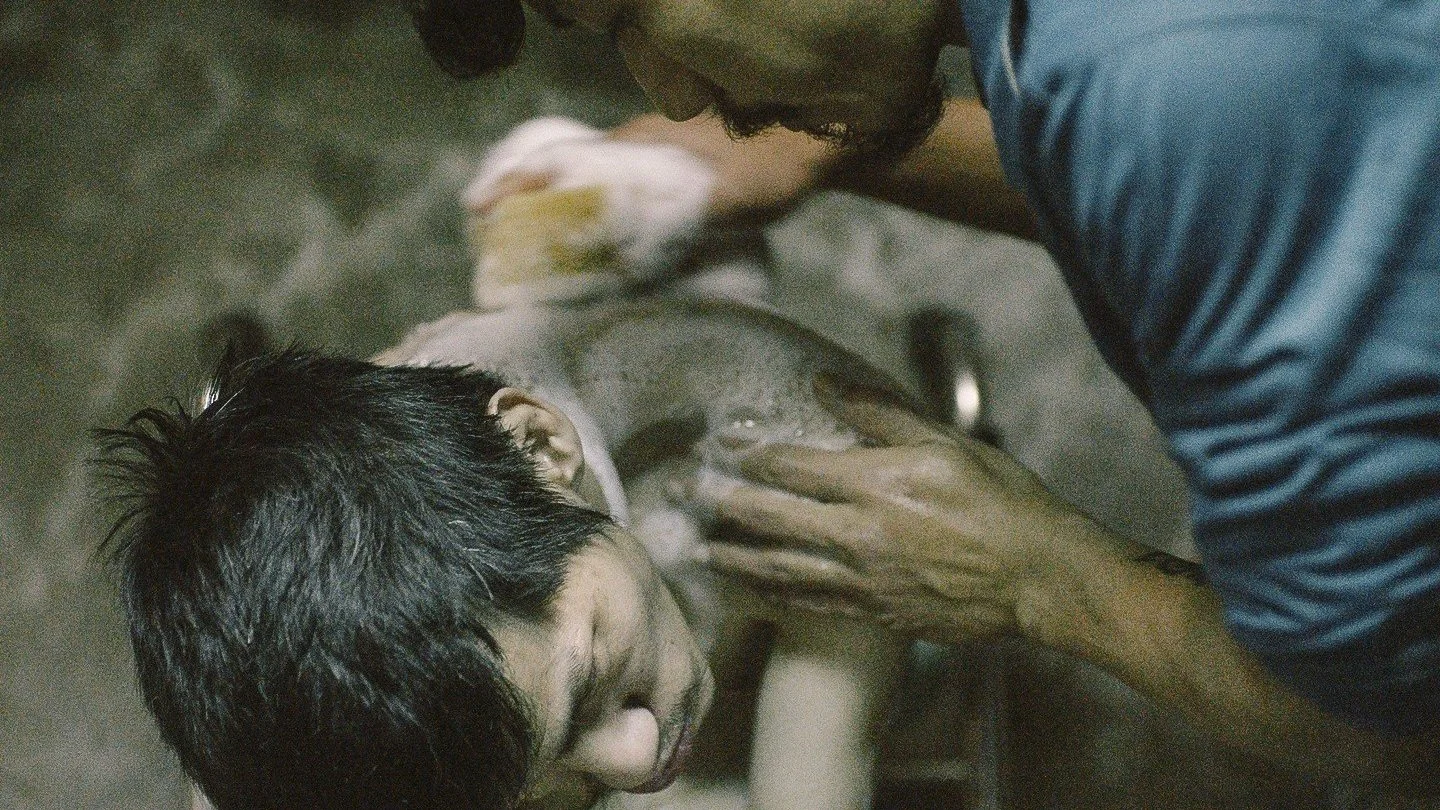
Image courtesy of Day for Night.
More often than not the rating that I have given to Mongrel is a pointer to a film being watchable but definitely not memorable. However, that is certainly not the case here since this work from Taiwan by the Singaporean writer/director Chiang Wei Liang, who makes this feature debut with his wife Yin You Qiao as co-director, is a truly remarkable piece even if it ultimately leaves a mixed impression. There is a strong sense from the outset that this is a work of intense seriousness made by somebody who is indeed an artist and has found for it a precise style suited to his particular purpose. Chiang, who is based in Taiwan and has set his film there, is in part drawing on personal experience and two major preoccupations of his are the terrible conditions of migrants in the Far East and the inadequacy of palliative care for the elderly and others in need. Both elements are present in Mongrel, a work in no way intended as an entertainment.
The film’s central character is Oom (Wanlop Rungkumjad) who is an illegal immigrant from Thailand working as a caregiver in the employ of a boss man, Hsing (Hong Yu-hong), who is exploiting Oom and others like him. What Chiang does is to portray the bleak existence of these people – the migrants seen come not only from Thailand but also from Vietnam, Indonesia and the Philippines – and of the patients they care for who are unable to afford more orthodox medical aid. In portraying their lives Chiang in effect imprisons us as though we are sharing their circumstances. This is done partly by adopting the old enclosed Academy ratio but also by proceeding at a slow pace and featuring long-held static shots without camera movement and by eschewing any music score that might distract from the sense of this being reality. Michaël Capron's finely judged photography is in colour but the production design by Ye Tzu-wei reflects the misery of their lives and the cast inhabit their roles without any sense at all of actorly display. By applying this approach so consistently the film feels less like some personal story than a portrayal of a complete world – the only one that these people know.
For some both the harshness of the vision and the minimalistic telling of the tale will render this a film to avoid, but there is nothing here incompatible with an attempt to create a true work of art. Indeed, the first half of Mongrel is deeply impressive, but I am less able to applaud the film when considered as a whole. One reason for this is the fact that when everything depicted is so grim a running time of over two hours makes it increasingly hard for viewers not to find it becoming burdensome for themselves. Another problem for me lies in the fact that what one might term the two sides of the story don't quite fit together as they should. Early on we find Oom looking after an elderly woman named Mei (Lu Yi-ching) and her son Hui (Kuo Shu-wei) who is suffering from cerebral palsy (the knowledge that the actor also has that condition himself adds to the darkness of the film if that is possible). This part of the story comes across as a key focus leading up to a moment when Mei indicates to Oom that she would approve of him helping her son to leave this life, a request that he refuses. Thereafter Mei and Hui largely disappear from the tale until they are abruptly and unexpectedly brought back late on to become central to the last part of the film.
In the meantime we have seen some of the migrant experience through scenes which show Hsing deceiving those working for him by allowing some to leave unaware that their fate in doing so is to become victims of human trafficking, this being something undertaken by Hsing under pressure from a gangster named Brother Te (Chen Wen-pin) to whom he is in debt. Oom is aware of what is going on and is to some extent complicit but, first by hint and then by action, he attempts to save some employees close to him from this fate. Earlier however he has been fully involved in concealing the fact that one woman working for Hsing has died (Oom has even assisted his boss in the secret burial of her body). Tough as Hsing is, there is some suggestion that he too is under pressure from the likes of Brother Te and is consequently to some extent another victim of this system.
Much of this is effectively dramatic but not all of the details are clearly explained and there is in the film’s second half an increasing sense that this desperate situation needs to be portrayed far more concisely if the weight of it is not to crush the viewer. The film has opened with an unexpectedly harsh illustration of what carers have to do but it has at the same time shown a tender side to Oom's character. When Mei and Hui come back into the tale, it will lead to an action by Oom which could be seen as a further example of his humanity asserting itself. Certainly Wallop Rungkumjad in his portrayal of Oom is splendidly adept at showing us a man whose association with Hsing could well be criticised but whose humane instincts are increasingly apparent. I was distantly reminded of Graham Greene’s novel The Power and the Glory but that was a work far more clear-cut in its portrayal of its central figure, a Catholic priest, who although outwardly far from saintly was in fact to be admired for what he achieved in spite of his weaknesses. Here the development in Oom's character remains more open to interpretation by the viewer, as is the emergence in the very last scene of the mongrel of the title which features the dog in a decidedly memorable last shot. That final image is a further reminder of the quality present in much of this film, but it exists alongside extended scenes which at 130 minutes can rather too often make this into an experience that feels overbearing.
Original title: Baiyi cang gọu.
MANSEL STIMPSON
Cast: Wanlop Rungkumjad, Lu Yi-ching, Hong Yu-hong, Kuo Shu-wei, Achtara Suwan, Chen Wen-pin, Monkao Teerapong, Asih, Jude Bermudez, Huang Kuei-hsiung, Hsu Phaksukya, Kantika, Fan Hsiu-mei.
Dir Chiang Wei Liang and Yin You Qiao, Pro Lai Weijie, Lynn Chen and Chu Yun-ting, Screenplay Chiang Wei Liang, Ph Michaël Capron, Pro Des Ye Tzu-wei, Ed Dounia Sichov, Costumes Yang Yi-Chun.
Deuxième Ligne Films/E & W Films/Le Petit Jardin-Day for Night.
130 mins. Singapore/Taiwan/France/The Netherlands/Japan/Germany. 2024. UK Rel: 23 May 2025. Cert. 15.