
& Sons

A starry family drama loses its grip thanks to a screenplay that becomes ever less convincing.
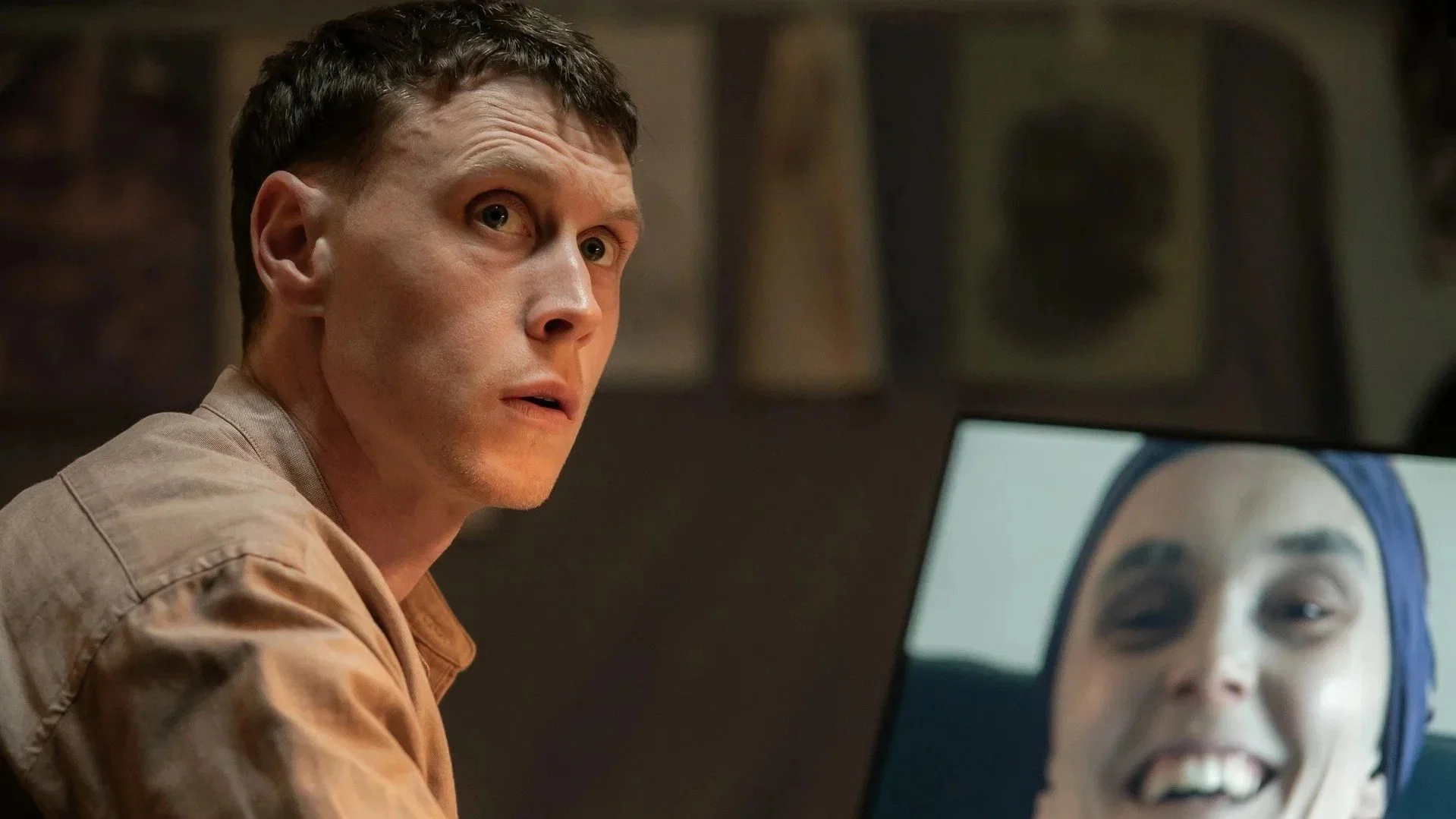
George MacKay
Image courtesy of Icon Film Distribution.
by MANSEL STIMPSON
There is always a risk when an established foreign filmmaker decides for the first time to make a film not in his or her own language but in English. Consequently, it was a wise move at least in theory for the Argentinian director Pablo Trapero on finding himself in that situation to opt for a screenplay which finds him credited alongside Sarah Polley. Over the years the Canadian actress has also become recognised as a talented writer/director with works such as Away from Her (2006) and Stories We Tell (2012). & Sons finds the two of them adapting David Gilbert's acclaimed novel of the same title and, if Polley’s involvement and Trapero’s own directorial skills seemed to promise success, anticipation mounted even more when one became aware of the number of talented actors participating in the film.
In the circumstances I was surprised when, just ahead of my viewing the film, I discovered that numerous online reviews by critics expressed strong disappointment with it. My own initial response was to feel that their comments had been much too harsh: it was not just that the actors were not letting them themselves down but that the opening scenes shot for the wide screen found Trapero, who was also involved in the editing, directing with pleasing fluidity. However, & Sons runs for two hours and the longer it went on the less persuasive I found it. The failure lies in the material itself and in the way in which the screenplay presents it although the acclaim for the novel makes that rather strange (the story now plays out in England rather than in America but that change is smooth enough and one assumes that in other respects the film follows the novel fairly closely).
What we have in & Sons is a film which, like a number of others, has at its centre a dysfunctional family. If hardly fresh, it is the kind of drama which, if handled with depth and finesse, can still make for great cinema. That was illustrated only last year when Joachim Trier gave us Sentimental Value. That was a film about a formidable patriarch who had always put his career as a film director ahead of his responsibilities to those dependent on him and who would readily use his own children and his own family history to bolster his once successful but now declining reputation. The more or less equivalent figure here is Andrew Dyer (Bill Nighy) but his fame is as a novelist. When we meet him he is something of a recluse, caustic in his comments and divorced from his former wife, Isabel (Imelda Staunton). She had left him after more than thirty years of marriage on the grounds that he had betrayed her by having a son, Andy (Noah Jupe), by another woman. The couple had earlier had two sons of their own, but the older one, Richard (Johnny Flynn) and his younger brother Jamie (George MacKay), have both suffered from their father's neglect and have had troubled lives. Indeed, Richard is a recovered alcoholic who has made a new life for himself in New York but whose attempts to write have been overshadowed by the fame of his father whose well-known novels remain very popular. As for Jamie, he too is seeking his own way but in his case as a documentary filmmaker.
At the outset it is established that Andrew Dyer is a cantankerous presence relying on a housekeeper (Anna Geislerová) to look after him but nevertheless showing real concern for young Andy who is nineteen years old and a student (this being in marked contrast to his attitude to Richard and Jamie in their youth). Now, however, claiming that he could be close to death, Andrew summons his adult sons and Richard travels over to England bringing with him his own teenage son, Emmett (Arthur Conti). When they are all together it turns out that Andrew’s purpose is to make an announcement that could never have been anticipated.
What I have described above is essentially a prelude which sets up the characters and builds towards what Andrew has to say and it is this early part of the film that works quite well. What follows, however, shows how the reactions to what Andrew has revealed range from total disbelief (dismissing it as the crazy fantasy of an old man) to apparent acceptance by way of extreme doubt that is later overcome. Since the revelation occurs some way into the film it is incumbent on critics not to reveal what it is. But if, as seems likely, the viewer’s reaction aligns with those who dismiss it as unbelievable then the tale becomes increasingly unconvincing as it proceeds because we are encouraged to take the opposite view. Had there been more cunning in the writing the film might have succeeded in making one ready to suspend disbelief. Instead of that, however, the screenplay opts for a subsequent surprise revelation on top of the first one, often feels contrived in its construction and, especially in the case of Richard, ranges through a series of changing emotions that never seem real to us.
The comparisons that can be made with Sentimental Value only emphasise the extent of this film’s failure. In that work the patriarch for all his failings invited a certain sympathy. But, while & Sons seems to want something of the same for Andrew Dyer, it never justifies it and for all Nighy’s efforts the character is a distancing one (what a contrast to what was achieved in Ian McKellen's characterisation of another older artist in The Christophers!). It is no less striking that & Sons brings up various issues about people who live by their art and about their work and their behaviour yet never goes deeply into them as Sentimental Value did. As you would expect, Staunton does everything that could be done for the role of Isabel, but the conviction that she brings to it can't sell one on the story being told when so much of it fails to ring true. Admittedly all the players emerge with their reputations intact. Nevertheless, one is left with a strong belief that they would have been better off making some other film. If there is an exception to that, it is Noah Jupe whose role, the most sympathetic in the film, proves far closer to being a leading figure than one might expect. A role as prominent as this is what he so richly deserved.
Cast: Bill Nighy, Noah Jupe, George MacKay, Johnny Flynn, Imelda Staunton, Arthur Conti, Anna Geislerová, Shalom Brune-Franklin, Dominic West, Pamela Shaw, Charlotte Dauphin.
Dir Pablo Trapero, Pro Phin Glynn, Axel Kuschevatzky, Cindy Teperman, Christina Piovesan, Emily Kulasa, Trudie Styler, Celine Rattray, Jackie Donohoe and Pablo Trapero, Screenplay Sarah Polley and Pablo Trapero, from the novel by David Gilbert, Ph Diego Dussuel, Pro Des Sonja Klaus, Ed Pablo Trapero, Gemma Cabello and Thom Smalley, Music Cristobal Tapia de Veer, Costumes Allison Wyldeck.
Infinity Hill/Elevation Pictures/Bankside Films/Calculus Media/Double Garage Films-Icon Film Distribution.
119 mins. UK/Canada/USA. 2025. UK Rel: 21 August 2026. Cert. 15.
