
A disabled woman fights for social change in Sian Heder’s passionate recreation of historic events.
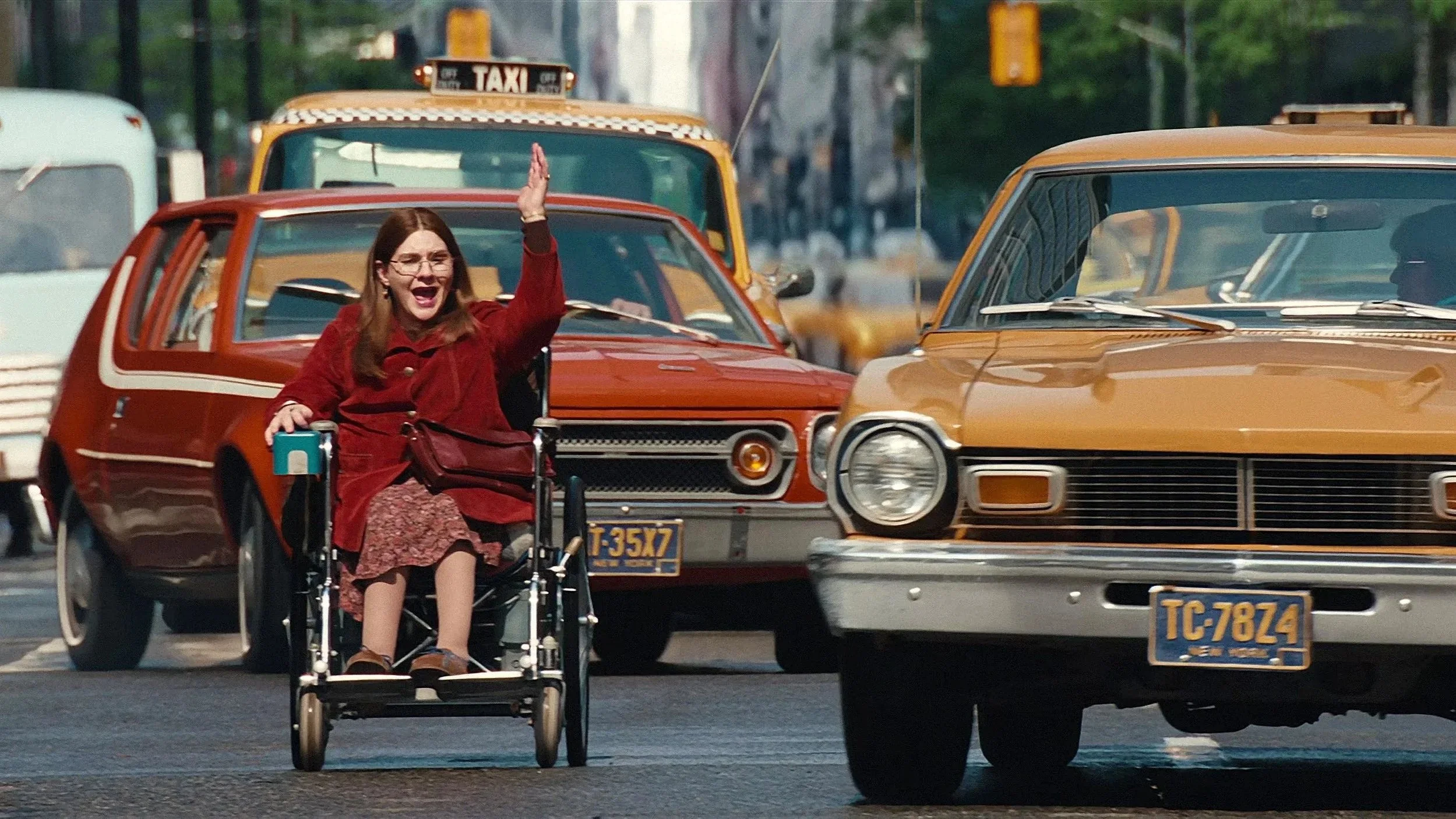
Street fighter: Ruth Madeley as Judith Heumann
Photo courtesy of AppleTV+.
by JAMES CAMERON-WILSON
Great title. Judith Heumann contracted polio at the age of 18 months and was a wheelchair user all her life. There’s a line in Sian Heder’s new film when someone says, “if the world thinks you’re invisible, you begin to think you’re invisible.” Yet, in spite of her debilitating disability, Judith was very human, with a sharp intellect, enormous courage and profoundly sexual feelings. Every human, regardless of what body they are packaged in, needs the comfort of human touch. But, hell, being strapped in a wheelchair means that doing your business can be quite a business. And Being Heumann doesn’t shy away from showing the daily humiliations of needing to visit the bathroom when you need to. Here, the Philadelphia-born Heumann is played by the English actress Ruth Madeley, who herself is a wheelchair user (she was born with spina bifida) but who has managed to carve herself an impressive acting career, including the lead in the recent BBC series The Rapture. She is already being hotly tipped for an Oscar nomination in some quarters which, if she lands one, would be a major breakthrough for disability rights.
Being Heumann starts with a bang as, accompanied by Iggy Pop’s ‘The Passenger’, the camera follows Judith Heumann as she races along the asphalt, tall buildings reflected in the puddles around her, way beyond her wildest dreams. Here, she is still at ground level, looking up and attempting to navigate the oblivious pedestrians, New York cabs and juggernauts around her. They just don’t see her – and, if they do, she is in their way. Judith Heumann is on a mission, though, to try and get the authorities to recognise – and to sign into law – Section 504 of the Rehabilitation Act of 1973 which recognised that 36 million disabled people in the US were entitled to the same equal rights and access as the rest of the population. However, the implementation of the bill was proving to be prohibitively costly.
As Heumann meets up with other marginalised New Yorkers at a peaceful protest, she decides to take the law into her own hands and gears everybody up to stop the traffic in the street. By now, just four minutes in, the director (and co-writer) Sian Heder has pretty much won her audience round and, depending on one’s sensibility, unleashed the first round of tears.
Heder’s first film, Tallulah (2016), won great critical commendation but was tucked away on Netflix and largely ignored. Her second feature also went straight to streaming (on AppleTV+) and while largely unseen by the public at large, won Oscars for best picture, best adapted screenplay and best supporting actor (Troy Kotsur). That film was CODA and also starred an English actress, namely Emilia Jones as Ruby, the child of deaf adults (hence the title). Now Heder has more than just deaf actors to play with, but the blind and dumb, amputees and various representatives of the marginalised who gather round Heumann to make their voices heard (even if they don’t have voices). United by a common mission, the activists make up a motley crew, storming the Department of Health, Education and Welfare in San Francisco for a sit-down protest.
Heder paints quite a scene of camaraderie, and not without humour, such as when a blind man (Charlie Rush-Reese) is assisted by a fellow protestor, to whom he politely says, “thank you.” “He can’t hear you!” volunteers another. Likewise, when Heumann defends herself, she says, “I’m not an asshole, I’m from Brooklyn.” Not all of this rings true, but the feeling of united humanity and the exploration of what it feels like to be disadvantaged is overpowering. Perhaps the most telling note is sounded when Heumann, on the phone, comforts her bureaucratic enemy Joseph Califano (Mark Ruffalo) – at a moment when he feels professionally compromised – “yeah, but when you’re old, you’ll still be able to get up and down off the sidewalk.”
Cast: Ruth Madeley, Madeline Delp, Roberta Colindrez, Jon Beavers, Antwan Tolliver, Ray Fisher, Mark Ruffalo, Dylan O’Brien, Rob Delaney, Andrew Pilkington, Michael Patrick Thornton, Russell Harvard, Daniel Durant, Charlie Rush-Reese, Rio Finnegan, D’Arcee Charington Neal.
Dir Sian Heder, Pro Kevin J. Walsh, David Permut, Sian Heder, John W. Beach and Kevin Cleary, Ex Pro Judith Heumann and Diana Pokorny, Screenplay Sian Heder and Rebekah Taussig, from Judith Heumann’s memoir Being Heumann: An Unrepentant Memoir of a Disability Rights Activist, Ph Jamie D. Ramsay, Pro Des John P. Goldsmith, Ed Geraud Brisson, Music Francesco Le Metre, Costumes Danny Glicker, Sound Harry Cohen, Dialect Coach Maeve Diamond.
Apple Studios/The Walsh Company/Gravity Squared Entertainment/Permut Presentations/Paper People Films-AppleTV.
128 mins. USA. 2026. UK and US Rel: 13 November 2026. Cert. 15.