
Sebastian Stan and Renate Reinsve play devout evangelical Christians in Cristian Mungiu’s Palme d’Or-winning drama set in Norway.
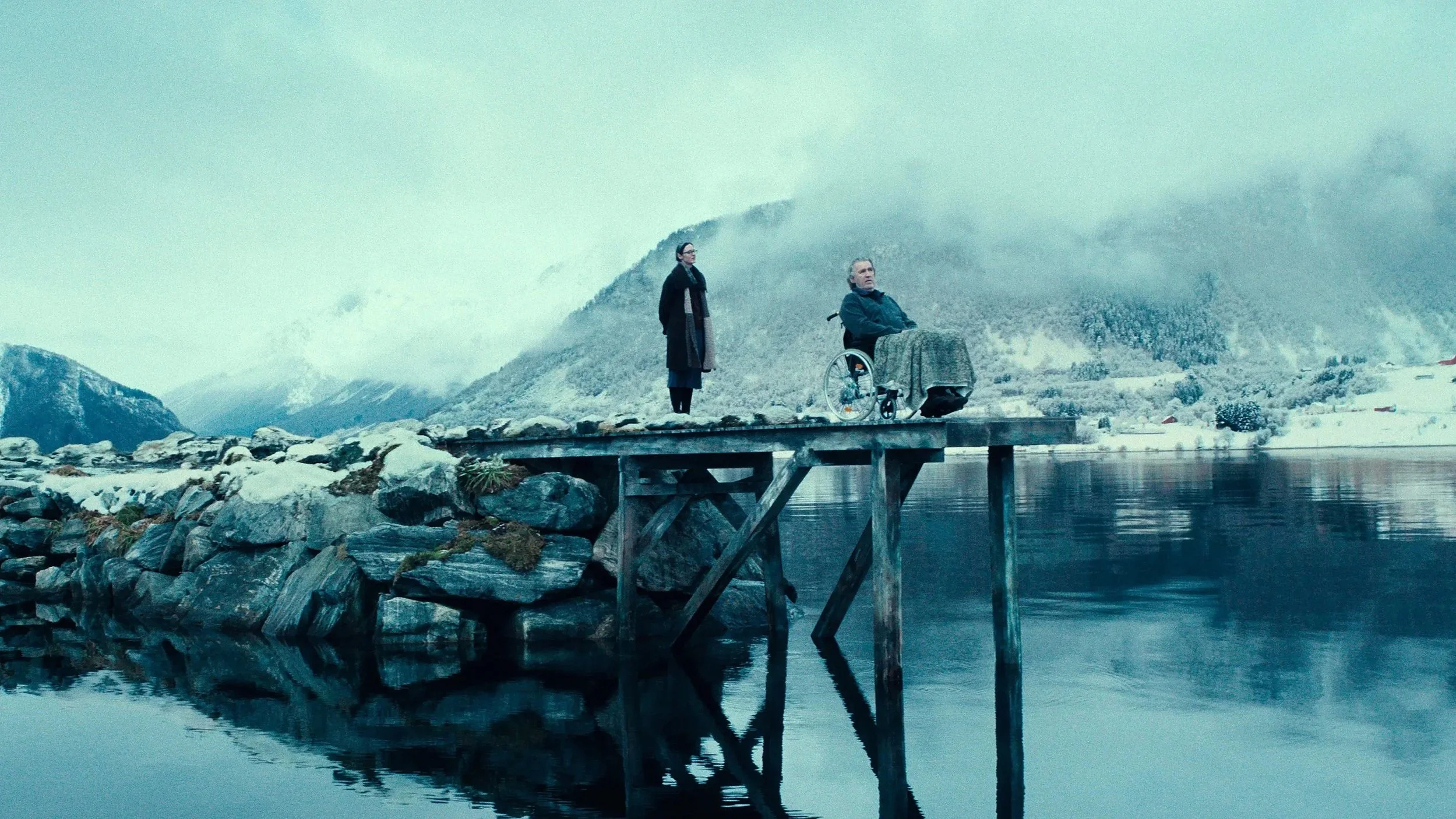
Image courtesy of Picturehouse Entertainment.
by MANSEL STIMPSON
The record of the Romanian director Cristian Mungiu who always writes his own screenplays is notable for the fact that all of them have won awards. That started with Occident made in 2002 but the film which made him an international name was 2017’s 4 Months, 3 Weeks, 2 Days. His subsequent work has continued to confirm his standing as a serious filmmaker deeply concerned with social and political issues within his own country. His latest offering, Fjord, has a leading character who is Romanian, that being Mihai Gheorghiu played by Sebastian Stan who is himself Romanian despite also now having American citizenship. Nevertheless, Fjord does stand apart from Mungiu's other work to the extent that it is set not in Romania but in Norway. It is to that country that Mihai comes since his parents have died and his wife, Lisbet (Renate Reinsve), who works as a nurse, is Norwegian and has family there. They have no less than five children - the two oldest of whom, Elia (Vanessa Ceban) and Emmanuel (Jonathan Ciprian Breazu), are teenagers - and Lisbet's mother is willing to help out with them.
The opening scenes of Fjord show the Gheorghius settling into the new community where they have chosen to live and where both parents find work – Lisbet continues to nurse while Mihai has engineering skills. It so happens that their neighbour, Mats (Markus Scarth Tønseth) is the principal of the local school where Elia and Emmanuel are now enrolled and Noora (Henrikke Lund-Olsen), the daughter of Mats by his first marriage, also attends. As for the present wife of Mats – that's Mia played by Liza Carlehad – she is a lawyer and the two families get on well. That's particularly so in the case of Elia and Noora although the latter is behaving in ways that cause concern to both Mats and Mia. It is apparent that the Gheorghius stand apart from those around them because, in addition to the Romanian blood in the family, they are deeply religious and adhere to the evangelical beliefs and outlook of the Pentecostal church. Nevertheless, initially there is no sense that any of this will prevent them from fitting in and being accepted in this new setting.
From the very start, Fjord illustrates why Cristian Mungiu has built up such a strong reputation. He has always had a rapport with his players that brings out the best in them and that is certainly the case here. Stan and Reinsve are both on fine form, but it is also the case that the large supporting cast are all impressive too in an unactorly way that contributes to the sense that we are watching real people in a real world. There is an immediate sense of everything being lived in and the flow of the film seems natural and unforced. The film is further enhanced by the excellent wide screen colour photography of Tudor Vladimir Panduru working with Mungiu for the third time and the complete conviction of the piece ensures that we identify fully with the Gheorghius when what seems like an insignificant detail suddenly blows up into something that threatens their whole future as a family.
For the critic, Fjord is a work which raises that not unfamiliar issue of how much to disclose about the plot. In some ways it feels appropriate not to reveal the nature of the incident which becomes such a big issue even though it arises relatively early in the film and is crucial if you want to know what Fjord is actually about. I feel that a compromise is called for so I will not at this stage disclose the nature of the film’s subject matter but will move on instead to say why the second half of Fjord became for me disappointing. Ironically that was felt more keenly because what I had seen up to that point had seemed to promise a masterpiece. Part of the problem for me is undoubtedly the film's length: the material just doesn't seem to call for a running time of almost two and a half hours. The drama that unfolds does involve court proceedings and, given the tone of the piece, I think it apt that everything around that aspect of it is made to feel closer to documentary than to melodrama. However, the realism is such that when we get to the actual trial scene one suddenly feels that the scope of the comments made by the prosecuting attorney (Christian Rubeck) is contrived. It seems as wide as it is in order to tick off points that the film wants to make. There is also a strong sense that the screenplay portrays a key instigator of the proceedings, Gunda played by Ellen Dorrit Petersen, in a way that far too knowingly makes her the villain of the piece.
Away from this main thrust of the tale, there are other aspects which come to feel less than satisfactory. The character of the troubled Noora (she cuts a wrist at one point) feels insufficiently rounded out and it is odd to find a tangential element – the growing bond between her and Elia, which might be leading to the suggestion that Elia is lesbian – suddenly being highlighted when it features so prominently in the film’s closing moments. Similarly, there are scenes with the elderly father of Mats, Åke (Yvind Venstad Kjeksrud), which hardly seem to justify their place in a film of this length. Viewers who favour very long movies may be more able to ignore the sense that Fjord is a potentially great film which would have gained substantially had it been more pared down or better able to justify those scenes in it which seem like offshoots.
At this point for those who would like to know more about the issues central to Fjord I will add some clarification (so please stop reading if you don't want to be told). At the school a bruise on Elia’s neck is noticed and the Child Protective Services step in and on questioning her and Emmanuel gather that Mihai from time to time disciplines his children in a way that amounts in the eyes of the Norwegians to beating them. Mungiu's film suggests that, even if Mihai’s actions might need to be toned down, the children love both their parents and want to be with them and for the authorities to put the children in foster care pending a trial that takes long to set up is in itself an excessive reaction (even Lisbet’s baby is taken away). Apparently Child Protective Services in Norway are indeed controversial due to the low threshold for launching investigations and Mungiu is certainly supporting that view while asking his audience to come to their own conclusions. This is valid and interesting subject matter which also extends to the question of whether or not racial issues play an unacknowledged part in the way that the authorities pursue this case. It might have yielded a fine film had Mungiu opted for, say, a two-hour running time. But, while for me 146 minutes was far too long, others disagree and among other awards Fjord won the 2026 Palme d’Or at the Cannes Film Festival.
Cast: Sebastian Stan, Renate Reinsve, Lisa Carlehad, Ellen Dorrit Petersen, Lisa Loven Kongsli, Henrikke Lund-Olsen, Vanessa Ceban, Markus Scarth Tønseth, Christian Rubeck, Yvind Venstad Kjeksrud, Anne Kokkinn, Maria Bock, Jonathan Ciprian Breazu, Giulia Nahmany, Sofie Vartdal, Bartek Kaminski.
Dir Cristian Mungiu, Pro Cristian Mungiu, Dyveke Bjørkly Graver, Andrea Berentsen Ottmar, Katrin Pors, Mikkel Jersin, Jussi Rantamäki, Emilia Haukka, Sean Wheelan, Kristina Borjeson, Mimmi Spang, Pascal Caucheteux, Vincent Maraval, Gregoire Sorlat, Marco Perego and Adela Vranceanu Celibadache, Screenplay Cristian Mungiu, Ph Tudor Vladimir Panduru, Pro Des Marius Winje Brustad and Simona Paduretu, Ed Mircea Olteanu, Music Kaspar Kaae, Costumes Kirsi Gum.
Mobra Films/Why Not Productions/Eye Eye Pictures/Film I Väst/Snowglobe Films/Goodfellas/France 3 Cinéma/Aamu Film Company-Picturehouse Entertainment.
146 mins. Romania/France/Norway/Denmark/Finland/Sweden. 2026. US Rel: 9 October 2026. UK Rel: 13 November 2026. Cert. 15.