
Being Ola

Ragnhild Nøst Bergem’s memorable and affectionate documentary centres on a Norwegian man with developmental difficulties.
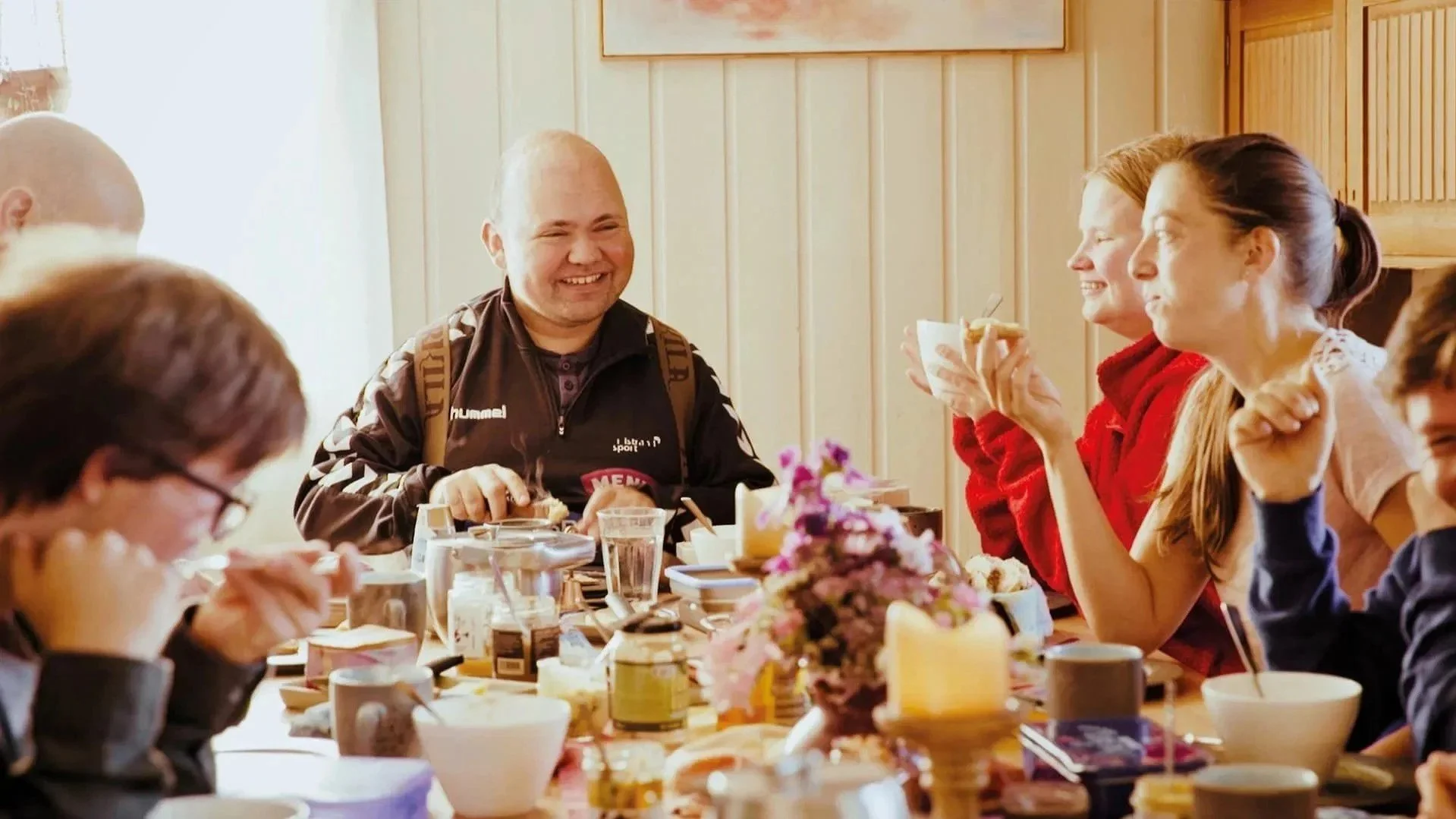
Image courtesy of Tull Stories.
by MANSEL STIMPSON
Ragnhild Nøst Bergem’s documentary Being Ola is made with such evident affection that it is no surprise to learn that there is a backstory to it. Bergem was born in 1990 and made her first feature, the award winning Vær her, in 2021. But it was before that when making short films that it became apparent that Bergem had a particular interest in filming documentary studies about people who lived with various forms of dementia and nerve disease. Early on this ambition led to her going to the village of Vidaråsen in the Norwegian county of Vestfold and while there she met for the first time a young man named Ola Henningsen. He was the same age as her and a friendship would grow up between them. This connection and her enthusiasm for this place - it was one in which people with learning difficulties and those without them existed together as a working community - drew her back and would result ultimately in this documentary feature which is centred on Ola himself.
The creation of this village in 1966 derived from a concept that had first taken root in Scotland around 1939 and which, drawing on the anthroposophical beliefs of Rudolf Steiner, led to the creation of the Camphill Village Trust, a company which had a clear aim. It was dedicated to setting up what have been described as inclusive, life sharing environments for children and adults with learning disabilities, mental health issues and other special needs. Vidaråsen became the first example of this in Norway. By choosing to concentrate on Ola himself, Bergem avoids the kind of documentary which would incorporate interviews through which the history and aims of this trust would be central. Instead, she follows the day-to-day life of Ola as somebody who, having been assessed as having developmental difficulties at the age of eleven, arrived in Vidaråsen uneasy about becoming part of this community but soon came to be immensely positive about living there.
Putting the focus so fully on Ola in this way makes Bergem’s film come across as a highly personal one, but at the same time there is a strong sense that Bergem recognises the extent to which what we learn about Ola makes him a fine representative of all those who are living lives comparable to his. Consequently, it fits that we are never told the precise details of the diagnosis which Ola received and which helped to explain why he was so slow to develop and express himself. What counts here is how Ola is so honest and engaging about his progress. He admits that there will be failures at times (he doesn't hold back from describing one such moment as a fiasco) but he shows admirable fortitude and persistence even though he recognises that becoming fully the person that he is will inevitably be a gradual process.
The first half of Being Ola establishes the individual style of the piece but, despite the absence of a narrator, Bergem ensures that we learn plenty about the nature of this village with its 150 inhabitants. We glimpse the shared activities, its shop, farm and dairy and its range of workshops which extend from painting to woodwork classes alongside outdoor games and instructions in cleaning. Another example of something both particular to Ola and simultaneously illustrative of the warmth of feeling in this shared community is the close friendship that grows up between Ola and a Dane, Lasse, who is working there and is not disabled. Lasse himself finds the set-up there highly appealing, but there is the drawback that being a young man he feels obliged not to stay indefinitely because his parents and family back in Denmark are missing him. It is a blow for Ola when Lasse decides that the time has come when he must return home and that is because the help needed and the help provided have drawn these two so closely together.
As time goes on, we will see another form of personal involvement when in a very basic yet heartfelt way Ola seeks to play ‘Chopsticks’ on the piano in celebration of one of the helpers who is celebrating her 70th birthday. More significantly, we become aware too of Ola's interest in writing as evidenced both by a story slowly composed which he eventually reads out and by a trip to town to be both host and speaker in an event at an establishment known as The Literature House. We come to realise that step-by-step Ola is becoming more independent in outlook even if achieving something of that in Vidaråsen itself is more within his grasp and capability than moving away would be. Nevertheless, having seen earlier how he retains contact with Lasse, the last section of Being Ola shows him setting out for Copenhagen in the company of the filmmaker in order to meet Lasse once again. There they reaffirm their lasting friendship.
These concluding scenes enable Being Ola to end on a positive note and one certainly comes to admire the spirit that drives Ola on. The film itself is to be welcomed not only for finding such an apt central figure but for its tone which extends to Eivind Hannisdal’s well-judged music score. Similarly appropriate is the decision not to overextend the material. The running length of 72 minutes is modest but entirely acceptable. I was distantly reminded of a too little-known documentary about a family in which the two sons were both diagnosed with Duchene muscular dystrophy. That film, A Space in Time made by Riccardo Servini and Nick Taussig in 2020, was absolutely remarkable in the way that the love shown in it made the film quite extraordinarily uplifting. That's a rare achievement in such a context and Being Ola not surprisingly does not quite match it. Nevertheless, this is a memorable work which can be regarded as a fitting triumph for Ragnhild Nøst Bergam and for Ola Henningsen himself.
Original title: Ola - En helt vanlig uvanlig fyr.
Featuring Ola Henningsen, Lasse Kortegaard Kristensen, Arnkjell Ruud, Ragnhild Nøst Bergem, Per Henningsen, Tone Henningsen, Amalie Holtegaaard.
Dir Ragnhild Nøst Bergem,Pro Eirin O. Høgetveit, Hans Lukas Hansen and Even Vesterhus, Screenplay Ragnhild Nøst Bergem, Ph Ragnhild Nøst Bergem, Ed Helge Billing, Stefan Sundlöf and Ragnhild Nøst Bergem, Music Eivind Hannisdal.
Einar Film-Tull Stories/Oska Bright Film Festival.
72 mins. Norway. 2023. UK Rel: 3 April 2026. Cert. PG.
