
DJ Ahmet

A 15-year-old Macedonian shepherd turns his back on the traditional values of his village in Georgi M. Unkovski’s comedy-drama which blends popular and arthouse appeal.
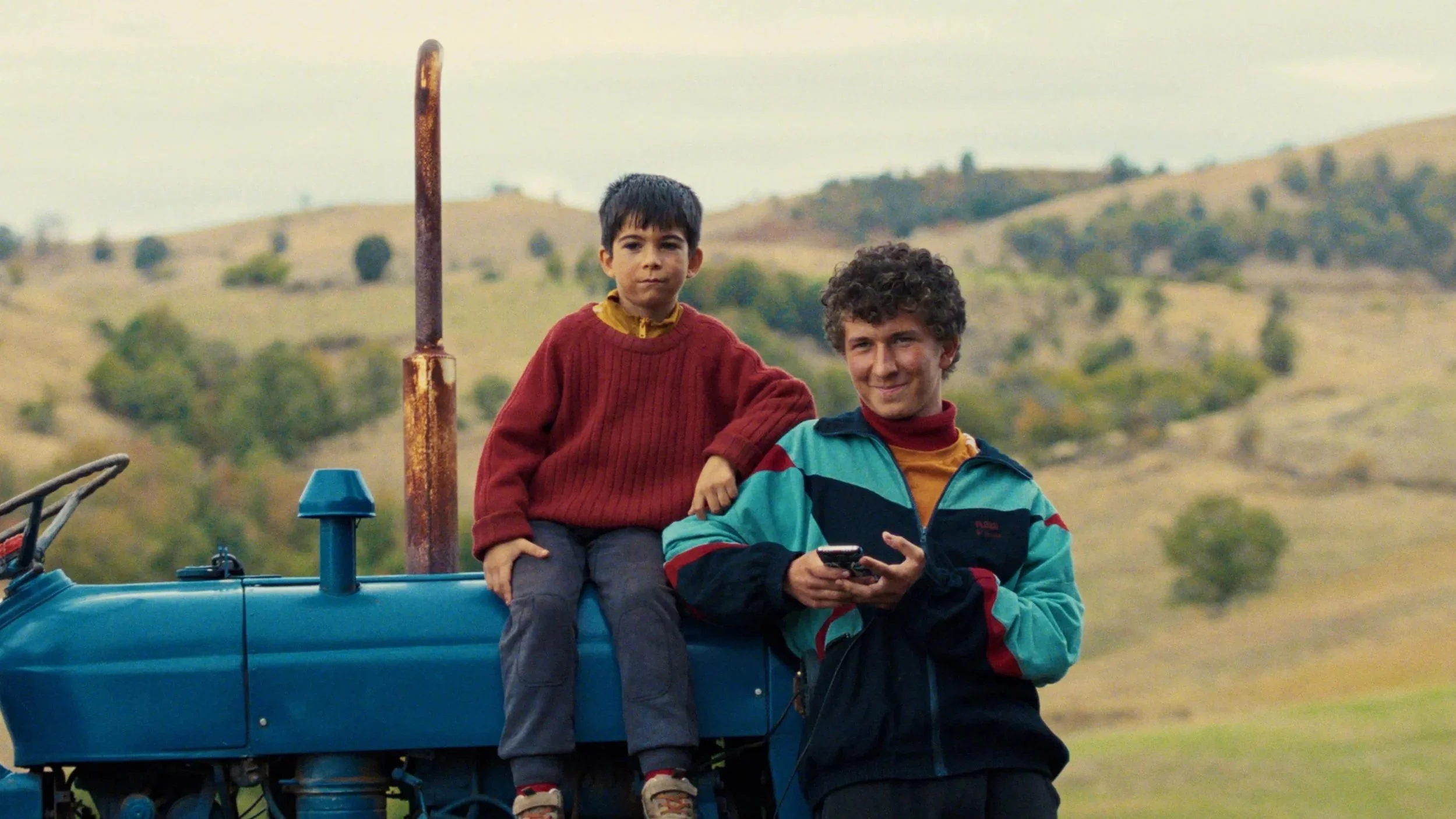
Image courtesy of Conic.
by MANSEL STIMPSON
DJ Ahmet is the most perfectly cast film that I have seen since I Swear and that is saying something since it was for that film that Lauren Evans rightly won the 2026 BAFTA award for Best Casting. Here that is the work of Kirijana Nikoloska and her success is all the more striking because the three leading players are all youngsters who had not appeared in a film before. The central focus is on two brothers in Macedonia who are living with their father. Ahmet (Arif Jakup) is fifteen and is very attached to his younger sibling, Naim (Agush Agushev). The third young player is Dora Akan Zlatanova in the role of Aya who, having been in Germany, has just returned to her grandmother's neighbouring house. She quickly takes the eye of Ahmet and responds positively. Nonetheless, their prospects are not good because an arranged marriage is being set up for Aya and the proposed bridegroom has better standing than Ahmed and is therefore in that sense a much superior match.
The filmmaker Georgi M. Unkovski was born in 1988 in New York but is indeed Macedonian and has now settled in that country which is the setting for his films. Until now they have been short pieces, so DJ Ahmet on which he is once again the writer as well as being the director is his first feature. It would appear that in making films in his own country he wants to capture a sense of life there, but in doing so he is also seeking to create work that has strong popular appeal. That he is succeeding in his aims is evidenced by the fact that DJ Ahmet has won no less than nine awards at festivals and many critics have admired the way in which it adroitly blends charming commercial appeal with qualities that mark it out for arthouse success. That was perhaps most aptly recognised at the 2025 South East European Film Festival held in Los Angeles where it won as Best Feature twice over gaining both the Audience Award and the Grand Jury Prize.
As I have already indicated, I feel that the casting here is exemplary and that means above all that audiences will relish the natural and unforced performances by those playing the two brothers. It was Arif Jakup who picked up a best actor award (this in Seville) but I may well not be alone in finding young Agush Agushev even more memorable. However, while the film is appealingly shot in wide screen by Naum Doksevski and thus gains extra appeal from its unfamiliar rural landscape, I do feel that as writer/director Georgi M. Unkovski still has quite a lot to learn. What he has created has huge potential but in telling his story he fails to blend the ingredients in a way that flows and coheres as much as one would wish.
Part of the problem lies in the fact that there are several threads to the piece which tend to intrude on each other. Furthermore, that is exacerbated by the fact that Unkovski fails to give his film a consistent tone. At the outset, for example, and again at the close, a long shot of women under a tree suggests a kind of Greek chorus commenting on local gossip and events. But, in contrast to this ancient feature, what immediately follows is a realistic contemporary tale which finds Ahmed’s father taking the boy out of school to help with the work on the farm which he runs and to look after the sheep. We see that the younger son, Naim, is not speaking and what I had read about the film before seeing it made it clear that Naim’s silence is a reaction to the death of the boys' mother. One might guess that although a speech impediment could explain it too, but the narrative leaves the issue uncertain for a long time. Nevertheless, the family situation and the father’s persistence in taking the reluctant Naim to a healer looks set to be central to the story. But then Aya comes into the picture, a song bursts out on the soundtrack and a touch of slow motion is added. This tells us that DJ Ahmet has just become a love story. It's a clear indication of this but it no longer feels a natural part of the realistic mode present in all the family scenes.
At this point and quite out of the blue we find another element coming into play, one which links with the film’s title in that we learn that Ahmet is keen on pop music. He secretly goes out at night when his father is away to attend a local rave in the forest nearby where Aya is also present. However, while he dances away ecstatically the sheep get loose and disrupt the event. The occurrence is videoed and goes viral which makes Ahmet something of a celebrity but not in a good way. That one of the wandering sheep goes missing adds to his problems. In realistic terms this does bring out the contrast between the traditional ways that persist in this region and the encroachment of the modern world (even that Greek chorus at the start has referenced the internet!). Nevertheless, the night sequence leading into the rave and its disruption is shot and edited in a manner which is sufficiently heightened to feel stylised and not an appropriate fit in this context. More successful is the introduction of comic touches, not least when Ahmet finds himself advising the local cleric over a fresh password for his emails.
As DJ Ahmet proceeds the challenge which Ahmet faces in seeking to win Aya against the odds comes to dominate, but with music continuing as a main thread too (there is a dance performance at a Yuruk Festival which plays a key part in the story). But the bitty approach of the earlier scenes tends to persist. The excellent casting which extends beyond the leads to the faces of the subsidiary locals means that the tale of a family that has suffered a bereavement plays so involvingly that it sets a standard that the film fails to maintain once the other aspects are allowed to disrupt it and take over. But the appeal of Arif Jakup and especially that of the near silent Agush Agushev is so strong that many viewers may find that it quite overrides what for me are the film’s drawbacks. So good are these youngsters and so welcome the opportunity to see Northern Macedonia on the screen that I can well understand why many will find this a winning work.
Cast: Arif Jakup, Agush Agushev, Dora Akan Zlatanova, Aksel Mehmet, Selpin Kerim, Metin Ibrahim, Atila Klince, Adem Karaga, Nadzi Shaban, Din Ibrahim, Usein Mustafa, Elhame Bilal
Dir Georgi M. Unkovski, Pro Ivan Unkovski and Ivan Shekutkoska, Screenplay Georgi M. Unkovski, Ph Naum Doksevski, Pro Des Dejan Gosevski and Aleksandra Cevreska, Ed Michal Reich, Music Alen Sinkauz and Nenad Sinkauz, Costumes Roza Trajceska.
Cinema Futura/Bas Celik Sektor Film/Backroom Production/365 Films/Alter Vision/Analog Vision-Conic.
99 mins. Macedonia/Czech Republic/Serbia/Croatia. 2025. UK Rel: 27 March 2026. Cert. PG.
