

Amanda Kramer’s crazy and fantastical comedy actually exhibits an emotional depth, which is just one aspect of her remarkably individual work.
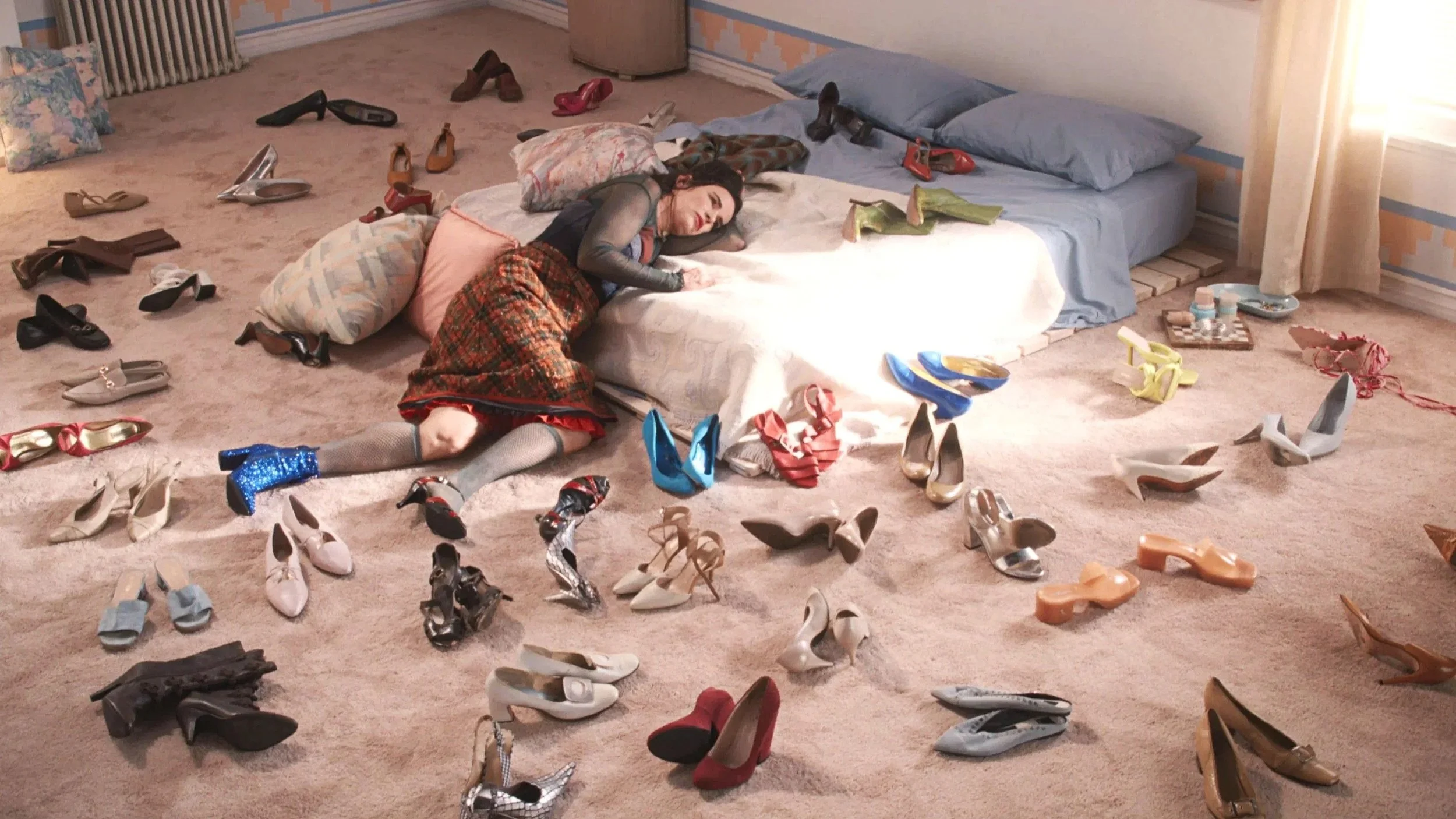
Image courtesy of Bulldog Film Distribution.
by MANSEL STIMPSON
In choosing to describe this film as a sad comedy I am already indicating that it is a work very much out of the ordinary but its intense individuality goes much further than that. By Design is the work of Amanda Kramer an independent filmmaker with a voice of her own. Although she has made a number of films not only as director but as a writer too, this is the first time that I have come across her work. It appears that By Design has, like some of its predecessors, met with decidedly mixed reactions and its concept is so odd that I was quite ready to find the film not at all to my taste. However, in the event I found its offbeat nature extremely engaging.
Films involving a body swap are by no means unknown – indeed Disney made Freaky Friday twice for the cinema and second time around followed it up with a sequel. Nevertheless, this element although at the heart of By Design takes on a completely original form here. That is because the body into which its central character, a woman in her forties named Camille (Juliette Lewis), enters is not another human being but a distinguished and stylish chair which she has seen in a salesroom. Camille regularly lunches with her best friends Lisa (Samantha Mathis) and Irene (Robin Tunney) after which they often look around shops together usually without making a purchase. But on this particular occasion Camille sees the chair and is so entranced that she decides that she must buy it even though she is much less well-off than her friends. Having checked out that she can afford it, she returns the next day only to learn that she has missed out because the chair has just been acquired by Marta (Alisa Torres). The previous day she had felt that the chair had called out to her and she had seen it as an object to be envied because it could readily be somebody's favourite thing. In shock at losing it, she wishes that she were the chair and in an instant her physical body collapses, but her inner self and indeed her soul now reside unseen within the chair.
This is, of course, an extraordinary set-up which might simply feel too silly to be the pivot of an effective story. However, Amanda Kramer has more ways than one of surmounting this hurdle. Crucially two factors quickly coming to play. The first is that Kramer adopts an element of striking stylisation from the start (it is present in the set designs, the colourful costumes and the style of shooting) so that any expectation of naturalism is countered outright. Even more importantly in the long run, Kramer makes it evident early on that her film is not just a comic fantasy but a metaphorical exploration of real issues in society and the way in which people live.
In her capacity as writer Kramer shows her skill from the outset by setting up her story using an offscreen narrator who is able to speak for Camille thus telling us her inmost thoughts. In this way we see things from Camille's viewpoint and recognise that there is no satisfaction in her life. She longs for someone who would recognise and respond to her true self and with whom she could share ideas. In contrast to that, Lisa and Irene are really using her: they act as her best friends but are always taking advantage of that in order to treat her as someone to whom they can confide gossip (sometimes about each other) while feeling superior because of their wealth. On the other hand, Camille can see the chair as being an object of desire and she wants to be appreciated in a like manner, to actually feel that for herself.
While Camille’s situation is at the centre of the tale, we find that the notion of life lacking fulfilment applies also to the other characters. The main plot development shows how the chair ends up in the sparsely furnished department of a black pianist named Olivier (Mamoudou Athie). Marta had been his girlfriend and her purchase of the chair was a parting gift to him having removed her own furnishings from their previously shared accommodation. Thus, Olivier is somebody whose life is not running smoothly. That extends to him getting by through working in a nightclub where his jazz instincts are not called on and there is a suggestion that satisfying the customers goes well beyond the music. He is unaware of Camille's presence in the chair that is now in his possession but he finds lonely consolation in it in a manner that involves a kind of sensual displacement.
Despite the essence of Camille being in the chair, her physical body has been brought back to her home where she is visited by her mother (Betty Buckley). The stylised nature of By Design allows not only her mother but also Lisa and Irene to talk to the inert and silent Camille as though she could still hear them and these one-sided conversations reveal their own unhappiness especially in the mother's case. It also illustrates how their closeness to Camille lacks any real deep concern for her.
If underlying unhappiness and the need for relationships with real interconnection are the main concerns here, it is the case too that Kramer's central metaphor also leads to the film having a secondary strand about the way in which society looks on objects as status symbols (a dinner party provides a scene which emphasises that). On the other hand, one short segment of the film, a sequence about a stalker (Clifton Collins Jr) who threatens Camille, seems to belong to a different movie altogether even if it is suggested that he too has a troubled background. There are indeed moments in its second half when one feels that the film has slightly lost its way although its concluding passages work well.
The very nature of the piece renders By Design a decidedly risky endeavour, but it is for the most part handled with real skill and that includes the way in which dancers are briefly incorporated as part of the stylisation thus encouraging one to accept the work on its own terms. The casting is very adroit and, if everybody does well (albeit that the late Udo Keir has a rather thankless cameo as the designer of the chair), three players stand out. One is Mamoudou Athie whose performance as Olivier is particularly sympathetic, another is Betty Buckley whose cameo as Camille's mother is admirably judged and then there's Melanie Griffith whose delivery as the narrator is quite perfect. Kramer’s film is a screen original in the deepest sense of that term and as somebody also involved in music she has an acute sense of what is apt for the film’s music score. Furthermore, she lets it play out to a recording by Ruby Cruz of Gershwin’s ‘Someone To Watch Over Me’ which being wistfully rendered perfectly captures the sad undertow to this comedy.
Cast: Juliette Lewis, Mamoudou Athie, Samantha Mathis, Robin Tunney, Alisa Torres, Betty Buckley, Clifton Collins Jr, Keir Gilchrist, Madison McKinley, Miranda Bailey, Cristo Montt, Bridey Elliott, Greer Cohen, Jessie-Ann Kohlman, Sophie von Haselberg, Udo Keir, and Melanie Griffith as the narrator.
Dir Amanda Kramer, Pro Amanda Kramer, Miranda Bailey, Sarah Winhall, Jacob Agger and Natalie Whalen, Screenplay Amanda Kramer, Ph Patrick Meade Jones, Pro Des Grace Surnow, Ed Benjamin Shearn, Music Giulio Carmassi and Bryan Scary, Costumes Sophie Hardeman.
Smudge Films/Cold Iron Pictures-Bulldog Film Distribution.
91 mins. USA. 2025. US Rel: 13 February 2026. UK Rel: 16 October 2026. Cert. 15.