
Dominik Moll’s real-life police procedural based around a protester’s injuries seems as timely and thought-provoking as ever.
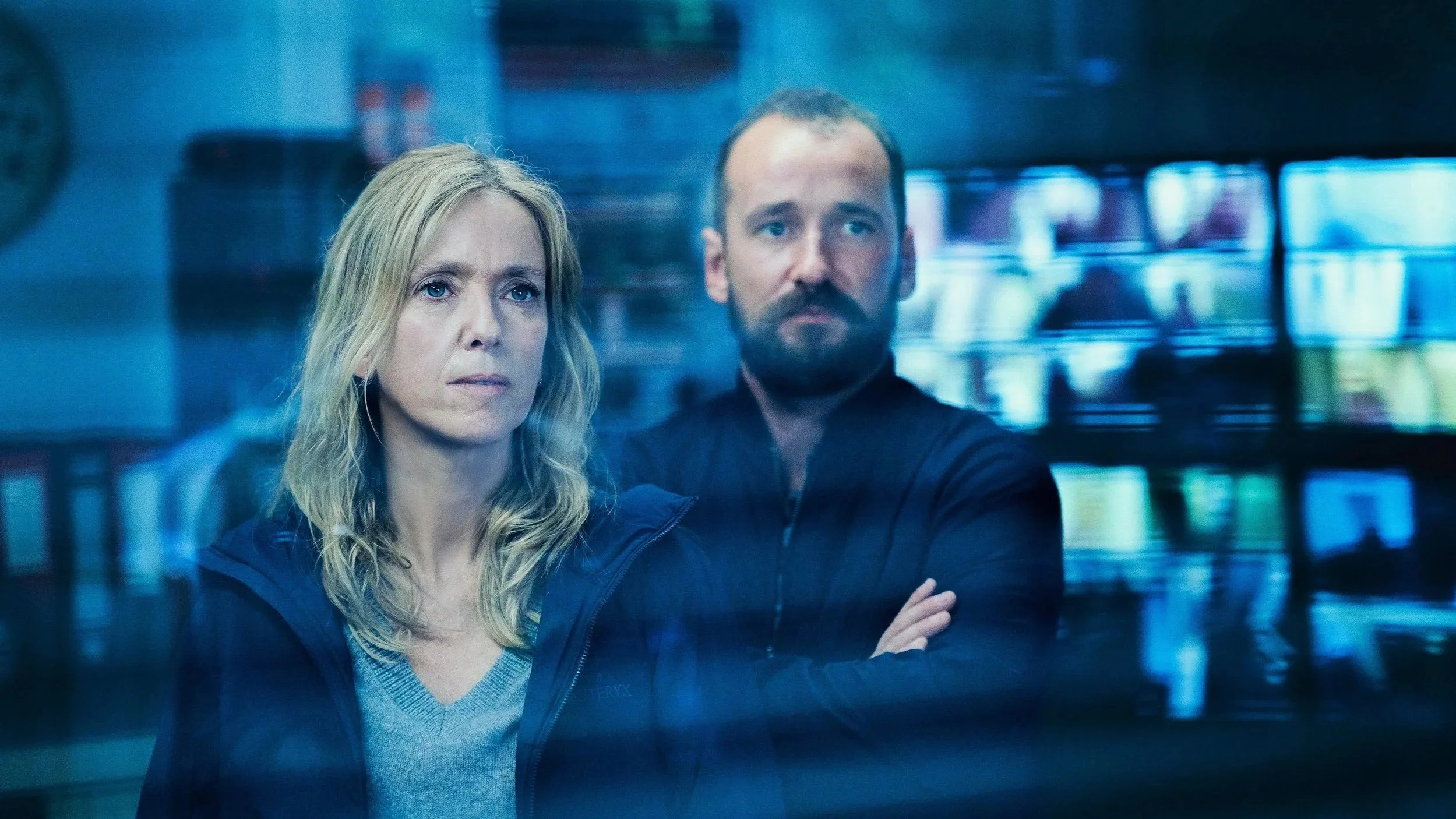
Léa Drucker and Jonathan Turnbull
Image courtesy of Conic.
by MANSEL STIMPSON
The French director Dominik Moll first came to prominence through the success of two psychological thrillers which he made, Harry, He's Here To Help (2000) and Lemming (2005). Nevertheless, modern audiences may know him best for The Night of the 12th. Appearing in 2022 it was a drama that was rather more than a police procedural in that it raised various social issues in telling the story of a crime that was based on a real-life murder. This new work of his, Case 137, can be seen as being very much a companion piece. It too draws on an actual event, tells the story of an investigation adopting a tone with an authentic almost documentary feel to it and sets out to be a thought-provoking piece.
The central character here is Stéphanie Bertrand played by Léa Drucker. She is a police inspector who is working for the IGPN, the internal affairs department which investigates claims against police officers. The year is 2018, a time when Paris – and other parts of France too – were being subjected to significant protests by members of the gilets jaunes (in English they became known as the yellow vest protestors) The case that the film studies in detail is that of a youngster here named Guillaume Girard (Côme Péronnet). He was rushed to hospital with serious injuries to the head caused by a rubber bullet fired at him by a member of the police unit that makes up the Search and Intervention Brigade, a body known as the BRI whose remit is to keep order on the streets.
In the course of the film, we get glimpses of Stéphanie’s home life as she looks after her young son Victor (Solàn Machado-Graner, excellent) having separated from her former husband, Jérémy (Stanislas Merhar), also a cop. We see too a visit she makes to St. Dizier where her elderly parents live and it turns out that this is also home to Guillaume's mother (Sandra Colombo) who is indignant that the investigation into the injustice done to her son is moving so slowly.
The procedural aspect of the story sets out in detail the various steps involved in tracing the identity of the BRI men involved, studying any video evidence of the confrontation and later handling the problem of proving which of two men fired the injurious shot. The man actually responsible denies his guilt claiming that he had fired a shot that missed and that his companion had been the one whose bullet went home. While the child actor brings warmth to those domestic scenes in which Stéphanie is not at work, Léa Drucker herself brings a sense of unactorly realism to her portrayal of Stéphanie, which makes her a wholly convincing presence in every scene in which she appears. Welcome as the more personal episodes are, Moll’s film treats the investigation itself as the key focus.
At one stage the story does take on a tone that is arguably closer to that of a thriller. This occurs when evidence comes to light that a maid in a posh hotel overlooking the site of the incident had had an opportunity to see exactly what happened. When interviewed, this woman (Guslagie Malandra) leaves Stéphanie with the impression that she is holding back and could have said more. By now, Stéphanie is so caught up in the case that she elects to follow the maid and to confront her. But, if Stéphanie’s unauthorised pursuit of her has a slightly fictional edge, what emerges is that the woman is all too aware that speaking out in such circumstances is unlikely to result in strong action against police officers who have gone too far.
In The Night of the 12th Moll cleverly revealed at the outset that the killing in that story was a case that remained unsolved. In doing so he made it clear that what followed would not be a tale which would end with the identity of the criminal being revealed. In Case 137 he is not quite so astute and, when the identity of the culprit emerges after ninety minutes or so, the audience may assume that the film has just about said all that it has to say. But, in point of fact, it proves to have a rather generous running time of almost two hours. That being so the further development of the story finds Stéphanie taking a risky decision in the hope of proving the case and the last half hour of the film is linked to that and to its consequences. It thus becomes clear that Moll's real aim in telling the story is to provoke discussion around the issues that arise.
There is never any doubt about the film offering a serious critique of violent misbehaviour by the police given that it can lead to innocents such as Guillaume being injured (he is portrayed as somebody not inherently political who, if angered by what he had seen on that night, had done nothing violent enough to justify the action taken against him). However, the film widens its concerns by bringing out the extent to which the French public had developed a hatred of the police and had come to feel strong sympathy for the gilets jaunes. A contrast is pointed out in that earlier on at the time of the Bataclan terrorist attack the public had been hugely supportive of the police force and their actions but subsequently the mood had changed. Even Stéphanie’s mother (Genevieve Mnich) seems to believe that there are better things for the police to do than go after their errant colleagues. Yet Stéphanie herself after twenty years in the force firmly believes standards must be maintained and that if the system regularly allows injustice to occur then everything that she stands for has been undermined. Ultimately Case 137 invites its audience to consider not just this particular incident and its investigation but to think about the social and moral issues that it raises.
Original title: Dossier 137.
Cast: Léa Drucker, Jonathan Turnbull, Mathilde Roehrich, Sandra Colombo, Guslagie Malandra, Genevieve Mnich, Christian Sinniger, Solàn Machado-Graner, Stanislas Merhar, Valentin Campagne, Florence Viala, Théo Costa-Marini, Théo Navarro-Mussy, Côme Péronnet, Hélène Alexandridis, Mathilde Riu.
Dir Dominik Moll, Pro Caroline Benjo, Barbara Letellier and Carole Scotta, Screenplay Dominik Moll and Gilles Marchand, Ph Patrick Ghiringhelli, Pro Des Emmanuelle Duplay, Ed Laurent Rouan, Music Olivier Marguerit, Costumes Dorothée Guiraud, Sound Rym Debbarh-Mounir.
Haut et Court/Charades/Canal+/Ciné+OCP/CNC/France 2 Cinéma-Conic.
116 mins. France. 2025. UK Rel: 16 October 2026. Cert. 12A.