Cotton Queen

A Sudanese teenager challenges what her village and family expect of her in Suzannah Mirghani’s sympathetic but less than adroit first feature.
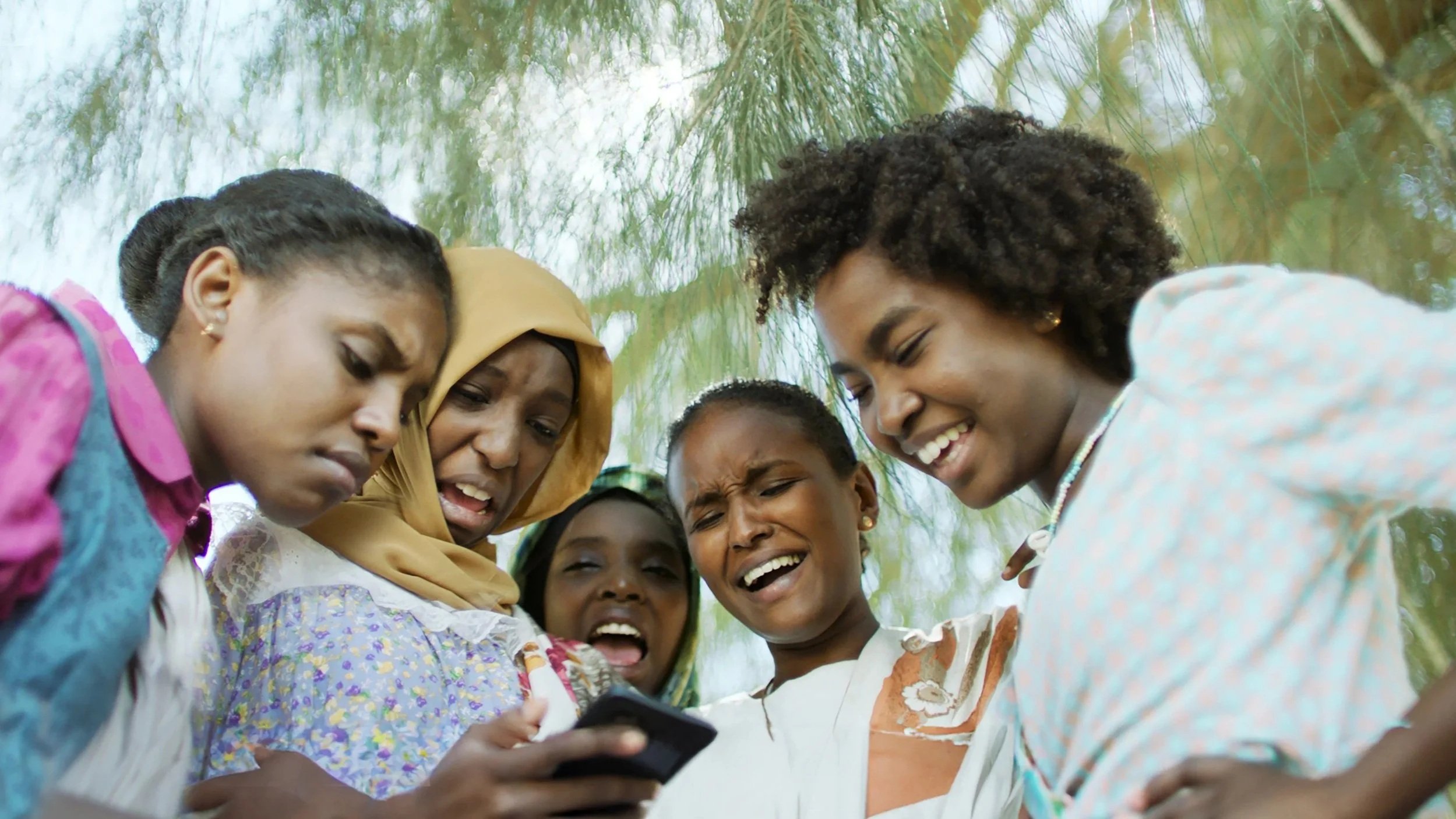
Image courtesy of T A P E Collective.
by MANSEL STIMPSON
This film, the feature debut of Suzannah Mirghani, is a work with many appealing features, so it saddens me to have to say that ultimately I found it unsatisfying. The good points include its leading player Mihad Murtada who has real screen presence, the excellence of the colour photography by Frida Marzouk and the well-judged music score by the always reliable Amine Bouhafa who is on his best form here. In addition, there are two factors that make one feel decidedly supportive of this venture. One is Mirghani’s achievement as writer/director in bringing us the first narrative feature to have been made by a Sudanese woman and the other is the nature of the story itself, one that is told from a female perspective. Cotton Queen is a sympathetic portrait of a teenage girl named Nafisa who, living in a cotton-farming village where traditional views prevail, seeks the freedom to shape her life for herself. Nevertheless, by the close of the film, I felt that this was far more an instance of good intentions than of a successful end product.
In point fact Cotton Queen grew out of an acclaimed short film which Mirghani had made in 2020 entitled Al-Sit. I have not seen that film but I understand that it set up the characters seen here and established the situation in which they find themselves. Furthermore, it already featured Mihad Murtada as Nafisa, that being her first screen appearance. The very fact that Cotton Queen is an extension of this earlier work lasting some twenty minutes should have meant that in her writing capacity Mirghani would give much thought to the best way to expand the material. That could be done by way of developing the characterisations of the central figures, by widening the portrait of village life or by the effective incorporation of a historical perspective emphasising colonialism as well as present day exploitation. The attempt to do all of that is certainly made, but uniting all these elements effectively and in a single narrative with a consistent style is a challenge which the film increasingly fails to meet.
The earliest scenes are the most effective as we are introduced to three generations of the family who are at the centre of the story. The oldest member and the family’s head is a widow, Al-Sit (Rabha Mohamed Mahmoud), who is very much in charge and makes the local girls work in her cotton fields including her own granddaughter, Nafisa. Although the girl’s mother, Aisha (Haram Bisheer), speaks critically of Al-Sit who imposes her will on all, Nafisa is initially rebellious only to the extent of slipping away to join her fellow workers such as Khadija (Aya Yassin Altageel) when they gather by the river despite Al-Sit forbidding her to go there. However, she is attracted to a local youth, Babiker (Talaat Fareed), and this is disapproved of too - and all the more so because both Al-Sit and Aisha have plans, separate ones as it turns out, to marry her off regardless of her wishes. In particular the arrival of a businessman, Nadir (Hassan Kassala), marks him out as a potential bridegroom. Representing his father who is its owner, he plans to settle in the one grand building in the village which is known as The English House and the history of which is linked to the days before Sudan became independent in 1956.
If these present-day events are central, Cotton Queen is also much concerned with colonial exploitation including the way in which stories have grown up around Al-Sit and about how she took a major role in saving the Sudanese from the British. Furthermore, when it emerges that Nadir is planning to challenge Al-Sit’s production of pure cotton by introducing genetically modified cotton seed into the area as a substitute, we are encouraged to see this as a profit-making scheme that in its exploitative character is akin to the old ways. Yet another concern of the film is the persistence of such traditional acts as female genital mutilation while superstitious beliefs which might be thought natural to the aged Al-Sit appear to be accepted equally by Aisha and even to some extent by young Nafisa.
Due to the current situation in Sudan, Mirghani chose to film in Egypt but that has not prevented her from giving a persuasive impression of rural life as experienced by the Sudanese today. However, Mirghani’s comparative inexperience is all too apparent in the way in which her screenplay often fails to round out the characters or to handle developments so that they come across persuasively. Babiker, for example, is weakly drawn with little to explain why Nafisa should be attracted to him. We get the impression that she is the one more deeply attracted, but then again perhaps not since at one stage he responds to her interest in poetry in a directly personal way. Although Aisha’s hostility to Al-Sit suggests a more modern attitude on her part, it nevertheless becomes clear that she is a prime mover in seeing Nadir as the right husband for her daughter. A belated revelation of exactly what Al-Sit herself is planning in this connection seems absurdly unlikely.
Stylistically too the film becomes problematic. Some viewers will be more ready than others to accept the switch from naturalism into the realm of magic realism. The first sign of it comes early when Nafisa views a figure up a tree who if not Cupid is nevertheless some kind of an angel. This aspect grows with dreamlike scenes which come to dominate the last section of the film which is increasingly stylised and harder to follow. The final scene arguably adds an almost symbolical touch to the proceedings. Yet, rather than feeling that Nafisa’s personal story has really touched us in its tragedy and in its defiance, one is left with a film which needed more detail and care to achieve that. One does of course sympathise with the film’s views and never doubts its sincerity. Furthermore, the fact that it has won awards must mean that for some audiences Suzannah Mirghani's endeavours have been more successful than they were for me.
Cast: Mihad Murtada, Rabha Mohamed Mahmoud, Haram Bisheer, Talaat Fareed, Mohamed Musa, Hassan Kassala, Aya Yassin Altageel, Fatma Farid, Tibr Magdy, Shamat Mohammedour, Tagali Magdy, Mariam Mahmoud.
Dir Suzannah Mirghani, Pro Caroline Daube and Didar Domehri, Screenplay Suzannah Mirghani, Ph Frida Marzouk, Pro Des Pierre Glemet, Ed Amparo Mejías and Simon Blasi, Music Amine Bouhafa, Costumes Simba Elmur.
Maneki Films/Philistine Films/Strange Bird/Arte-T A P E Collective.
94 mins. France/Germany/Saudi Arabia/Qatar/Egypt/Palestine/Sudan. 2025. UK Rel: 2 October 2026. Cert. 12A.