
D Is for Distance

Emma Matthews and Christopher Petit exhibit great filmmaking in their personal, highly original documentary exploring epilepsy and so much more.
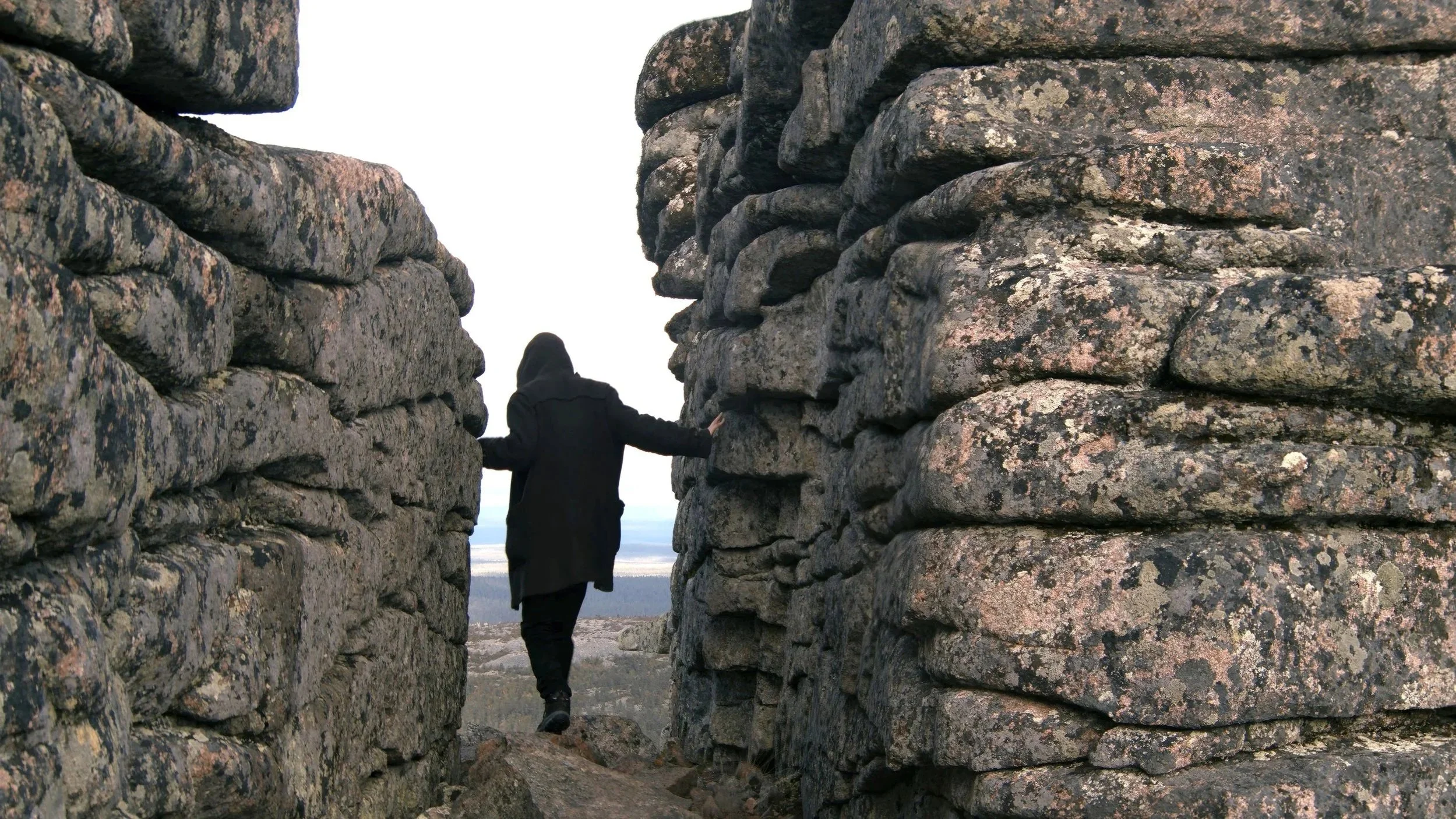
Image courtesy of BFI.
by MANSEL STIMPSON
The title D Is for Distance is undoubtedly apt but it also proves to be surprisingly paradoxical because in the event this film is very involving. I had not expected that since what I had read about the film before seeing it suggested that it was an offbeat essayist work which contained much footage that seemed irrelevant to its main concern. But, in the event and despite it containing elements that do indeed remain rather obscure, I found that its unusual approach was just what was needed to treat the subject at its heart. D Is for Distance was jointly made by Christopher Petit and his partner Emma Matthews and it is centred on the experience that resulted from their son, Louis, being diagnosed with epilepsy. This happened in 2016 when the boy was twelve years old and became subject to seizures. Drugs were prescribed under the NHS but it became clear that Louis was experiencing severe memory loss, blackouts and hallucinations and indeed there was also the risk that he might die. The boy’s interest in drawing and painting became a lifeline for him, a way of expressing himself. Later on, help of another kind came when Emma learnt of the situation in Holland where cannabis was accepted as a suitable form of medication in cases such as his.
It is nothing new to find a documentary film dealing with serious illness within a family and it is even the case that there is one little known such piece made by a filmmaker father which is enormously haunting: Hans Conrad Fischer’s Nela: The Story of a Painter (1980) about his daughter who died of leukaemia aged 22. That film had a traditional approach but certainly escaped being mawkish or unduly sentimental, which is always a danger in such pieces, and even managed to be uplifting and transcendental. However, D Is for Distance stands out from the rest by adopting a completely original approach although like Fischer’s film it does incorporate home movie footage that looks back. Indeed, in addition to seeing and hearing Louis himself, Emma is often on screen, with Christopher also present but less frequently. Nevertheless, a central feature here is the text which was written by Petit but is delivered in voice-over. This is done in a calm and sensitive way which is distanced enough in tone to explain the film’s title (when referring to Louis’s parents it usually describes them as ‘the mother’ or ‘the father’). The speaker is Jodhi May who captures what is required to perfection.
The balancing factors that come into play and ensure that the marked restraint of the commentary does not discourage our emotional involvement are two in number. One of them is Petit’s sense of cinema and of how much can be conveyed through images. Born in 1949, he was editor of the London magazine ‘Time Out’ in the 1970s and then turned his hand to independent filmmaking and made a particular mark in 1979 with Radio On, a film which I have never seen. Subsequently, he encountered problems in funding the idiosyncratic films that he wanted to make. He has done work for TV, made shorts and even one or two further features, but since 1993 he has found it easier to write novels. Nevertheless, D Is for Distance immediately reveals his exceptional eye and his ability to convey states of mind while working in conjunction with Emma (she is already an established editor and here also shares the directorial credit with Petit). The freewheeling style adopted for the film means that in reflecting their lives in the period since 2016 it is the shared experience that is captured rather than a single individual viewpoint. Louis himself is certainly very much present in images captured over the years including footage of his seizures which the doctors had asked his mother to take, but at the same time what we see represents the memories of his parents and their daily concern ever since his diagnosis. Emma is equally a key presence and her voice trying to reach Louis when the child is at his most unresponsive (“Can you hear me?") becomes a repeated refrain.
But, even though we see much less of Christopher Petit, D Is for Distance also plays not only as a film deeply expressive of his concerns in relation to Louis but is also a work that has a very much wider basis in that it takes account of life today as he sees it. In this respect his potent love of cinema makes its own contribution. We find him including here extracts from old films, many indeed from silent cinema, which link with the dreams and hallucinations experienced by Louis and also have an association with the boy’s pleasure in his own artwork. Elsewhere one can see why critics have found the range of incorporated references unwieldy and often hard to pin down as to their relevance. Louis does accompany his father on a trip to Finland connected with a proposed film about the Cold War spy master James Angleton but, if that can be seen to belong, the archive footage of Angleton himself and also of William Burroughs is surprisingly extensive while references to Watergate and the assassination of President Kennedy don't clearly earn their place.
Criticism of the NHS which is indeed relevant to Louis extend into laments about today's world but the latter do fit in because, despite this film being essentially being about Louis, it also stands as a personal testimony by Petit bitterly regretting the passing of a world which was in many ways exemplified by the magic of cinema. This last element brings me to the other great strength of D Is for Distance which is the vital role that music plays in it. Often making use of old recordings, several bringing westerns to mind and reflecting innocent pleasures of prelapsarian times (pre-2016 in every sense), Petit displays an instinct for unexpected but apt music choices that comes close to matching the gift which the late Terence Davies had for that. Songs heard here include ‘Red River Valley’, ‘My Rifle, My Pony and Me’ from the film Rio Bravo and the 1922 recording of ‘Dis Train’. This film is also one in which images of travel by car and by train play a large part and become a kind of metaphor for life going on and time passing but now with a constant awareness that how Louis is faring is aways a central issue. D Is for Distance is not faultless, but it's a haunting work of art which through offbeat means emerges as a moving film which achieves a character that is all its own.
Cast: Louis Petit, Emma Matthews, Christopher Petit, and Jodhi May (narrator).
Dir Christopher Petit and Emma Matthews, Pro Mika Tania and Jussi Eerola, Screenplay Christopher Petit, Ph Emma Matthews and Christopher Petit, Ed Emma Matthews, Music Rio Harada-Parr.
Elokuvayhtiö Testifilmi Oy/Yle-BFI.
90 mins. Finland/Germany/France. 2025. UK Rel: 3 April 2026. Cert. 12A.
