
Two Women

Chloé Robichaud’s French-Canadian sex comedy is inept in every way.
Laurence Leboeuf
Photo courtesy of Icon Film Distribution.
by MANSEL STIMPSON
The unusual background history to this film is revealed in its opening credit titles. What we have now is a remake of a film by Claude Fournier which was made in 1970 under the title Deux femmes en or (Two Women in Gold) and which was reissued in 2006 dubbed into English. Just recently the playwright Catherine Léger adapted it for the stage in an English language version under the title Home Deliveries but 2025 also saw this new film version by Chloé Robichaud again written by Léger but this time in French (the movie reaches us with subtitles). That the piece has existed in all these versions would suggest that it has both merit and staying power, but neither is apparent on viewing Two Women which has very little to recommend it.
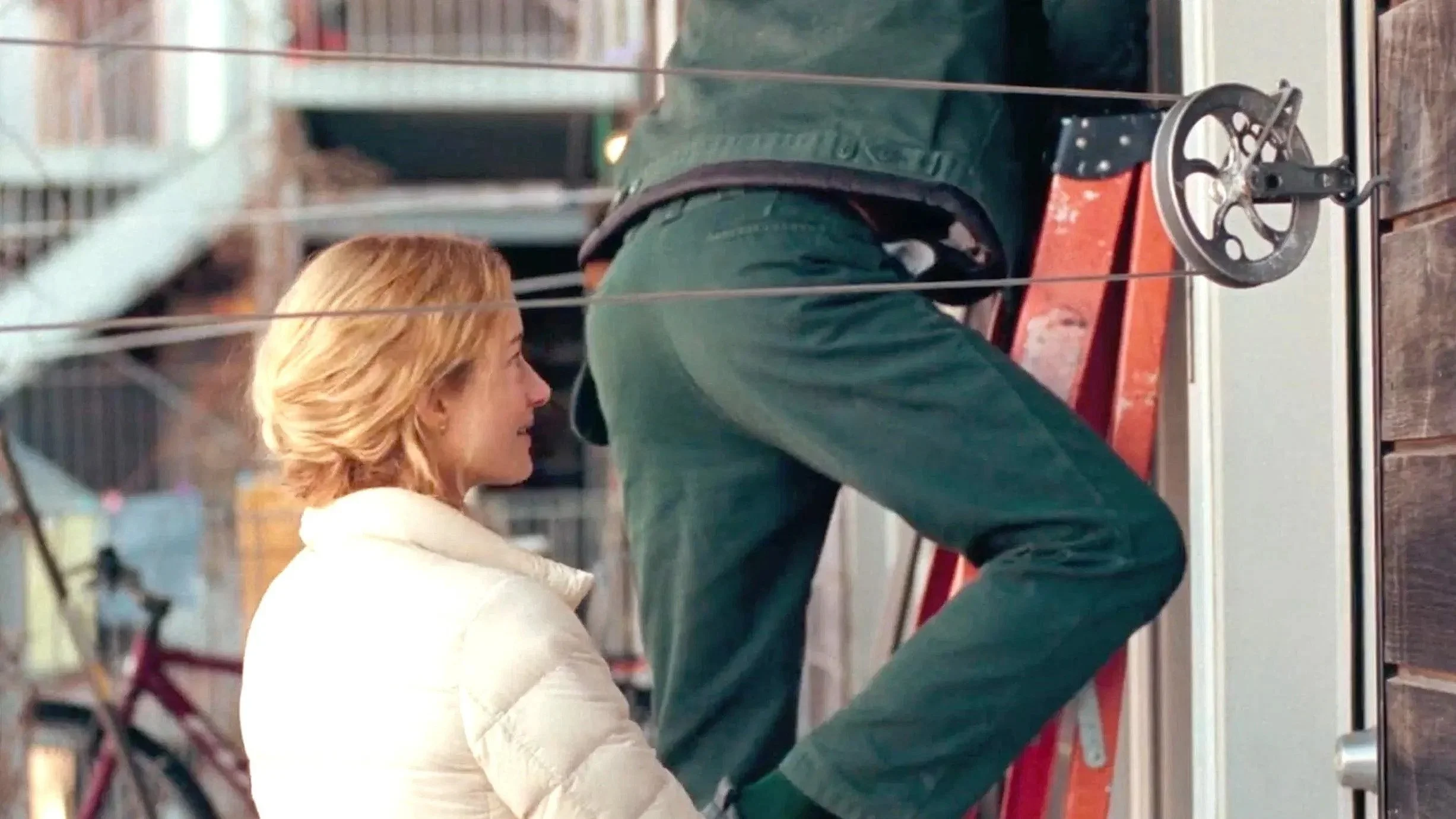
I am told that the earlier film version is something of a cult movie and that it made a mark in 1970 is understandable because it is a sex comedy which apparently took full advantage of censorship changes which enabled it to feature much nudity at a time when that was a novelty. This new treatment retains some of that including scenes of full-frontal female nudity although the men are treated far more discreetly albeit that the film loves to emphasise close shots of their clothed backsides. But now that nudity in films has become commonplace this aspect is hardly a selling point and one looks in vain for any features that can explain why it was thought that a 2025 remake would be a good idea.
The two women of the title are Florence (Karine Gonthier-Hyndman) and Violette (Laurence Leboeuf) who are adjoining neighbours living in a condominium in Montréal. It is Violette whom we meet first. She is heard complaining about sounds from nearby within the building which she describes as being the squawks of crows although her imitations of them suggest noises made during sexual intercourse. That is something that she is missing in her own life with her husband, Benoit (Félix Moati). Breastfeeding has limited her libido and, when it recovers, Benoit seems disinclined. Indeed we soon discover that Benoit has a work colleague, Eli (Juliette Gariépy), who has become his mistress. As for Florence, she lives with her partner, David (Mani Soleymanlou) and they have a ten-year-old son, Max (Mateo Laurent Membreno Daigle), but again things are not going well. David has lost any great sexual urge and seems quite content concentrating on his greenhouse which exists close by on what some would prefer to see as a parking site. For her part Florence is now taking antidepressants.
Being friends as well as neighbours Florence and Violette confide in each other over their dissatisfaction and decide that monogamy is a notion designed by men to keep women in their place. Acting on that realisation they decide that they have as much right as men to have a roving eye and to set out to seduce. As the plot develops, they turn to encounters with various workmen whose services bring them to the block, be it a man installing cable TV (Sam Breton), a plumber (Claude Legault), a painter (Arnaud Soly), a salesman (Fabien Cloutier) or the exterminator summoned to check out the crows supposedly heard by Violette (Maxime Le Flaguais).
Two Women sets out to be a sex comedy for today but it is lacking in any of the wit that would make for effective humorous dialogue and also missing are the momentum and build-up which are needed when farce is the aim. That being so, the film’s attempt to take a modern stance and to make the two women its heroines calls out for a screenplay that engages through characterisation and emotional involvement. Unfortunately, none of that is forthcoming. The actresses, Karine Gonthier-Hyndman and Laurence Leboeuf, do what is required of them, but neither Florence nor Violette become rounded or engaging figures about whom we can care.
The film is agreeably enough shot in widescreen and colour by Sara Mishara, and Philippe Brault’s music score seeks to give a helping hand, but Two Women falls short in virtually every way. Even its sex scenes lack any erotic or sensual appeal and as it goes on Robichaud’s film tries to branch out but once again fails. The second half suddenly brings in snatches of song on the soundtrack and then Florence even gets to sing in a night scene where she is alone but mysteriously has orchestral accompaniment. Yet more inept is a late move into seriousness with Florence declaring her love and concern for her son Max, an element not previously touched on at all. It is the case that in this tale men come out of it badly and that in theory might give the film a modern edge. But, since the actions of Florence and Violette offer so little for us to find appealing, Two Women never acquires a worthwhile aim. Furthermore, its entertainment value is virtually non-existent.
Original title: Deux femmes en or.
Cast: Karine Gonthier-Hyndman, Laurence Leboeuf, Mani Soleymanlou, Félix Moati, Mateo Laurent Membreno Daigle, Juliette Gariépy, Sophie Nélisse, Isabelle Brouillette, Sam Breton, Maxime Le Flaguais, Claude Legault, Fabien Cloutier, Arnaud Soly, Donald Pilon.
Dir Chloé Robichaud,Pro Martin Paul-Hus and Chloé Robichaud, Screenplay Catherine Léger from her play Home Deliveries adapted from the film Deux femmes en or by Claude Fournier and Marie-José Raymond, Ph Sara Mishara, Art Dir Louisa Schabas, Ed Matthieu Bouchard, Music Philippe Brault, Costumes Patricia McNeil.
9Pulsar Content/PH4SE Productions/9500 4750 Québec/Amérique Film/Telefilm Canada-Icon Film Distribution.
100 mins. Canada. 2025. UK Rel: 3 April 2026. Cert. 15.
