
Deaf

In Eva Libertad’s solo-directorial debut, difficulties emerge for a deaf woman when she becomes pregnant.
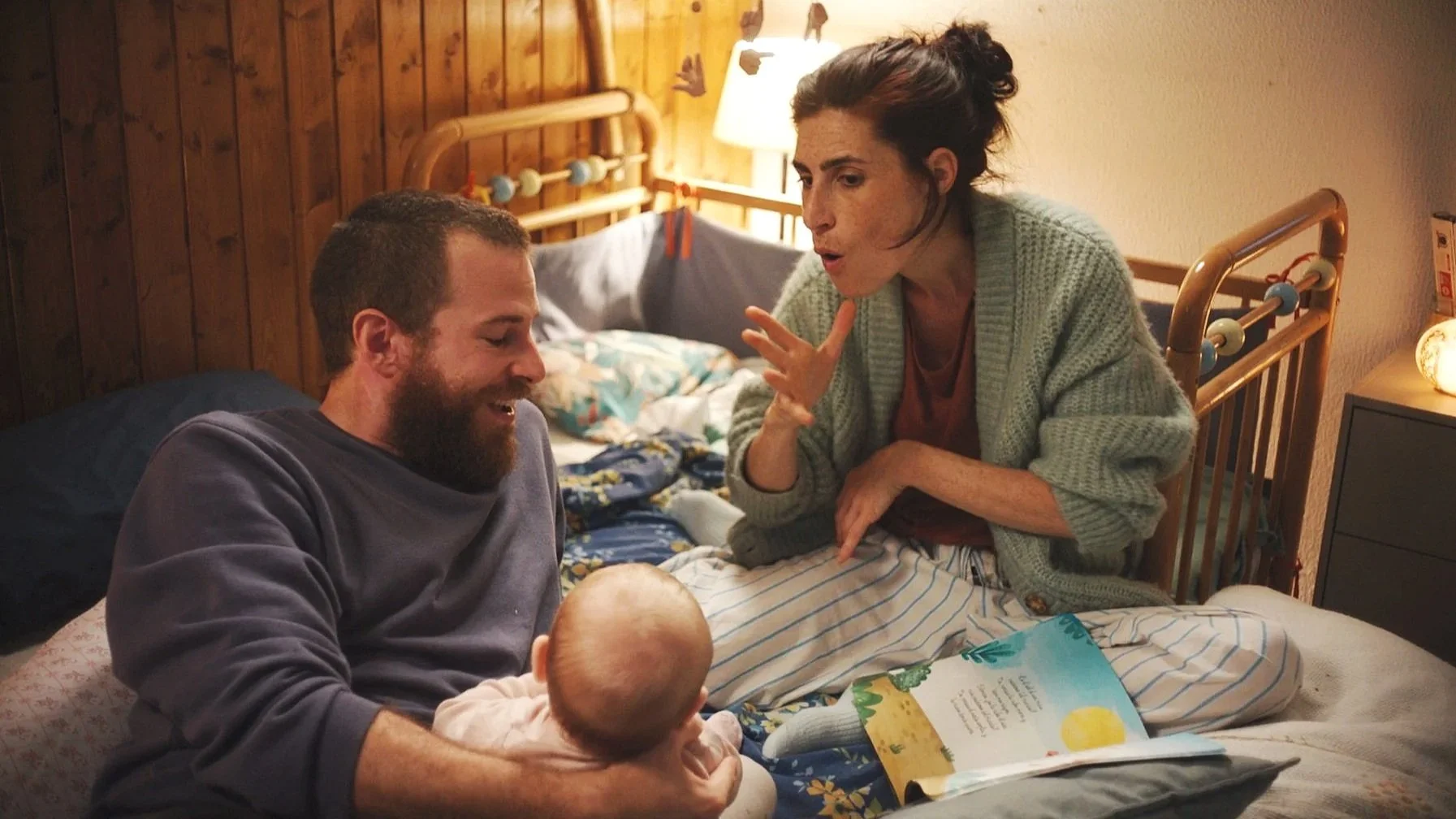
Image courtesy of Curzon Film Distributors.
The title of Eva Libertad’s film boldly indicates its central issue. The British distributors, Curzon, have announced that, given its nature, Deaf will be shown at all screenings with descriptive subtitles. That means that audiences viewing this Spanish film will find that the subtitles cover not only the spoken dialogue and translate what is expressed through Spanish sign language but also describe the background sounds. In other words, this story of a happily married couple – that of a hearing man, Héctor (Álvaro Cervantes), and his deaf wife Ángela (Miriam Garlo) – will be seen in a form which, in addition to making it accessible to deaf people, will constantly remind those viewers who can hear of what it is like to be deaf. When it comes to the words spoken but rendered in subtitles, we will be reading them in that form but that will echo the need of the deaf to read lips.
In addition to directing Deaf, Eva Libertad also wrote it and, save for a late switch in style, has opted to tell the story in a simple and straightforward way which seems entirely apt. We first encounter the couple in the countryside accompanied by their dog, Luka, and swimming in a pool after which we discover that Ángela is employed in a small pottery works run by Irene (Oti Manzano). However, the central concern of the story quickly emerges and that is the fact that Ángela is pregnant. Her parents, Fede (Joaquín Notario) and Elvira (Elena Irureta) had not expected that she would have a baby, a view doubtless based on the belief that she might well hold back rather than have a child who might be deaf like its mother. Ángela herself had not been born in that state but it had developed very soon thereafter and she and Héctor are now told that it is a fifty-fifty chance as to whether or not her child will be born deaf. Furthermore, they are told that there are no tests that can be undertaken ahead of the birth to settle this question.
With the pregnancy announced, Ángela’s parents, just like the couple themselves, put aside any doubts and in the event the baby, a daughter who will be named Ona, does prove to be a hearing child. The first third or so of Deaf covers the events that lead up to the birth and thereafter the film portrays the life of the couple and their child during the period up to Ona’s first birthday. This makes for a well-acted tale which is adroitly cast. Garlo and Cervantes fully convey the close bond between Ángela and Héctor and the subsidiary roles are persuasively taken too. The passing of time during the year after the birth is made apparent through the simple means of showing Ona growing as the months pass (the role is credited to no less than seven youngsters!).
In theory Deaf is a very welcome film and that is a view which would seem to be confirmed by it having received numerous awards including six at the 2025 Malaga Spanish Film Festival and two when in competition internationally at the 2025 film festival in Berlin. I myself approached the film as being one with admirable intentions. First and foremost, it will give deaf people an opportunity to see themselves portrayed as central figures in a film about their lives and, despite the highly successful career of Marlee Maitlin (the subject recently of a thoroughly worthwhile documentary biopic), there are all too few films that do that. Secondly, Eva Libertad’s film provides an opportunity for a hearing audience to identify with what it means to be somebody unable to hear. And, if that were not enough, I felt even greater admiration on learning that Eva Libertad is the sister of Miriam Garlo who is herself deaf. That fact made it apparent that Libertad must have written Deaf specifically for her sister. Subsequently when checking up online I found that Garlo had had a role in Libertad’s only previous feature (2020’s Nikolina made in conjunction with Nuria Muñoz Ortín who is one of the producers here) and had also in 2021 played the lead part in a short with the same name as this feature again co-directed by the two of them. The latter piece also dealt with a couple akin to Ángela and Héctor and would seem to have been a step towards the making of this feature.
But, despite all these good intentions and the acclaim (certainly justified as far as the acting is concerned), I am left puzzled by the nature of the story that Eva Libertad has chosen to tell. Initially it all seems promising, but when it gets to the lengthy birth scene with Héctor present to communicate on his wife’s behalf the impact is harrowing and could well alarm any pregnant deaf woman watching it. Thereafter, the portrayal of little Ona’s first months are rather inconsequential, but as the child grows and starts to speak Héctor is more quickly able to establish what her needs are and to respond accordingly and this leads to tensions. Understandably Ángela feels that her key role here is being undermined and eventually this will lead to a cruel moment in which Héctor tells his wife that what she really wants is a deaf partner and a deaf daughter. This is by no means unconvincingly portrayed and far better than having a sentimentalised narrative. But it is largely negative stuff and it leads to Ángela walking out and visiting friends alone.
It is here that Libertad jettisons the unassertive style of the storytelling to switch suddenly to a soundtrack which seeks to represent Ángela’s experience of the world by eliminating any clear words spoken to her and setting up an almost constant hum. Since this is done suddenly, it takes a moment or two to realise that this is not some error in the projection room and unfortunately thereafter it continues to feel like a device imposed from the outside, a manipulation by the filmmaker. But, if that seems like a misjudgment, it is a minor one compared to the film's failure to tackle the issue of whether or not Ángela and Héctor can make up and overcome their conflicts. A note of hope could surely have been added without the resolution seeming unduly optimistic. As it stands, however, although the film concludes with a scene showing Ángela and one-year-old Ona together, the ending feels essentially downbeat. So it’s fine to create a film with deaf characters that will attract deaf audiences, but I fear that many of them may well find Eva Libertad’s Deaf anything but a positive experience.
Original title: Sorda.
MANSEL STIMPSON
Cast: Miriam Garlo, Álvaro Cervantes, Elena Irureta, Joaquín Notario, Agustín Otón, Oti Manzano, Erika Rubia, Agustín Mateo, José Ortuño, Paula Peces García, Pedro J. Herandez, Almudena Ramos.
Dir Eva Libertad, Pro Miriam Porté, Nuria Muñoz Ortín and Adolfo Blanco, Screenplay Eva Libertad, Ph Gina Ferrer García, Pro Des Anna Auquer, Ed Marta Velasco, Music Aránzazu Calleja, Costumes Desirée Guirao and Angélica Muñoz.
Distinto Films/Nexus CreaFilms/A Contracorriente Films/Diverso Films-Curzon Film Distributors.
100 mins. Spain. 2025. UK Rel: 12 September 2025. Cert. 12A.
