
Fairyland

Andrew Durham’s splendid first feature is distinguished by superlative performances in this true-life memoir of homophobia in San Francisco in the 1970s and 1980s.
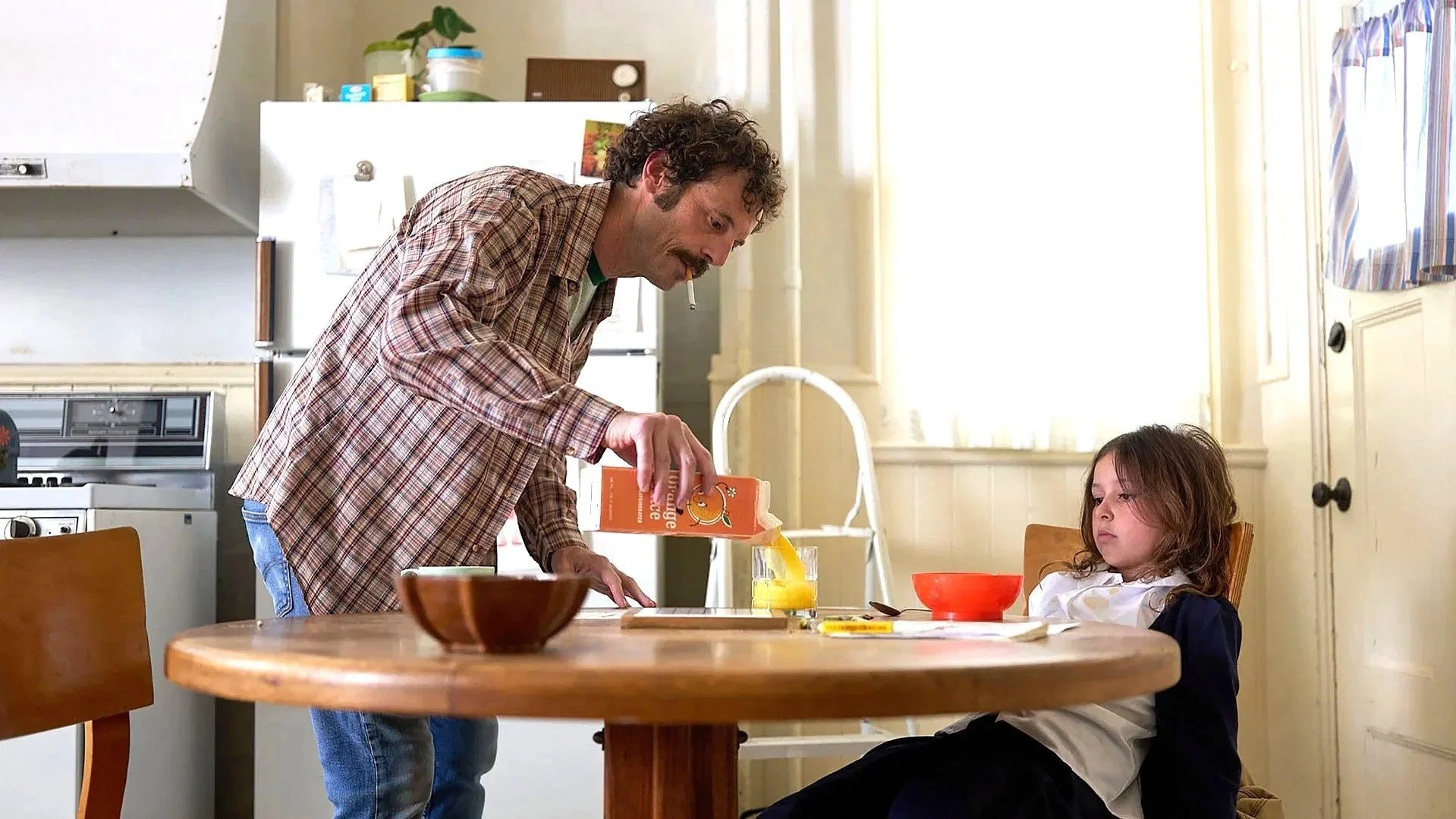
Fairy dust: Scoot McNairy and Nessa Dougherty
Image courtesy of Icon Film Distribution.
by MANSEL STIMPSON
This splendid film far exceeded my expectations. The shooting of it took place back in 2022 and the following year it was the winner of the audience award at Princetown's International Film Festival. But, despite that success, the news that a film is being released after a gap of years immediately causes one to have low hopes as regards its quality. Difficulty in finding a distributor delayed the release of Fairyland until early October 2025 in the USA and the UK is only catching up almost eight months later. Yet, far from all this being due to its poor quality, Fairyland is one of the best films that I have seen this year.
That is all the more surprising because the man in charge – Andrew Durham who is credited as both director and writer – was making his first feature film. As it happens, Durham was uniquely qualified to handle this material. The source of the film is the book by Alysia Abbott which was published in 2013 under the title Fairyland: A Memoir of My Father. In it, Abbott told the story of what it had meant to her to grow up in the 1970s and 1980s in San Francisco as the daughter of a gay widower, the poet Steve Abbott. It so happens that this was also the time when Andrew Durham was in the same city and was also experiencing life as the child of a gay father so, in adapting Alysia's memoir for the screen, he had a personal depth of understanding on which he could draw.
That helps to explain the success of a film which is quite remarkably assured and my only real doubt about it is the choice of title. Opting for Fairyland on its own could suggest that it was a fantasy movie for children while, on another level, it could also sound like a tasteless exercise happy for some reason to reference the old homophobic description of gays as fairies. I have now learnt that the exact title, Fairyland, was in fact an actual homophobic nickname for San Francisco and using it in this way could be said to be reclaiming it and taking back that name. But, regardless of that, my own view is that to have kept to the full title of Alysia Abbott’s memoir would have been more apt.
Enhanced as it is by superlative performances, the great feat of Durham's film is that it feels absolutely real and lived in. It begins with a brief prologue set in America's Midwest in 1974. This is when Steve Abbott (Scoot McNairy) receives a phone call telling him that his wife has been killed in a car crash. The scene plays, however, from the viewpoint of his infant daughter, Alysia (Nessa Dougherty), who overhears it and indeed it is her viewpoint that the film follows throughout - appropriately so since the central focus of Fairyland resides in the relationship between daughter and father. Early on the film follows them to San Francisco. Resisting suggestions that other family members of his late wife would be happy to bring up Alysia (Geena Davis appears in the role of the maternal grandmother), Steve settles in in the Haight- Ashbury district determined to look after his child himself. The household which he joins is a bohemian one and Steve soon starts a relationship with one of the occupants, Eddie (Cody Fern). Another man living there, Johnny (Ryan Thurston), wears dresses while Paulette (Maria Bakalova) sells drugs. But these people are seen exactly as young Alysia sees them: different and unusual but in no way threatening to her. This segment of the film takes up most of its first third and plays as a portrait of the period before Aids came along when San Francisco was a mecca for those with alternative lifestyles and of varied sexuality. This era is conjured up quite splendidly with some authentic footage from the period incorporated into a perfectly judged recreation of that time. It makes effective use of songs on the soundtrack and of news reports heard in passing on the radio or on TV some of which reference hostility to gays. Yet because we know the wider horror that Aids would bring, this representation of the city in the seventies is poignant as well as being an evocation of the household at the centre of the film as possessing the quality of an alternative family.
Nevertheless, the happiness portrayed is only part of the picture. Alysia experiences homophobic bullying on the part of girls at the school which she attends and, as Steve embraces his gay life, all too often he is not there to look after Alysia when he should be. Despite these failings, his love for her his evident but his behaviour can certainly be criticised. What looks like neglect – and can feel like it to her – is something that Steve seeks to justify by claiming that he is ensuring that his child learns to be independent. All of this is portrayed without any sentimentality and without whitewashing Steve and consequently watching the film is like observing reality. It unfolds in a way that never draws attention to itself, or more accurately does not do so until it starts to move forward with a series of leaps in time. The biggest jump is that which suddenly finds Alysia some years on and with a prospect of attending a college in New York. She is now played by Emilia Jones. She has reached an age when she doesn't want her close girlfriends to know that her dad is gay and, just as Steve sometimes behaves badly, the film is equally ready to show Alysia saying cruel and insensitive things to her father.
Inevitably with the devastating arrival of Aids, the mood of the film changes (no more songs on the soundtrack). But it also shifts to other locations with scenes in New York City and also in Paris to which Alysia goes as a student and where she is attracted to a French youth (Ben Attal). Nevertheless, the final scenes inevitably bring us back to San Francisco. These time switches might have been distracting and certainly many subsidiary characters suddenly disappear from the narrative. Yet these figures are so well realised in the acting and in the writing that they are vivid portrayals and the film’s structure actually brings into focus the interrelationship of Steve and Alysia through all of its phases and its conflicts while registering its deep significance for both of them. The child actress Nessa Dougherty is superb, but so are Scoot McNairy and Emilia Jones who both play with complete naturalism so that Fairyland is a wholly persuasive account of a parent/child relationship. One may well guess that theirs is not a tale that can end happily but, in so far as Fairyland is also at heart a film that honours San Francisco, it is interesting to note what emphasis emerges at the close. There is a reference to the remains of a Nob Hill mansion destroyed by the 1906 earthquake and now known as ‘Portals of the Past’ which adds to the beauty of Golden Gate Park to which it was moved. In bringing that into his film Andrew Durham confirms that Fairyland is about the city’s persistence and its ability to put bad times behind it. It is entirely appropriate that the film is dedicated to two fathers, that is to say to the father of Alysia Abbott and to the father of Andrew Durham.
Cast: Emilia Jones, Scoot McNairy, Cody Fern, Maria Bakalova, Bella Murphy, Nessa Dougherty, Adam Lambert, Geena Davis, Ben Attal, Ryan Thurston, Isabella Peregrina, Roman Gonzalez, Wallace ‘Cabe’ Thompson.
Dir Andrew Durham, Pro Sofia Coppola, Megan Carlson, Laure Sudreau, Siena Oberman, Greg Lauritano and Andrew Durham, Screenplay Andrew Durham, from the memoir Fairyland: A Memoir of My Father by Alysia Abbott, Pro Des Olivia Kanz, Ed Peter Hagan and Lawrence Klein, Music Michael Penn, Costumes Maggie Whitaker.
American Zoetrope/Outoboros Entertainment/Artemis/Black Magic/Safe Place Pictures/Lost Gang Films West-Icon Film Distribution.
116 mins. USA/France. 2023. US Rel: 3 October 2025. UK Rel: 29 May 2026. Cert. 15.
