
Rafael Manuel’s original first feature explores social disparity in the Philippines through the eyes of a 17-year-old golf club employee.
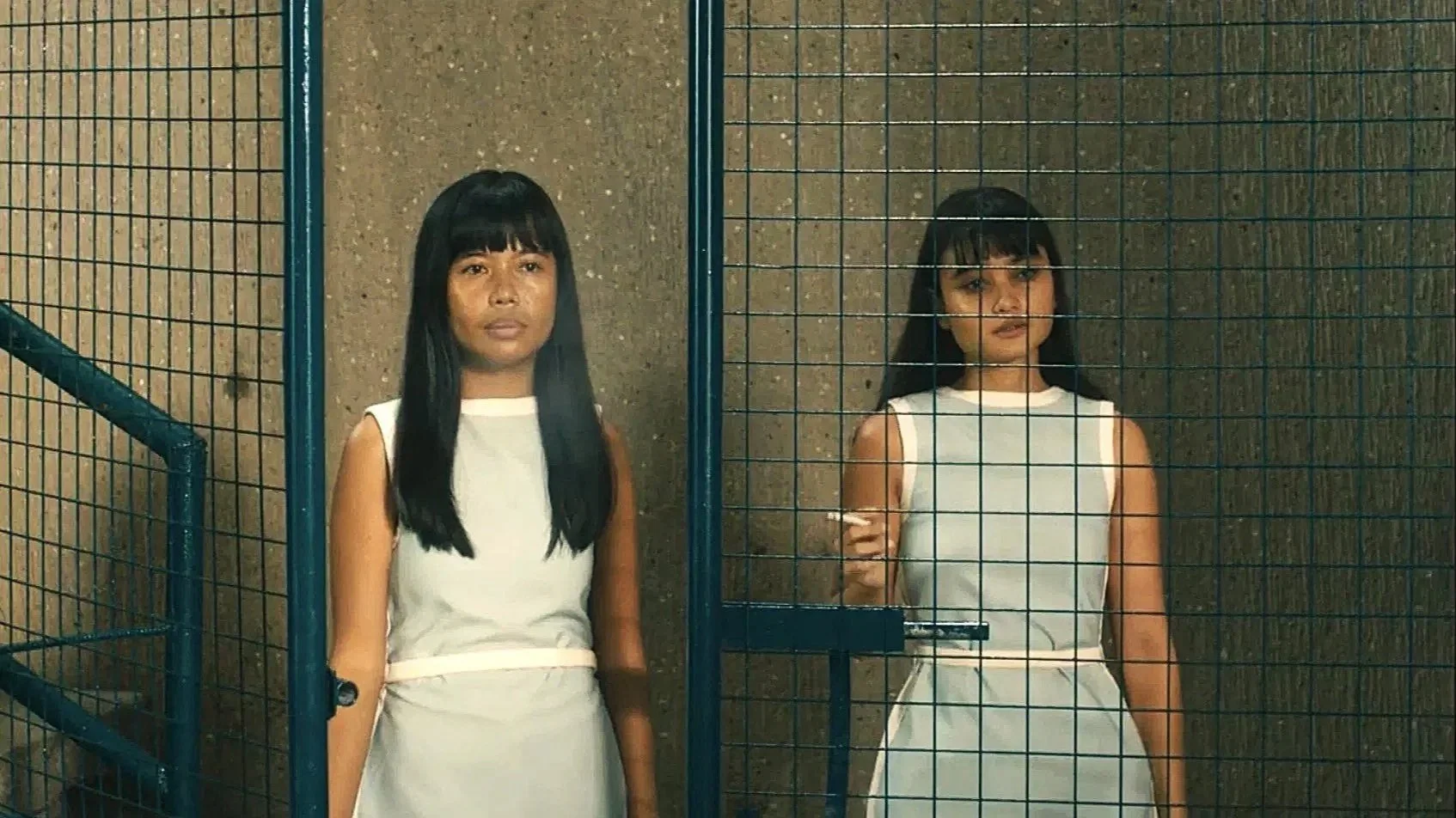
Image courtesy of BFI Distribution.
by MANSEL STIMPSON
It is not that rare to find a filmmaker who is engaged on his or her first feature embracing the idea of expanding subject matter that they have already touched on in a short film. This is exactly what the Filipino writer/director Rafael Manuel has done here even to the extent of retaining the original title that he used in 2020, Filipiñana. Indeed, in this instance some of those who worked on the short are also involved here. That is particularly wise in the case of Jorrybell Agoto reprising a role for which she is ideally cast and equally astute is the retention of Xenia Patricia as photographer since her contribution here is impeccable. But what really surprises is the fact that Manuel's filmmaking style in this feature is stunningly original (not having seen the short I cannot say if there were pre-echoes of it then).
Manuel’s film is set for most of its length in a luxurious country club just outside Manila where golf is played. The only other location seen appears in a pre-credit segment at the start which, in contrast to what follows, gives us a glimpse of the city and finds a tourist coach bringing in visitors who are already caught up in traffic chaos. But, if the film thereafter becomes limited to this elite area, there is a strong sense that Manuel’s subject-matter is much wider than that might suggest. It was in 1946 that the Philippines gained independence having earlier been subjected to Spanish rule for centuries and comparable control by America in the 20th century in addition to being occupied by the Japanese between 1942 and 1945. That history might suggest that the country has in more recent times thrown off the yoke, but Filipiñana portrays a world in which the extreme class contrasts that we witness carry a distinct echo of colonialism and all that it represented.
Unusual though it is, it would be wrong to suggest that Filipiñana is a work which fails to introduce us to a number of central characters and furthermore Agoto’s role is the film’s focal point. She plays a 17-year-old girl named Isabel who has recently arrived from Ilocos in the north and has found work alongside many other youngsters engaged as tee girls by the golf club. Another new arrival is in a decidedly different position: Clara (Carmen Castellanos) has chosen a life in New York rather than one in Manila but her uncle Renato (Carlos Siguion Reyna) a leading figure in the club is keen to encourage her to work with him. A further key figure is the president of this resort, Dr Palanca (Terry Guzman) who, like Isabel, has connections with Ilocos. For the rest we come across a whole range of girls who act either as caddies or as tee girls each with their own brand of uniform but very much kept apart (it is a fixed rule that tee girls must never trespass on the actual course). The girls encountered include Ina (Isabel Sicat), Mica (Micah Musa), Charlie (Elle Velasco) and Janine (Nour Hooshmand).
If Filipiñana were a standard work the film would introduce us to these characters and then set up a narrative that would become the pivot of the work. However, we soon realise that Manuel has an approach which turns the elite club into the centre of the work in its own right. Not only does the design of the film provide a detailed view of a place where the rich are at home but it also sees the setting as a metaphor for the social structure of the Philippines. Shot in the limited 4:3 ratio, the film captures the confinement of the working-class employees and there are references of different kinds which bring home the character of the place. Thus, it is noted that pine trees in the grounds which had been imported were always bound to die due to the heat, but the issue is waived aside with the remark that they can readily be replaced. Then again, we learn that Manila is suffering from a significant drought but it is apparent that in the club water flows freely.
But, over and above incidentals such as these, Manuel's visual sense ensures that each shot in the film is composed to underline the divide between the employees and those who run the place or can afford to belong as members (many such visitors come from China). It's an approach which yields many memorable images but none more so than a shot in which a golfer in the teeing area is viewed from behind in a close shot with legs apart while the tee girl placing the ball for him is seen through his legs. It is an image of masculine power which renders the girl akin to a servant or even a slave. In addition, because it is only the lower part of the man's body that is seen here, it also carries an implication of male sexual dominance.
Filipiñana is a film which deliberately makes very little use of camera movement and the character and size of the club and its grounds are expressed through static shots often presented in sequences which are chosen more for their effectiveness in achieving that than as a way of building up a strong narrative. There are nevertheless what could be called plot threads including the fact that Isabel having found golf clubs seemingly abandoned by Dr. Palanca seeks to return them to him. There is the link that both of them have Ilocos connections but when asked Isabel is vague about her interest in the doctor. We might wonder if she sees an advantage in being a young woman who attracts his attention and indeed in one scene he holds out his hand inviting her to dance with him. That she might have a different aim altogether only emerges very late on and on paper it might sound as though the film’s climactic scenes which carry elements of violence are more conventional. But, in fact, even here the presentation of the material remains unusual. The film’s final scene in particular is decidedly enigmatic.
Although the running length of 101 minutes is nothing out of the ordinary, there is no denying that the film’s pace is slow and so too is its development. Despite the able acting from the rest of the cast and the ideal casting of Jorrybell Agoto in the central role, it seems fair to suggest that Filipiñana is likely to be regarded as something of an acquired taste. The metaphor at its heart certainly works, but whether or not it keeps enough in reserve to sustain its impact all the way through is probably an open question. Nevertheless, the way in which the setting overshadows the employees and the sense of powerlessness conveyed by placing an individual as a small figure at the very bottom of an image illustrates perfectly the precision and confidence with which Rafael Manuel expresses himself. His voice is his own.
Cast: Jorrybell Agoto, Carmen Castellanos, Teroy Guzman, Carlos Siguion-Reyna, Isabel Sicat, Nour Hooshmand, Elle Velasco, Micah Musa, Sunshine Teodoro, Angeli Bayani, Dyas Adarlo.
Dir Rafael Manuel, Pro Jeremy Chua, Alex Polunin, Bianca Balbuena, Bradley Liew, Nadia Turincev, Omar El Kadi and Rafael Manuel, Screenplay Rafael Manuel, Ph Xenia Patricia, Pro Des Tatjana Fanny Honegger, Ed Rafael Manuel, Costumes Carla Villanueva and Tatjana Fanny Honegger.
Potocol/Ossian International/Epicmedia Productions/Easy Riders Films/Idle Eye-BFI Distribution.
101 mins. UK/Singapore/Canada/France/USA. 2026. UK Rel: 20 November 2026. Cert. 12A.