

Love and deception are explored in Marie Kreutzer’s disquieting drama that challenges the status quo of a perfect world.
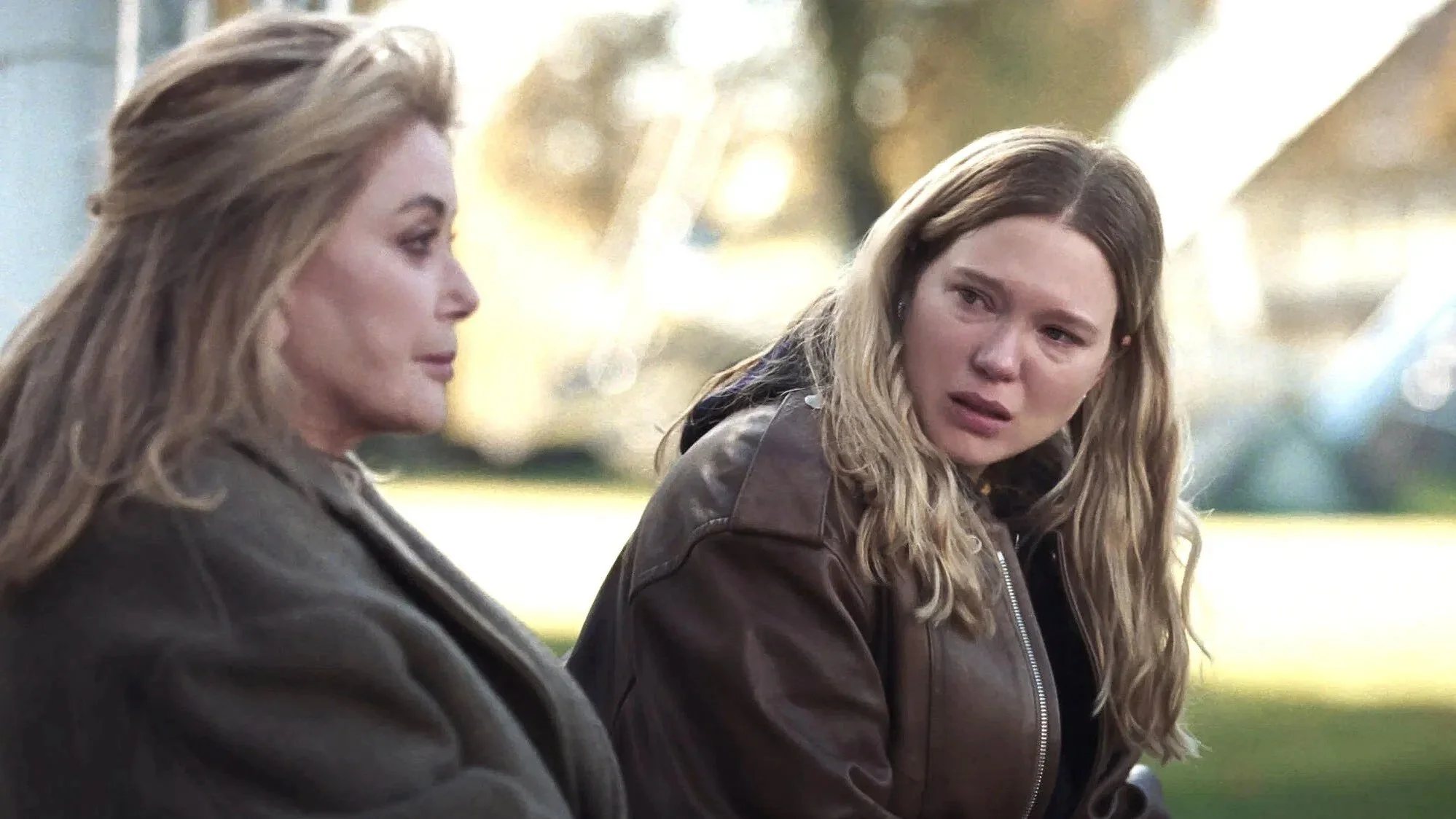
Consequences of love: Catherine Deneuve and Léa Seydoux
Photo courtesy of Netflix.
by JAMES CAMERON-WILSON
Gentle Monster is in no hurry to divulge its hand and even when it’s over we aren’t entirely sure what we have witnessed. Which is the point, because in the world of male sexuality there are no straight edges. Léa Seydoux plays Lucy Weiss, an avant-garde musician who we first see sitting at the piano singing Charles & Eddie’s ‘Would I Lie To You?’ “… everybody wants to know the truth…” Maybe that is the first hint at what is to come. She is at home, in the German countryside, at a house recently purchased to establish the idyllic lifestyle of herself, her husband Philip (Laurence Rupp) and their nine-year-old son, Johnny (Malo Blanchet).
The writer-director Marie Kreutzer is of the European sensibility that puts atmosphere before action, guiding us into the lives of this loving family and their perfect world, in which even the silences – and the birdsong – are to be relished. Johnny is obviously a happy child, Philip is manfully attempting to erect a trampoline in the new garden and it seems perfectly natural that Philip should lift his son onto his lap at the breakfast table, even though he – Philip – is naked.
Then, after the opening title, the police turn up at the house and Munich investigator Elsa Kühn (Jella Haase) confiscates all of Philip’s electronic devices – his computer, phone and 18 USB flash drives. Lucy is aware of Philip’s dubious past and suspects that his drug dealing of yore might have caught up with him. But of course she has no clue…
Switching perspectives, the drama focuses on the private life of Elsa, who is living at home with her elderly father (Sylvester Groth) who has started to make inappropriate advances towards his carer. Suffering from dementia, he cannot remember one day from the next and even confuses Elsa with his late wife. As a parallel narrative, this promises to give the film an added depth, although Elsa’s subplot is never really given its due.
The film’s strength lies in its performances and attention to the lived-in production design and, as ever, Léa Seydoux is magnificent, her dislocated wife and mother grasping at every new explanation as if it must explain everything. Elsa is more clear-eyed but is bound by the red tape of her department, where she can but suggest to Lucy that she gets in touch with a psychologist. Lucy herself is asked by a journalist why she only performs the work of male artists (“We are all influenced by love songs performed and written by men,” she argues, “so I take their words and question them.”). Is she really that naïve?
What Marie Kreutzer does so expertly is to take the seemingly inconsequential and provide these moments with consequence, so that an innocent home video of the couple’s perfect life takes on an entirely new prospect. Unlike many films dealing with unacceptable behaviour towards children, Kreutzer’s is a far more nuanced study, spotlighting the grey areas and in some ways shaming the unintended complicity of the women who live amongst the predators.
Cast: Léa Seydoux, Jella Haase, Laurence Rupp, Malo Blanchet, Anton Rubtsov, Nils Strunk, Sylvester Groth, Patrycja Ziółkowska, Regina Fritsch, Catherine Deneuve, Jeanne Werner.
Dir Marie Kreutzer, Pro Alexander Glehr and Johanna Scherz, Screenplay Marie Kreutzer, Ph Judith Kaufmann, Pro Des Myrna Wolff, Ed Ulrike Kofler, Music Camille, Costumes Monika Buttinger, Sound Gustaf Berger.
Film AG/Komplizen Film/Kazak Productions/Kjellson & Wik/Film I Väst-Netflix.
115 mins. Austria/Germany/France. 2026. UK and US Rel: 18 November 2026. Cert. 15.