

Vincent Munier’s French nature study reveals a philosophical depth that makes it a unique and deeply impressive documentary.
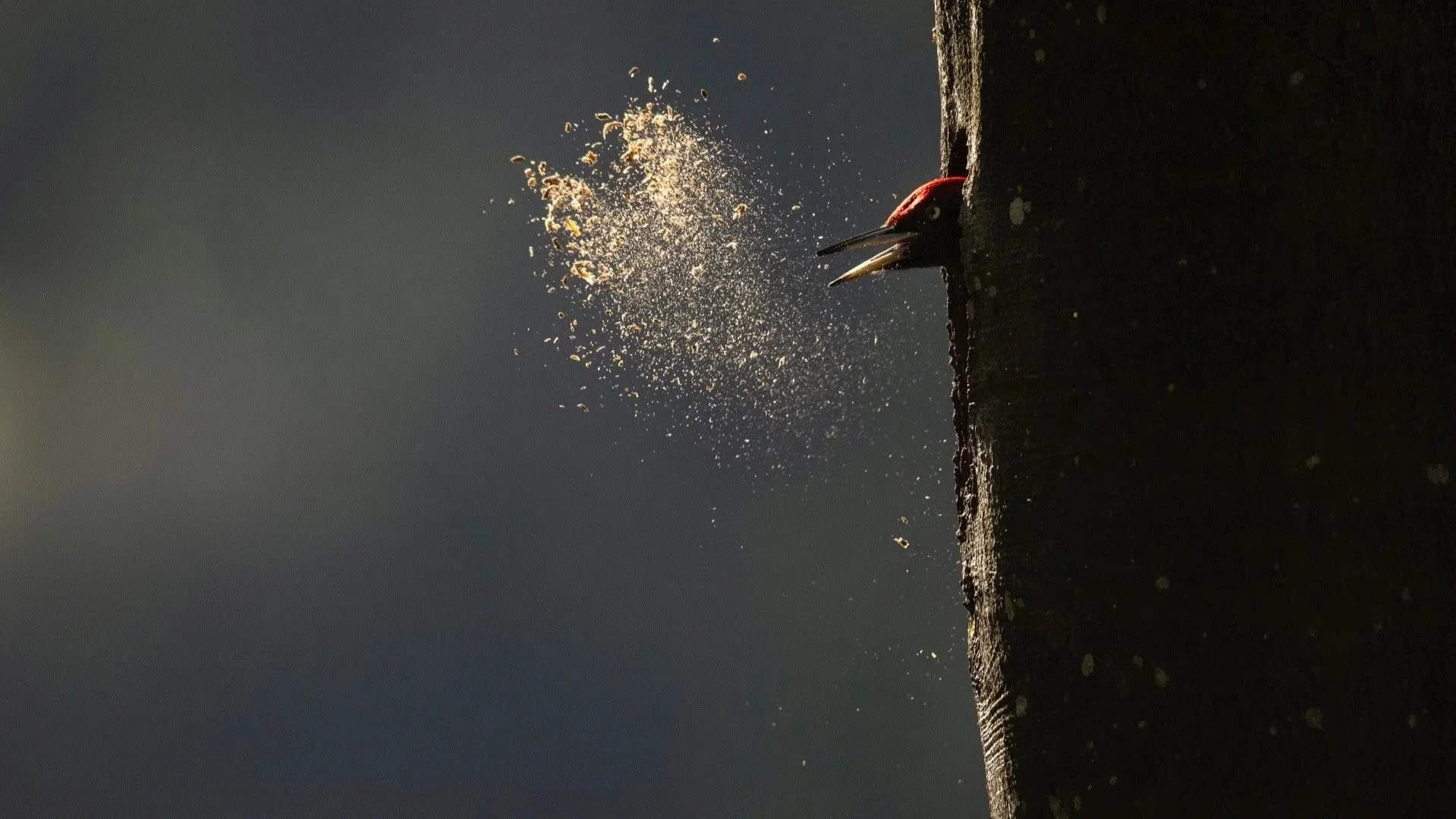
Image courtesy of Dartmouth Films.
by MANSEL STIMPSON
The concept of a film’s director being its key creator and thus its auteur was developed in France in the 1950s. It is no longer novel to use that term but, even if documentaries are not totally objective and can carry the personal signature of their maker, one does not readily think of that notion in this context. That is why it is so significant that the character of Whispers in the Woods is such that one does not hesitate to describe this documentary’s director, Vincent Munier, as an auteur.
That being so, it's entirely apt that Munier is French himself (he was born in Épinal in 1976). He has made only one previous feature and that was 2021's award-winning The Velvet Queen which he directed with Marie Amiguet and which, despite being a French production, was shot in Tibet. It recorded how Munier himself accompanied by his friend the novelist Sylvain Tesson set out to film wildlife in the Tibetan wilderness and the film was hugely popular. Its pull was all the greater due to it being publicised as being centred on the hope of filming that most appealing of rare breeds, a snow leopard. When reviewing that film, I admired its great photography but was struck most of all by the philosophical character of the piece. That was expressed through Tesson's narrative and even more tellingly through Munier’s own words when he talked with his companion and expressed his own attitude to nature. In this second feature of his, Vincent Munier, now taking the sole directorial credit, has imbued the whole film with his reverential awe for the natural world. It stands as a remarkable achievement and one with a voice of its own that is quite distinct from all the nature documentaries made by other filmmakers.
The main setting for Whispers in the Woods is the Vosges region in north eastern France where we encounter three members of the Munier family, Vincent himself, his father Michel and his son Simon. The latter now aged thirteen or so is responding to wildlife in the area in a way which makes it apparent that a deep veneration for nature is something which in this family passes from father to son. Rather unusually we learn nothing at all about other members of the family and, despite the emphasis on the three individuals, at the heart of this film is the relationship between nature and ourselves. What we have here is in its way a meditation on that. The Muniers admire plants and trees and all the life found around them. That extends from small birds to stags with their fawns and they seek to capture images of them and to record their sounds. All that does mean, of course, that this film shares some common ground with other nature documentaries. Considered from that viewpoint Whispers in the Woods as photographed by Vincent and two colleagues for the wide screen is well up to the high standard that we expect these days. Nevertheless, while what we see here is memorable, no less central to this film is the expression of reverence for the natural world which exists within the souls of the Muniers.
In practical terms their outlook extends to a deep concern not to disturb the animals in the woods and there is throughout a sense of what a privilege it is whenever the Muniers manage to get close to them. The film begins in darkness – much of it features subdued colouring and the images often take on a poetic quality. Indeed, early on we hear a quotation from a Russian poet that accompanies shots of early morning light, the words in question evoking the idea of the spirit of the night calling the day. The meditative nature of the piece also finds expression in scenes without words where an apt mood is set by the film’s music score (Warren Ellis who was the composer for The Velvet Queen is again a major contributor). Indeed, there is a sense here of the wonders of the life that exists in the woods, much of it hidden away, justifying quite as much respect and admiration as any human beings deserve.
Coming to appreciate the attitude that the Muniers have for the natural world and being allowed to share that with them is at the heart of this film, but it is nevertheless a work which also develops the equivalent of a plot thread. When we first see the three Muniers in their abode in the woods the talk turns to individual memories of the epiphany they had when they first recognised how important contemplating nature was to them. Michel records the impact on him back in the 1960s of seeing for the first time the bird which is the largest of the grouse family, the capercaillie. Later we learn that, even though young Simon is making his own discoveries of wildlife in the Vosges, there is no longer an opportunity for him to see one of these birds since they have become extinct in that region. The area does yield footage of owls and lynxes but the appeal of introducing Simon to a capercaillie is such that all three take a trip to Norway where they still exist. This section of the film, a decided contrast of location that provides a more colourful setting albeit in winter, takes up much of its last third.
It could well be that for the general public a film that offers a chance to see a bird of this kind lacks the drawing power that The Velvet Queen possessed by featuring a snow leopard and it is the case that, unlike many nature films, this is one in which Munier chooses to show the patience that is needed to wait and watch. But, if that makes Whispers in the Woods slow at times, it also etches in the humility which the Muniers bring to their observations of nature. Sir David Attenborough is doubtless no less passionate about it than they are but, deeply felt as it obviously is for him, a key element of his attitude would appear to be furthering scientific knowledge. With Vincent Munier, his commitment seems closer in character to a religious sense. It is surely not a mere chance phrase when it is said that trees emerge from mist like a resurrection. What he feels may not be akin to a church religion but it expresses a view of life and of all that exists on earth and a belief that we must continue to feel awe.
After the scenes in Norway, the film returns to the Vosges. In one of Munier’s few miscalculations, a kind of montage of bits and pieces follows which seems out of place at this point, but the film then moves on to a final testament. We are told here that we exist within what passes away, yet reference is made to an eternal cycle and there's even a mention of how a dead tree has a role to play in giving new life. It is this viewpoint, a philosophy of life in itself, which Whispers in the Woods expresses and in doing so Vincent Munier has created a work unique to him.
Original title: Le chant des forêts.
Featuring Michel Munier, Simon Munier, Vincent Munier.
Dir Vincent Munier, Pro Pierre-Emmanuel Fleurantin, Laurent Baujard and Vincent Munier, Ph Laurent Joffrion, Antoine Lavorel and Vincent Munier, Ed Vincent Schmitt and Laurent Joffrion, Music Warren Ellis, Dom La Nena and Rosemary Standley.
Kobalann Productions/Paprika Films/France 3 Cinéma/Le Bureau/Ciné+OCS-Dartmouth Films.
95 mins. France. 2025. UK Rel: 13 November 2026. Cert. U.