
From Hilde, with Love

Liv Lisa Fries is excellent as Hilde Coppi, a heroine of the resistance to the Nazis, although the length and structure of Andreas Dresen’s drama rather undermines her performance.
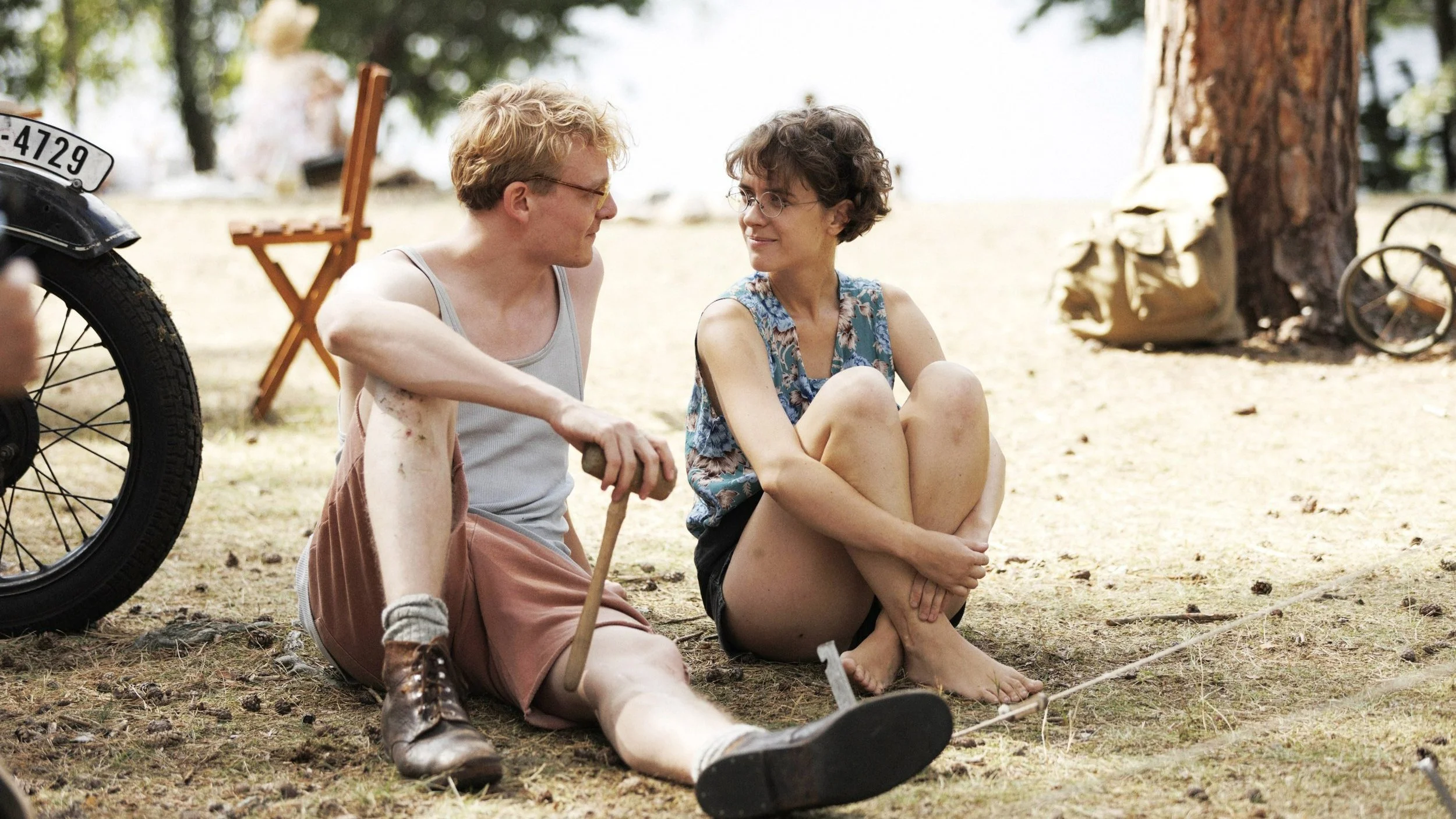
Johannes Hegemann and Liv Lisa Fries
Image courtesy of Picturehouse Entertainment.
Hilde Coppi, the real-life heroine of Andreas Dresen's new film, is probably less well known than her counterpart Sophie Scholl whose story has been told in no less than three films made for the cinema (The White Rose and Five Last Days in 1982 and Sophie Scholl: The Final Days in 2005). Both were women who had the misfortune to live in Nazi Germany and were so incensed by Hitler's regime that they became part of an underground resistance group noted for distributing leaflets criticising the Nazi state and its policies. In each case this would lead to them being executed in 1943 (Sophie was guillotined in Stadelheim prison in Munich on 22nd February and Hilde met the same fate in Berlin's Plötzensee prison on 5th August). From Hilde, with Love is not in fact the first film to be made about Hilde Coppi since there was an East German movie made in 1971 by Horst E. Brandt but that appears to have been released only in East Germany itself and in Russia. However, in Sophie Scholl’s case there has also been a television drama telling her story which was made in 2013 when it provided one episode for the German television series Women Who Made History. It is intriguing to find that that item has a direct link with this new film since in 2013 it was Liv Lisa Fries who played Sophie Scholl and who now appears as Hilde Coppi for Dresen. Whether or not that earlier role influenced the casting here, Fries is the greatest strength of From Hilde, with Love giving a performance that is fully worthy of awards.
As written by Laila Stieler, the film opens with Hilde being taken away for questioning and quickly finding herself in a prison cell. These opening scenes immediately establish the extent to which Fries has sunk herself into the role. There are no histrionics in her performance, just a complete sense of being inside the part which fits perfectly with the realistic tone of the piece which virtually eschews any music score. What Stieler’s screenplay does is to follow through Hilde’s time in a women's prison including the birth of a son there and onward to a secret trial and her eventual execution. But this narrative is interrupted by frequent flashbacks which make up much of the footage. That does, of course, allow for some variety in the material, not least because one of her activist colleagues was Hans Coppi (Johannes Hegemann) with whom she fell in love and whom she married in June 1941. This allows for memories of happier days to be recalled. As well as that we witness the activities of the group which would later become known as The Red Orchestra. While Sophie Scholl had taken a parallel course spurred on by the humanity inherent in her religious beliefs, Hilde and Hans came to take their stand having embraced Communism. This meant that the activities undertaken by them included listening in to the Voice of Russia broadcast from Moscow which would enable them to pass on to the relevant families encouraging news of relatives who were German prisoners of war, this being a time when propaganda in Germany claimed that the Russians did not take prisoners.
Given that the brave actions of The Red Orchestra were in fact less potently dramatic than what was undertaken by many others involved in action against state fascism, it must have seemed an apt decision to divide out the film’s material in this way. In the event it does not work too well. It certainly doesn't help that the flashbacks are not in chronological order so that the viewer is left to decide how each one fits into the time scale. Furthermore, in seeking to convey something of how the group came about the film introduces so many subsidiary characters that it becomes hard to disentangle them at times. Early on Stieler and Dresen seek to find a specific excuse for a particular memory to come to the surface and to yield a flashback, but subsequently they just cut regardless. Compared to the intensity found in the scene in which Hilde gives birth, later episodes including those featuring Hans after he has in fact died (he was executed seven months before Hilde) seem out of place since they are just more flashbacks rather than something that conveys a deep sense of loss. Compared to the films which concentrated on Sophie Scholl’s last days, Hilde’s final months carry less dramatic weight and consequently with the later flashbacks feeling somewhat arbitrary Dresen’s decision to make a film lasting a little over two hours seems like a misjudgment.
But in contrast to all that the scene of the day of execution is really well-judged contrasting as it does the waiting experienced by the victims (they literally have to queue up) and the short sharp shock of the moment of death. There are also some effective words heard here in voice-over spoken not by an actor but by Hilde's now aged son. Yet Dresen can't then resist adding one more flashback of a romantic kind and that to my mind is another misjudgment. But the large cast all prove competent while Liv Lisa Fries herself never puts a foot wrong.
Original title: In Liebe, Eure Hilde.
MANSEL STIMPSON
Cast: Liva Lisa Fries, Johannes Hegemann, Lisa Wagner, Alexander Scheer, Emma Bading, Sina Martens, Lisa Hrdina, Lena Urzendowsky, Hans-Christian Hegewald, Nico Ehrenteit, Jacob Keller, Tilla Kratochwil.
Dir Andreas Dresen, Pro Claudia Steffen, Christoph Friedel, Peter Hartwig, Regina Ziegler and Markus Olpp, Screenplay Laila Stieler, Ph Judith Kaufmann, Pro Des Susanne Hopf, Ed Jörg Hauschild, Costumes Birgitt Kilian.
Pandora Filmproduktion/RBB/Arte/Ziegler Film/Iskremas Filmproduktion-Picturehouse Entertainment.
124 mins. Germany. 2023. UK Rel: 27 June 2025. Cert. 15.
