
Modi: Three Days on the Wing of Madness

Johnny Depp directs an eccentric but often striking take on the life of the Italian painter and sculptor Amedeo Modigliani.
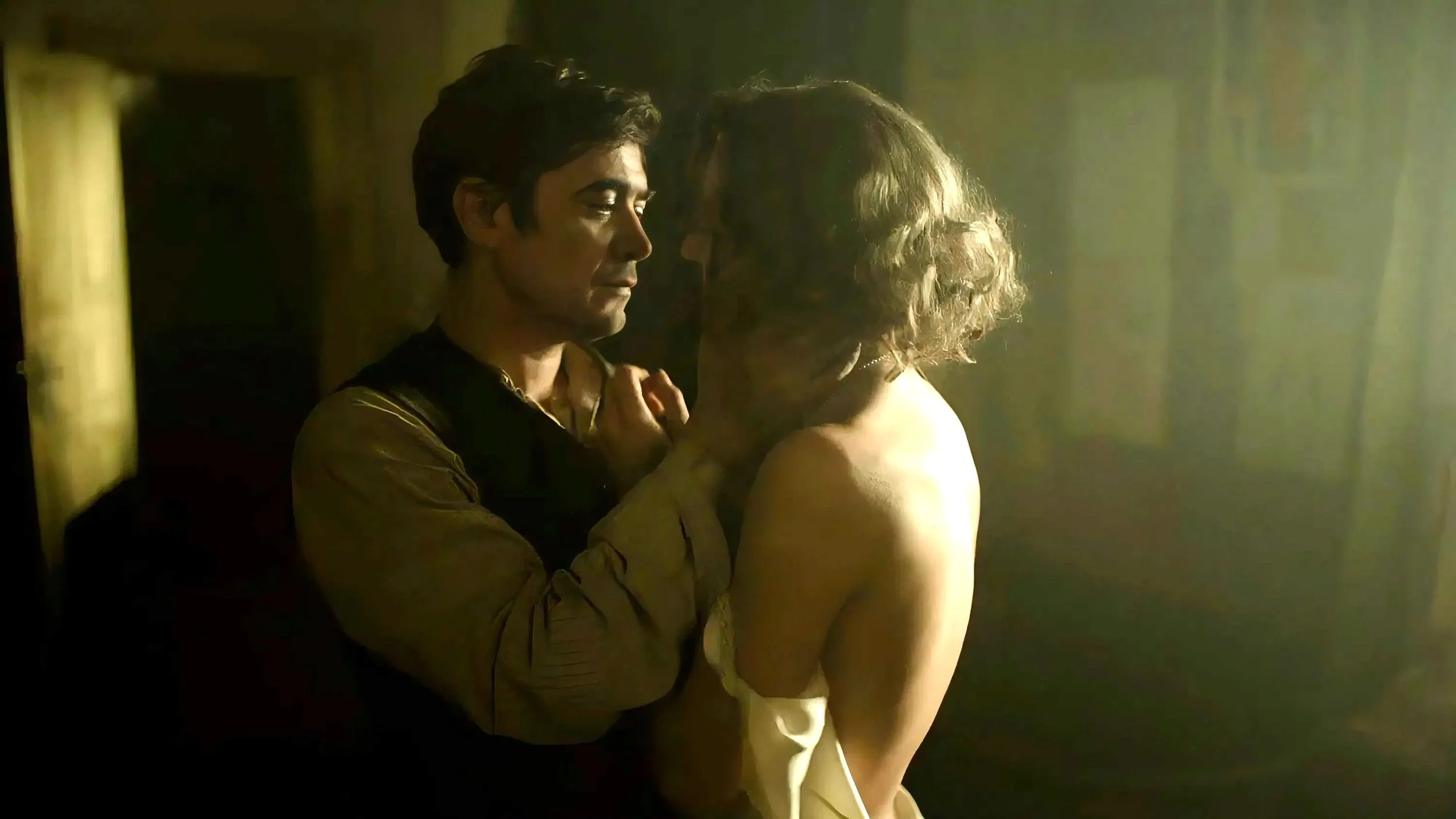
Riccardo Scamarcio and Antonia Desplat
Image courtesy of Miracle/IN.2.
Despite the disruption of Johnny Depp's big time Hollywood career, his recent film work has been far from uninteresting. His performance as the photographer W. Eugene Smith in the 2020 real-life drama Minamata was one of his best and he showed how adventurous he could be by taking on the role of Louis XV in Maïwenn's period drama Jeanne du Barry and playing it in French. Now we have Depp returning to the director’s chair despite his earlier feature in that capacity, 1997’s The Brave, having proved notably unsuccessful. His second bid is admittedly an uneven work, but parts of it are very good indeed and its faults stem more from the writing than from any weakness in Depp’s direction.
Originally known as Modigliani: Three Days on the Wing of Madness, a title which at least indicated that the painter and sculptor Amedeo Modigliani was its central figure, the present version of it is more cryptic since not many people will know that the artist was referred to by some as Modi. He lived from 1884 to 1920 and it would appear that two films have been made both concentrating on his last years, namely Jacques Becker’s Montparnasse 19 (1958) and the little seen Modigliani (2004). This new film shows Modigliani living in Paris in 1916 and takes place over three days. Publicity for the film indicates that it should not be viewed as a conventional biopic, but it does seek to give an impressionistic picture of the artist expressive of his bohemian character, his struggles and the drive that he possessed which ultimately gave him the determination to keep going despite his art not being acclaimed. Indeed, it can be said that we are here invited to see Modigliani as an example of the misunderstood artist existing in a society that makes judgments about art without having the depth of understanding to assess it in a genuinely meaningful way.
Depp’s film was written by a husband-and-wife team, Jerzy Kromolowski and Mary Olson-Kromolowski, who based it on a play by Dennis McIntyre but who have completely hidden its stage origin. Their approach is decidedly cinematic but in such a way that the opening scene makes it clear from the outset that the viewer will be required to take it on its own terms. Here we find Modigliani (Riccardo Scamarcio) in the famous Dôme cafe where he is taunted for being Jewish and gets into a fight. It's a scene with serious undertones that could have been portrayed realistically but it leads into a fight which builds up and which will end with the artist crashing through a stained-glass window. Although Modigliani is shown to have cut his hand in the process, the tone that comes across has turned to farce and when he runs away with the police in pursuit the scene echoes the Keystone Cops. To emphasise this the film cuts between full screen images in colour and black-and-white shots in the old ratio which conjure up thoughts of silent cinema and later this contrast comes up again and again.
What this opening does most emphatically is to confirm that this will not be a film that invites you to see it in wholly naturalistic terms and establishing that fact has it uses. In particular it overcomes the problem of the cast speaking in English throughout when the period French setting is rendered so well (good photography and well-designed sets and costumes). Yet the fact remains that quite often the stylised elements which take various forms prove distracting. In showing Modigliani’s friendship with fellow artists Chaïm Soutine (Ryan McParland) and Maurice Utrillo (Bruno Gouery) it portrays them in broad comic strokes that come across as close to the evocation of the Keystone Cops in the opening sequence (they may be drunk for much of the time but there's a strong element of caricature here). In contrast to that, there are dreams and hallucinations: some clearly play as such and express the horrors of the First World War but others fail to fit in effectively and seem self-indulgent. However, the style of the piece is such that it can encompass a range of music on the soundtrack (in addition to the film’s own score we have extracts from apt period recordings by the likes of Mistinguett and Charles Trenet alongside the 1998 recording ‘Cathedrals’ and a song by Tom Waits).
Nevertheless, what is striking here is the fact that the best things in the film all arise when the film is at its most straightforward. Apparently, Depp was encouraged to direct this film by Al Pacino who way back was involved in the possibility of a film about Modigliani which he or Martin Scorsese might have made. In the event Pacino now appears in this film in the role of a rich buyer of art named Maurice Gangnat who is approached by Modigliani in the belief that this man is interested in his work. Dramatically this scene is at the very heart of the piece and, although the role is short, it counts as more than a cameo and finds Pacino on top form. Hardly less distinguished is a supporting contribution from Stephen Graham who fully inhabits the role of Modigliani’s art dealer, Léopold Zborowski. If it is these two actors who stand out, that is not to say that the leading players disappoint. Scamarcio as Modigliani and Antonia Desplat as his muse and lover, the writer Beatrice Hastings, both do well by their parts.
In the final assessment, though, there is a strong sense that the offbeat stylisations play too strong a part in the film’s character without ever truly justifying their presence. Even so it may well be that they do add something: in that key scene with Pacino’s art collector Modigliani is told that his paintings lack life but, in contrast to many conventional period pieces, this film can never be said to do that. I do find it a very uneven work but, in addition to the other good things in it, the last scene of all is very satisfying being admirably judged and perfectly timed.
Original title: Modigliani: Three Days on the Wing of Madness
MANSEL STIMPSON
Cast: Riccardo Scamarcio, Antonia Desplat, Ryan McParland, Bruno Gouery, Al Pacino, Stephen Graham, Luisa Ranieri, Sally Phillips, Eva-Jane Willis, Matthew Wolf, Nicky Goldie, Russell Anthony.
Dir Johnny Depp, Pro Barry Navidi, Johnny Depp, Andrea Iervolino and Monika Bacardi, Ex Pro Peter Kohn, Agar Forlan, Bianca Goodloe, Nadine Luque, Svetlana Migunova-Dali, Jomana Al Rashid, Shivani Pandya Malhora, Mohammed Al Turk, Konstantin Elkin, Svetlana Migunova-Dali, Mattias Westman, Mohammad Alghaith, Akshay Bhutiani, Edward Walson, Leonard Loventhal, Akshay Bhutiani, Konstantin Elkin, Edward Walson, Mattias Westman, Nicola Allieta, Jennifer Eriksson, Patrick Fischer, Richard Kondal, Menelaos Pampoukidis and Dasha Sherman, Co-Pro Stephen Malit, Stephen Deuters, Jason Forman, Sam Sarkar and Viktoria Petryani, Co-Ex Pro Simon Afram, Stefania Capitani, Katja Horelli, Paolo Monaci, Ciro Orsini and Didi Wong, Screenplay Jerzy Kromolowski and Mary Olson-Kromolowoski, from a play by Dennis McIntyre, Ph Dariusz Wolski and Nicola Pecorini, Pro Des David Warren, Ed Mark Davies, Music Sacha Puttnam, Costumes Penny Rose, Dialect coaches Sarah Shepherd and Brendan Gunn.
IN.2 Film/Modi Productions/Barry Navidi Productions/Ilbe/Westman Films/World Vision-Miracle/IN.2.
108 mins. UK/Hungary/New Zealand/Kenya/USA. 2024. UK Rel: 11 July 2025. Cert. 15.
