
Teodora Ana Mihai’s vivid if limited drama examines issues of morality and responsibility surrounding the tragedy of the European Cup Final of ‘85.
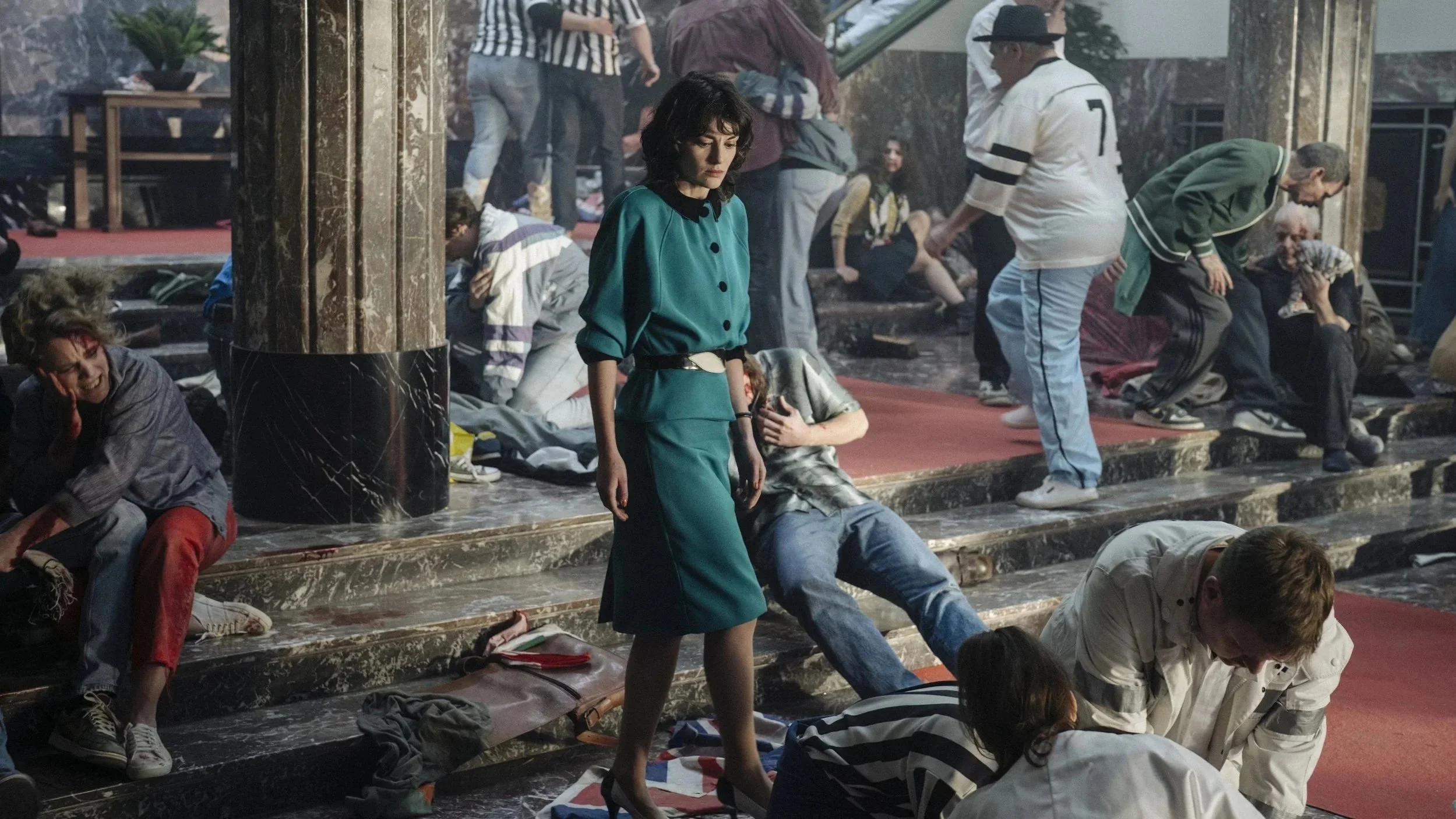
Image courtesy of Icon Film Distribution.
by MANSEL STIMPSON
Judge it by the skill of the filmmaking on display and Heysel 85 is an impressive achievement. The director is the Romanian Teodora Ana Mihai and she has done a splendid job in recreating so vividly the tragic events that occurred on 29th May 1985 in the Heysel Stadium in Brussels where Liverpool were due to play Juventus in the European Cup Final. That was the occasion when, in an age noted for football hooliganism, violence broke out ahead of the start of play with Liverpool fans attacking those of Juventus. Panic and chaos ensued, a wall fell and it led to no less than thirty-nine spectators being killed. In addition, about six hundred were injured.
Heysel 85 is not concerned with the match itself and, significant as the occasion was in football history, it is not at heart a film about the game. The focus here is on two things: the moral issue of whether or not the match ought in the circumstances to have been cancelled and the way in which all of those who might be held responsible for allowing the chaos to develop were anxious to duck the blame. In retrospect questions were asked about the ticket sales, in particular those on the black market which added to the difficulty of keeping the rival supporters in seats well apart. It was also obvious that failure to keep the stadium in good condition and repair had contributed and furthermore there was a failure in their duties by the police and others in charge of security. If the local authorities had a share of responsibility, so too did UEFA since as the governing body of football in Europe they had approved the choice of Heysel Stadium as the site for the match despite having received warnings that it was unsuitable.
The film’s portrayal of these events, its recreation of the key hours in that day, is handled with immense skill. Photographed on 16 mm. by Marius Panduru, the look of the film is such that actual footage from 1985 can be incorporated and feel all of a piece. Mihai’s direction achieves a tone which avoids any sense of theatricality and the editing of Bert Jacobs adds to the sense that the viewer is present at the actual event. A further feature in achieving that is the film’s sound design supervised by Senjan Jansen. The noise in the background coming from fans on the terraces provides a background swell which makes us feel the extent to which the tensions are building up while those in charge debate what is happening and what needs to be done.
It is also the case that with a running time of 92 minutes the film is not over-extended. Nevertheless, despite the judgment of all concerned being so astute over how to portray the event persuasively, I do feel that one has to question whether this material is strong enough to justify all the effort put into this film. One issue that arises here but which is probably not a major one concerns the elements in Heysel 85 which are not accurate. It is, of course, quite standard to find an acknowledgment in films that involve the re-enactment of actual events to the effect that some liberties have been taken. In this film, however, the statement in the closing credits is unusually broad. Having indicated that Heysel 85 was inspired by real events, it goes on to declare that "all characters and dialogues were fictionalised and not intended to represent existing persons". Just how far one should take that indication I am not certain, but I did come across a reference online to the fact that the real-life mayor at the time was not Marc Dumont, the mayor named in the film and played by Jesse De Pouw. However, the documentary style of the movie is likely to encourage the belief that a central character such as this is taken directly from real life, which in this instance means that the mayor’s alcoholism affected his handling of the situation. The statement in the end credits may be read as refuting that, but not everybody will take note of it. However, it could be argued that this does not matter since these events took place over forty years ago so the real-life mayor who was involved may not even be an existing person now.
The more serious point to be made about Heysel 85 is that for a feature film what is covered here is short on actual drama. As subject-matter for debate the issue of the morality of authorising the match to go ahead is potent stuff, especially when balanced against the concern that was expressed at the time that cancellation would arouse even more violence from supporters of the two teams who, having made the considerable effort to be present, would be infuriated if no game went ahead. Similarly, the reluctance to accept blame that is demonstrated makes this situation an interesting insight into human nature, but again it hardly seems enough to become the basis of a compelling dramatic work.
One senses that the writers of the screenplay may in part have been aware of this. After all they were faced with the problem of creating a narrative form that would help to shape the way in which the situation was portrayed on screen. Quite reasonably in the circumstances they came up with the idea of featuring two figures caught up in the event whose individual stories the audience would follow. One of them is an Italian journalist and broadcaster named Luca Rossi (Matteo Simoni) present for the match as a reporter but also facing the fact that members of his family including a teenage brother (Fabio Capodicasa) are inside in the stands and may have been injured or killed. Luca’s situation is close enough to the realities of what happened for him to be an acceptable representative figure but, while Simoni plays the part well enough, the writers are unable to build up the character in a way that conveys much individuality and depth.
They are more successful with their other thread which is centred on the mayor's daughter, Marie (Violet Braeckman). She is acting as her father's press secretary so is at the heart of things. It is effective to show her as somebody caught between her dutiful role in helping and supporting her father and finding herself growing increasingly critical of him. She will ultimately come to the realisation that she supports what is becoming the losing view, namely that morally speaking it would be wrong to let the game go ahead as though nothing had happened. Here the character does develop and Violet Braeckman’s strong presence is a great asset to the film. As already indicated, one can also admire Mihai’s achievement as director, but ultimately I still find myself unable to escape the conclusion that to portray the tragedy of 29th May 1985 in this way is of rather limited value.
Cast: Violet Braeckman, Matteo Simoni, Josse De Pauw, Fabrizio Rongione, Paolo Calabresi, Michel de Warzee, Bruno Georis, Giovanni Guzzo, Barnaby Apps, Richard Wells, Anne-Claire, Fabio Capodicasa.
Dir Teodora Ana Mihai, Pro Hans Everaert, Screenplay Lode Desmet, Isabelle Darras and Teodora Ana Mihai, from an idea by Lode Desmet, Matthias Lebeer and Hans Everaert, Ph Marius Panduru, Pro Des Hendrik Van Kets, Ed Bert Jacobs, Music Anna Bauer, Costumes Linda Bogers.
Menuetto Film/Les Films du Fleuve/Topkapi Films/Leitwolf-Icon Film Distribution.
92 mins. Belgium/The Netherlands/Germany. 2026. UK Rel: 20 November 2026. Cert. 12A.