
I Swear

The true story of John Davidson’s battle with Tourette's syndrome is distinguished by outstanding performances in a film that is compassionate, funny and heartbreaking.
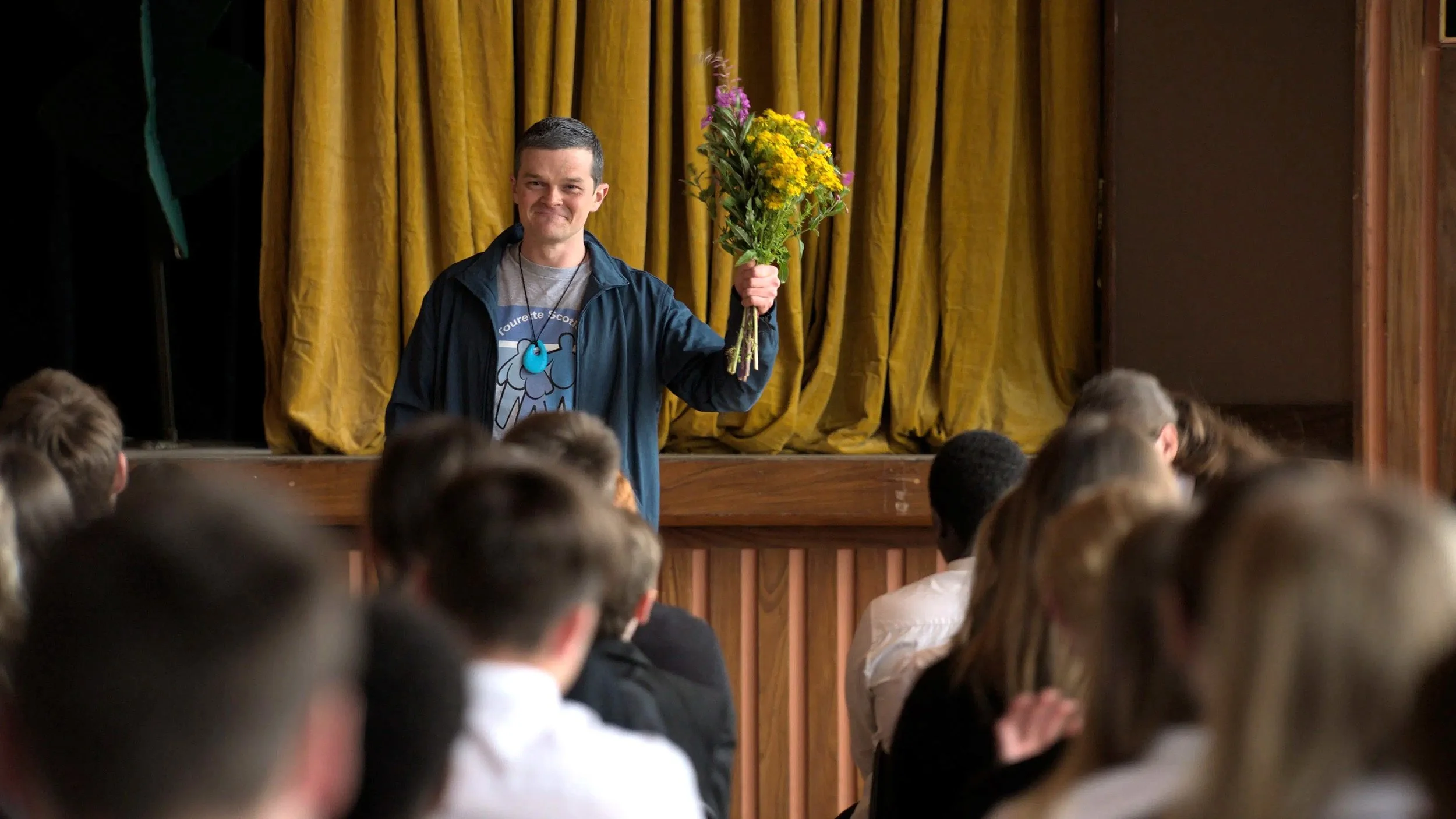
Robert Aramayo
Image courtesy of StudioCanal UK.
Many people deserve thanks for their contribution to making I Swear one of the most memorable films of the year and a potential commercial hit, but none more so I would suggest than its casting director. The latter is Lauren Evans and this is one of those rare occasions when one senses that a perfect choice has been made right through from the leads down to even the smallest roles. That adds immensely to the effectiveness of I Swear but the credit for getting it set up must, of course, go to Kirk Jones since he is both the writer and the director. One feels that it must have been a difficult task to persuade backers that a film about a real-life person, John Davidson, who has been living with Tourette syndrome since the age of thirteen would be a good idea and that it could even be made in such a way that it would be a moving and uplifting experience capable of appealing to a mass audience. But in the event regardless of a few imperfections that is exactly what Kirk Jones’s film offers.
Making Davidson the central character is for several reasons a perfect choice in itself. He was born in Galashiels in 1971 and as a schoolboy would start to show signs of Tourette’s in the 1980s when the condition had yet to be recognised and understood. As is appreciated now, it is a compulsive neurological disorder which still lacks a cure and which causes those who have it to act in ways that they cannot control. Yelling obscenities is probably its most well-known feature, but odd head movements and facial grimaces as well as making inappropriate comments are among the symptomatic tics. By including scenes from John Davidson's childhood, the film enables viewers to see just how difficult it was in those days for anybody with this condition: the lack of knowledge about it would lead those who witnessed the tics and heard the swearing to regard it as deliberate bad behaviour and to punish those who so behaved accordingly.
In I Swear we see John's father being unable to cope and walking out while his mother struggles to understand what is going on and John himself comes close to death by suicide. Thereafter the film moves on thirteen years to show John as a young man finding help from a friend's mother who had been a nurse and who invites him into her home. Furthermore, while those with Tourette syndrome often find it difficult to get a job because of their outbursts, John is lucky enough to be taken on by an understanding man who runs a community centre and needs an assistant. He will meet with great success in this post, but no less central to John’s story is the fact that he goes on to become involved in studies in Nottingham designed to reduce the effects of Tourette’s having already become a prominent promoter of knowledge about this condition. These activities would lead to Elizabeth II honouring him with the MBE in 2019, an event which provides a prologue here before the film goes back to proceed in chronological order thereafter.
Although Tourette syndrome is much better known now, there is still room for wider education about it and I Swear does just that. In doing so it follows in John’s own footsteps and becomes at the same time an uplifting tribute to him. The tone of I Swear is quite deliberately that of popular cinema and it may be that, as is so often the case with films based on true stories, some liberties have been taken in the telling of it. Just occasionally a scene does seem slightly overdone, but that is rare and, as noted at the outset of this review, I Swear is brilliantly cast. David himself is played as a young man by Robert Aramayo, a decidedly up-and-coming actor who is quite splendid here. But it is characteristic of the casting that the childhood scenes find Scott Ellis Watson playing the 13-year-old John excellently too. The established names involved (Maxine Peake as the woman who is so encouraging to John, Shirley Henderson as his mother and Peter Mullan as the man who employs him) are all on their very best form. All credit too to the way in which the screenplay handles John’s swearing. Some audiences today seem to adore on-screen swearing which might encourage them to laugh too much in this dramatic context but the film allows for that. It recognises that some amusement is apt enough yet ensures that the prevalent impression is of what this uncontrollable behaviour can cost John (those audiences who deplore swearing in films will surely adjust to its validity here).
I have mentioned that the film is less than perfect and one's instinct from the outset is that this is a tale which hardly calls for a running length of two hours. Since it starts out with the award of the MBE, the film gives the impression that it is drawing to a close when, following a late fade to black, it eventually leads back to that episode. But in the event, this occurs when the film has another fifteen minutes or so to run and, acceptable as they are, the remaining scenes run the risk of being somewhat anti-climactic rather than appearing as an essential part of the drama. It is, however, a nice moment when during the end credits actual images from 2019 show us the real John Davidson and the late Queen herself. Although I was less than fully satisfied with these closing scenes, I Swear is a fine example of a film handled in a way which gets everything right where it really matters. It deserves to be a big commercial hit and to win acting awards, too.
MANSEL STIMPSON
Cast: Robert Aramayo, Maxine Peake, Shirley Henderson, Peter Mullan, Scott Ellis Watson, David Carlyle, Steven Cree, Francesco Piacenti-Smith, Andrea Bisset, Jamie McAllister, Ron Donachie, Paul Donnelly.
Dir Kirk Jones, Pro Georgia Bailiff, Kirk Jones and Piers Tempest, Screenplay Kirk Jones, Ph James Blann, Pro Des Sabrina Linder, Ed Sam Sneade, Music Stephen Rennicks, Costumes Denise Coombes, Sound Niv Adiri, Dialect coaches Mary Howland and Natalie Grady, Casting director Lauren Evans.
Tempo Productions/One Story High-StudioCanal UK.
121 mins. UK. 2025. UK Rel: 10 October 2025. Cert. 15.
